How the Five Compare on the Numbers
Two listings deserve a word before the five. Yiyiring sells a lidded bottle whose own third bullet says it measures accurately up to 8 ounces, far below the capacity in its title, which makes it a storage container rather than a measuring jug. Amazing Abby’s three jug set, at 1, 2 and 4 cups, was left off as a near duplicate of its own four jug set, which adds an 8 cup jug to the same trio and publishes the same embossed imperial and metric marks.
A small loaf is a small measurement: a few hundred grams of flour and a little less water. So the question here is not capacity but resolution, and the pool answers it badly. Only one of these five publishes how far apart its graduations are, and it is the 5 liter laboratory jug whose interval is 250 ml, which is coarser than a whole loaf’s water.
What none of these publishes is the figure that actually decides a small loaf, which is the lowest mark on the jug. A 2 quart jug whose scale starts at 1 cup is useless for the water in a single small loaf, and a jug whose graduations are 250 ml apart cannot resolve that quantity at all. Four of the five publish no interval and no starting mark, so the only pick that can be sized to a small loaf on published data is the one that arrives as four jugs.
Resolution, Not Capacity
Why Four Jugs Beats One Big One
Amazing Abby is four separate jugs at 1, 2, 4 and 8 cups, and that is the honest answer to a resolution problem. A 1 cup jug marked in imperial and metric has its graduations spread over the same physical height as an 8 cup jug spreads eight times as much liquid, so the small jug is inherently finer. For a single small loaf you use the 1 cup and ignore the rest.
The listing states 1 cup as 8 oz and 250 ml, 2 cups as 16 oz and 500 ml, 4 cups as 32 oz and 1000 ml, and 8 cups as 64 oz and 2000 ml, so the whole ladder is published in both systems. It also states that the markings are embossed and highlighted, which is the combination that stays readable after years of washing.
Where the Single Jugs Sit
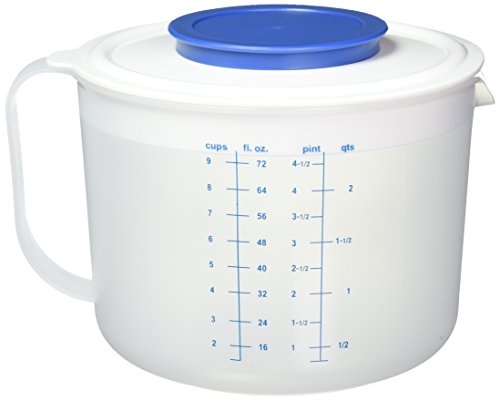
NaNaPaly publishes 64 oz, 2000 ml and 8 cups for the model here and lists three other sizes it also sells, the smallest being 32 oz. Norpro publishes 9 cups, 2.2 liters and 72 oz on one jug with five different unit scales printed on it, which is the widest set of units in this pool and the most useful if you cook from mixed sources.
Restaurantware is 2 quarts and cannot decide what that is. Its second bullet says the jug measures up to 2 quarts, which it calls 4 cups, and its fifth bullet says it is a 2 quart jug, which it calls 8 cups. Two quarts is eight cups, so the second bullet is wrong, and this page uses the figure in the fifth.
Markings, and Which Ones Survive
Etched, Embossed, or Molded
Four of these five say how the scale is applied, which is unusually good for this category. NaNaPaly states laser etched markings and calls them wear resistant and fade proof, which is the strongest claim here. Amazing Abby states embossed and highlighted. Restaurantware states embossed graduations and ties them directly to eliminating guesswork. EISCO states raised molded graduations.
Norpro is the exception. It describes clear, easy to read graduated measurement scales in five units without ever saying whether those scales are printed on the plastic or formed into it. On a jug that goes in a dishwasher and takes a hand mixer beater inside it, that is the one detail a buyer wants, because a printed scale is the one that wears away.
Units Matter More Than They Look
Norpro prints US cups, pints, fluid ounces, liters and milliliters, five scales on one jug. NaNaPaly prints ounces, cups and milliliters and puts the scale on both sides so it reads from either hand. Amazing Abby and Restaurantware both print imperial and metric without naming which units. EISCO prints milliliters only.
For bread that last one is a real limitation dressed as a strength. Bread recipes are commonly written in grams and milliliters are the closer unit, so a metric only jug is not a problem in itself. The problem is 250 ml intervals, because the water for a single small loaf frequently falls between two marks with nothing in between.
Lids, Handles, and the Jug You Mix In
The Only Jug Built for a Beater
Norpro is the only pick here designed to be mixed in rather than measured from. Its lid is a two piece splatter guard whose center cap pops out so a hand mixer beater or an immersion blender goes in while the lid stays on, which keeps batter off the counter. The listing sells it as both a mixing bowl and a pouring pitcher.
For a small loaf that matters less than for a batter, since bread dough is kneaded rather than beaten, but a wet starter or a poolish is stirred and it does splash. No other listing in this pool has a lid of any kind, so the choice is between a jug that can be covered and four that cannot.
Handles, Spouts, and Weight
NaNaPaly is the most specific about the handle, calling it a 7 shaped ergonomic design with an anti-slip surface, and it argues the case with a figure that does not belong to this product: a grip secure enough for 160 ounces of liquid, a capacity this listing does not sell. Norpro states an integrated handle and a contoured pour spout, and EISCO a handle and a tapered spout.
Amazing Abby and Restaurantware describe neither a handle nor a spout anywhere in their bullets. The published weights are also worth reading with care: EISCO gives 0.2 pounds for a 5 liter polypropylene jug, which cannot be right, and Amazing Abby’s 1.3 pounds covers four jugs rather than one.
Which One Fits Your Kitchen
One small loaf at a time. Amazing Abby is four polycarbonate jugs at 1, 2, 4 and 8 cups, published in both systems down to 250 ml, with embossed and highlighted markings, stackable and dishwasher safe. The 1 cup jug is the only vessel in this pool fine enough to measure a single loaf’s water.
Mixing a wet starter without splashing. Norpro is a 9 cup jug at 6 by 8.5 by 7 inches with five unit scales, a two piece splatter guard lid whose center cap pops out for a beater or an immersion blender, an integrated handle and a contoured pour spout, top rack dishwasher safe at 0.55 pounds.
Markings that will not wear off. NaNaPaly is 64 oz, 2000 ml and 8 cups in food grade polycarbonate with laser etched, stated fade proof markings on both sides in ounces, cups and milliliters, a 7 shaped anti-slip handle, and a stated range from minus 4 F up to 248 F, at 4 by 4 by 6 inches.
A light jug for a crowded counter. Restaurantware is 2 quarts of clear plastic with embossed dual unit graduations at 7.75 by 6 by 7.5 inches and 0.26 pounds, stated dishwasher safe. Its own bullets give the capacity as both 8 cups and 4 cups, and this page uses the former.
Big batches and hot liquids. EISCO is a 5000 ml polypropylene jug at 6.6 by 10.5 by 8.9 inches with raised molded graduations every 250 ml, a tapered spout and a handle, rated to 135 C and stated autoclavable, microwave and dishwasher safe. Its interval is far too coarse for one loaf.
What We Could Not Verify
These are the figures that decide whether a jug can measure a small loaf at all, and four of five withhold them.
- Only EISCO publishes a graduation interval, and 250 ml is coarser than the water in a small loaf.
- No listing publishes the lowest mark on its scale, which is what decides whether a small quantity can be read.
- Norpro never says whether its five unit scales are printed on the plastic or formed into it.
- Restaurantware gives its 2 quart capacity as 8 cups in one bullet and 4 cups in another.
- EISCO publishes 0.2 pounds for a 5 liter polypropylene jug, which is not a credible figure.
- NaNaPaly argues its handle strength using 160 ounces of liquid, a capacity this listing does not sell.