How the Five Compare on the Numbers
Three listings were left out. NESCO sells add-a-trays in food grade plastic rather than silicone, which is the wrong material for this page, and its dimension fields of 4 by 2.5 by 14 inches cannot describe a 13 and a half inch round tray anyway. YGKATING and SUCISENI are both solid edged rectangles cut for named machines, a Cosori and a Magic Mill in one case and SUCISENI’s own FD-12 and FD-18 in the other, and only SUCISENI publishes an edge height, at 0.2 inches.
The five that remain split on the one thing that matters, and it is not size. Three are open mesh sheets that let hot air through from below, and one is a solid mat with a raised edge that holds a liquid puree in. Those two products look similar and do opposite jobs. The fifth listing hedges by supplying ten of each.
What the table cannot tell you is how much drying time a mesh sheet costs you. Every mesh listing here argues that its weave lets air through, and not one publishes an open area percentage or any before and after figure. GUCUJI comes closest by publishing a hole size of around 1 by 1 mm, which at least lets you picture the weave, and nobody else in this pool publishes anything comparable.
Mesh or Solid Is the Whole Decision
What a Mesh Sheet Is For
A mesh sheet solves one problem: small food falling through the bars of the dehydrator tray. GUCUJI states it directly, saying the 1 by 1 mm holes stop blueberries and raspberries dropping through while letting air move from above and below. Lova makes the same case for berries, sliced herbs, thin jerky strips and small vegetable pieces. XZZWLL frames it as even drying through air circulation.
What a mesh sheet cannot do is hold a liquid. Puree poured onto mesh goes straight through onto the tray below, and that is not a fault but a design. If the only reason you want liners is that your herbs and berries fall through the rack, a mesh pack is the right purchase and the cheaper one by weight of silicone.
What an Edged Mat Is For
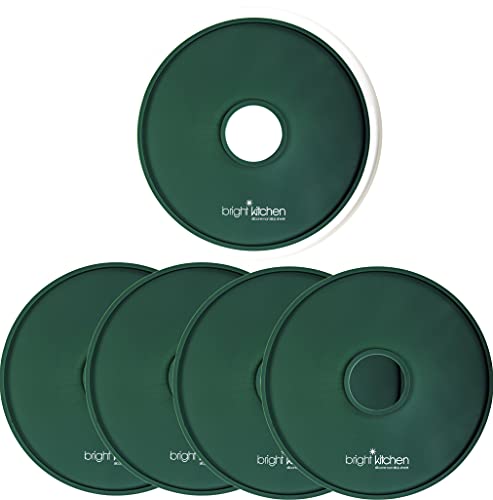
Bright Kitchen is the solid option here and its whole argument is the lip. It publishes a 1/4 inch edge and states that the edge holds liquid batter on the sheet with no spill, aimed at fruit leather and fruit roll ups. That is a job no mesh sheet in this pool can do, and it explains why the two products sit in the same search results.
The cost is airflow. A solid mat blocks air from below entirely, so anything on it dries only from the top and takes longer. It is also heavier: Bright Kitchen publishes 1.0 pound for four sheets while XZZWLL publishes 0.4 pounds for eight, which is the difference between solid silicone and a coated mesh, and a useful proxy for how much material you get.
Fitting a Round Tray With a Post in the Middle
The Center Hole Nobody Agrees On
Round dehydrator trays stack around a central column, so a round liner needs a hole in the middle and the hole has to match. Only two listings publish one and they are nowhere near each other. XZZWLL states 1.6 inches, given also as 4 cm, on a 13 inch sheet. Bright Kitchen states 3 inches on a 12.5 inch sheet.
That is a difference you cannot fix with scissors in the wrong direction. A 1.6 inch hole will not pass a 3 inch column, and a 3 inch hole on a machine with a slim column leaves a ring of tray uncovered where small food will fall through. GUCUJI publishes a 12.6 inch round sheet and no hole figure at all, which for a round liner is the gap that matters most.
Cutting to Fit Instead
Lova sidesteps the problem by selling squares. Its sheets are 14 by 14 inches, larger than any round tray in this pool, and it states that they trim cleanly with household scissors for smaller or custom shapes, and asks you to measure your tray first. Twelve sheets means every rack in a typical machine gets lined in one batch.
GUCUJI also states that its round sheets can be cut to any size, and backs that with the longest compatibility list here, naming twelve Nesco models plus a MasterChef machine. Between them those two listings are the pragmatic answers: one starts oversized and square, the other starts round and correct for a named machine and trims from there.
What Separates Specified Silicone From Vague Silicone
Thickness, Mesh Aperture and Temperature
Every listing here says food grade silicone and BPA free, so those words carry no information. What separates them is whether anything is quantified. GUCUJI publishes a thickness of 0.8 mm, given also as 30 mil, a mesh hole size of around 1 by 1 mm, and a temperature range of -40 C to 220 C with the Fahrenheit equivalent. That is three real figures where most listings publish none.
CiCixixi publishes -40 F to 428 F, which matches GUCUJI’s upper limit in the other unit. The excluded YGKATING and SUCISENI listings publish -86 F to 446 F and -40 F to 446 F respectively, so the range across this whole category is narrow and the differences are not meaningful for a dehydrator. XZZWLL, Lova and Bright Kitchen publish no temperature figure at all.
Piece Counts and a Weight Worth Checking
CiCixixi publishes 7.5 pounds, which stands out sharply next to 0.32 pounds and 0.4 pounds elsewhere on this page and looks at first like an error. It is not. The set contains twenty pieces plus a spatula, ten of them solid mats, and at that count the figure works out close to Bright Kitchen’s 1.0 pound for four solid sheets. The outlier is the piece count, not the weight.
The mesh packs are much lighter per sheet, which follows from a coated mesh having less silicone in it than a solid mat. GUCUJI publishes 0.32 pounds for five and XZZWLL 0.4 pounds for eight. None of these figures can be ranked against another as a sheet weight, because every pack holds a different number of a different thing, so this page does not try.
Which One Fits Your Kitchen
You want the sheet that publishes actual figures. GUCUJI is a 12.6 inch round mesh sheet, given also as 32 cm, at a stated 0.8 mm thickness with holes around 1 by 1 mm, rated -40 C to 220 C, cuttable to any size, listing twelve Nesco models plus a MasterChef machine, in a five pack at 0.32 pounds.
Your round trays have a slim center post. XZZWLL is a 13 inch round mesh sheet with a 1.6 inch center hole, given also as 4 cm, stated to fit most 13 inch round trays, dishwasher safe and rated for hundreds of uses. Eight sheets at 0.4 pounds, with no thickness or temperature figure published.
You want to line every rack and trim to shape. Lova is a 14 by 14 inch square mesh sheet that trims with household scissors, supplied twelve to a pack at 1.23 pounds, going on the top rack of a dishwasher and rated for hundreds of batches. It asks you to measure your tray and publishes no temperature figure.
You are making fruit leather on a round tray. Bright Kitchen is a solid 12.5 inch sheet with a 3 inch center hole and a 1/4 inch edge stated to hold liquid batter with no spill, for all Nesco round and square models, dishwasher safe, four sheets at 1.0 pound. It warns plainly that it may not fit other brands.
You do not know yet which you need. CiCixixi supplies ten edged silicone mats and ten mesh screens at 11.81 by 9.84 inches plus a silicone spatula, rated -40 F to 428 F, dishwasher safe, and stated to roll for storage without permanent creases. The set is published at 7.5 pounds.
What We Could Not Verify
These are the figures that decide whether a liner fits and how much drying time it costs, and most are missing.
- No listing publishes an open area percentage for its mesh, so how much drying time a liner adds is unknown everywhere.
- Only two of the five publish a center hole figure, and they differ, at 1.6 in and 3 in on similarly sized round sheets.
- Only GUCUJI publishes a thickness, at 0.8 mm, so the other four cannot be compared on how much silicone is in a sheet.
- XZZWLL, Lova and Bright Kitchen publish no temperature figure at all, stating only that the silicone is heat resistant.
- CiCixixi publishes no size for its mesh screens separately from its solid mats, and names no compatible machine.
- GUCUJI makes no dishwasher claim, despite publishing more figures than any other listing in this pool.