How the Five Compare on the Numbers
The argument for an adjustable ring in a small kitchen is not that it is small. It is that one object stands in for a shelf of fixed tins, and only one maker in this pool puts it in those words: BakeMviert states that it replaces multiple fixed-size pans with a single adjustable design. So the deciding figure is the range, and the second question is what the ring still cannot do on its own.
Because it cannot do much on its own. A ring is a band of steel with no bottom and no liner, and between them these listings answer that in three different ways: one supplies acetate, one supplies acetate and stickers, one tells you to line it yourself and two say nothing. The table gives the range first, then what arrives with it.
What the table cannot tell you is how much of that range is usable at full height. A ring set to 12 inches has the same band of steel stretched further, and Iwinna is the only listing publishing a thickness for it, 0.4 mm. Nobody states a maximum batter weight, a stability limit at the widest setting, or whether the overlap at the joint leaks. Three of the five publish no wall height at all.
One Ring Instead of a Stack of Tins
Six to Twelve, and One That Also Goes Square
Four of these five cover 6 to 12 inches round, which is three or four common tin sizes in one object. Hushee is slightly narrower at 6.3 to 11.8 inches, and DATANYA cannot agree with itself, stating 6.5 to 12 inches in one bullet and 6 to 12 in another. Those differences are small enough not to decide anything on their own.
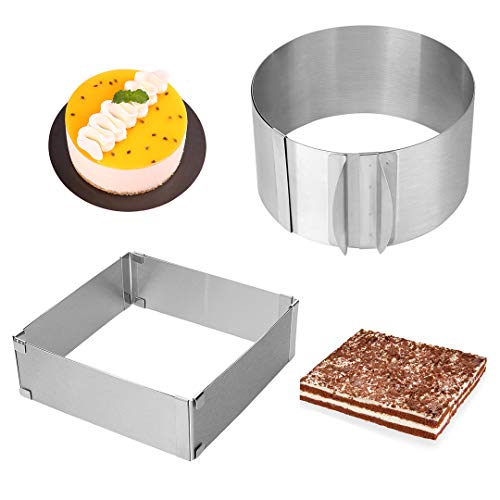
Meichu is the one that genuinely changes the count. It states adjustment from 6 to 12 inches round and from 6 to 11.5 inches square, which is the only listing in the pool covering both shapes. For a kitchen with one cupboard, a single object replacing both a round tin and a square one is a stronger version of the argument every other listing here is making.
What the Range Does Not Cover
Height is the limit the range does not describe, and it is where these five diverge most. Iwinna states 5.9 inch walls and adds that the industry standard is 2.75 inches, arguing you can build an eight layer cake or a croquembouche in it. Hushee states each mold stands about 6 inches high. DATANYA publishes only a 2.3 inch field.
Meichu and BakeMviert publish no height in any form, which on a ring is the second most important figure after the diameter: it decides whether the thing is a cake mold or a plating ring. Two listings left out of the five illustrate why that matters. One states a wall height that its own title and size field both contradict, and the other states three different heights across a bullet, a size field and a dimension field.
A Ring Has No Bottom
One Maker Says So Out Loud
BakeMviert is the only listing that treats the missing base as a feature and explains what to do about it, stating the ring is designed without a bottom base to prevent sticking during removal, and that it easily pairs with aluminum foil for a custom baking bottom. It also describes the ring doubling as a heavy duty cutter. That is the whole practical instruction nobody else gives.
The other four leave it unsaid, and it is not a small omission in a kitchen that owns few trays. Every one of these rings needs something underneath before batter goes in, whether that is a lined sheet pan, a plate for a mousse, or foil. A ring that replaces a stack of tins still does not replace the tray under it.
The Liner Is the Other Missing Part
Two of the five ship acetate. DATANYA supplies a roll 5.5 inches wide and 394 inches long along with twenty four stickers to seal the collar after cutting, and describes the set as four pieces including the ring. BakeMviert supplies a 6 inch acetate roll it calls extra high and sturdy enough to support heavy fillings while still flexible enough to cut.
Iwinna does the opposite and is honest about it, instructing you to line the collar with an acetate cake form to help the cake release, without supplying one. Meichu and Hushee do not mention lining at all. For a first purchase in a small kitchen, a ring that arrives with its liner is one fewer order and one fewer thing to store.
What the Ring Itself Publishes
Scales Etched Inside, and Two Handles
Three of the five publish a way of setting the size accurately. BakeMviert states highly visible laser etched measurement marks on the inner wall for quick setup and portion control. Iwinna states laser etching too. Hushee states a height scale inside rather than a diameter scale, which is a different and arguably more useful thing on a 6 inch wall.
Iwinna is also the only listing describing the mechanism in detail, stating two handles that you hold and pull outwards, a one hand adjustment, and a non stick adjustment that does not rust easily. It publishes 6.3 by 6.3 by 5.91 inches and 1.12 lb, making it the only pick in this pool whose published dimensions plainly describe the ring rather than the box it came in.
Where the Figures Disagree With Themselves
Two of the five publish dimension fields that are packages. Meichu’s 4.72 by 4.72 by 2.76 inches cannot be a ring that opens to 12 inches, and Hushee’s 11.8 by 6.3 by 5.9 inches is a carton holding two. Hushee’s size field reads 15 cm while its own bullet states each mold stands about 6 inches high, which are the same figure written two ways.
Hushee is also the only listing here supplying two rings, at a published 2.21 lb for the pair, which is worth noting against Meichu’s 1.07 lb and Iwinna’s 1.12 lb for one. Two rings means two tiers set at once, which in a small kitchen is either the point or the problem depending on how much bench you have.
Which One Fits Your Kitchen
One object instead of two shapes. Meichu is the only pick that adjusts round from 6 to 12 inches and square from 6 to 11.5, so it stands in for both families of tin. Stainless steel, stated easy to clean with a non stick adjustment, at a published 1.07 lb. It publishes no wall height.
A ring that tells you what else you need. BakeMviert states it has no bottom base on purpose and pairs with aluminum foil for a custom baking bottom, includes a 6 inch acetate roll, and is stated safe for the freezer, the microwave and the dishwasher. Laser etched marks inside, and a 6 to 12 inch range.
Tall cakes and a published ring. Iwinna states 5.9 inch walls against an industry standard of 2.75, steel 0.4 mm thick, two handles for one hand adjustment and laser etching inside. It is the only pick whose 6.3 by 6.3 by 5.91 inches and 1.12 lb describe the ring itself, and it tells you to buy acetate separately.
Two rings and a height scale. Hushee supplies two molds adjustable from 6.3 to 11.8 inches, each about 6 inches high, with a scale inside the wall, at a published 2.21 lb for the pair. Its dimension figures describe the carton, and it says nothing about lining.
A ring that arrives ready to line. DATANYA ships four pieces: the ring, an acetate roll 5.5 inches wide and 394 inches long, and twenty four stickers to seal the collar. It states smoothly finished edges with no sharp spots, and states its range twice, once as 6.5 to 12 inches and once as 6 to 12.
What We Could Not Verify
All of this comes from the makers’ own listing text. These are the questions it leaves open.
- Only one of the eight listings addresses the fact that the ring has no base, or says what to put under it.
- Three of the five publish no wall height, which decides whether the ring is a cake mold or a plating ring.
- Only one listing publishes a steel thickness, and nobody publishes a stability limit at the widest setting.
- No maker states whether the overlapping joint leaks with a wet batter.
- DATANYA states its range as 6.5 to 12 inches in one bullet and 6 to 12 in another.
- Two listings left out of the five publish a height in a bullet that their own size field contradicts.