How the Five Compare on the Numbers
Sixteen adjustable rolling pins sit on the fact sheet for this topic and five are here. The pool holds two pairs of duplicates: one stainless pin sold with a red mat and a black mat at identical figures, and one pin sold in two lengths with the same five silicone rings. Only one of each pair appears below, because a page treating them as four products would be padding rather than comparing.
What separates the rest is the ring set. Every one of these pins works the same way, with removable collars on each end that lift the barrel off the bench, so the useful specification is which thicknesses you get and whether the maker says clearly what they are. Three rings, four or five, and one listing that sells five and names none of them.
What the table cannot tell you is how wide a sheet any of these will roll, because no listing publishes a barrel diameter and only one publishes a barrel length. Length matters because a bread dough rolled to a rectangle needs a rolling surface wider than the dough, and handles eat into a published figure invisibly. A 19 inch pin with long handles may reach less than a 16.54 inch pin with short ones.
The Ring Set Is the Product
Both Units, for Every Ring
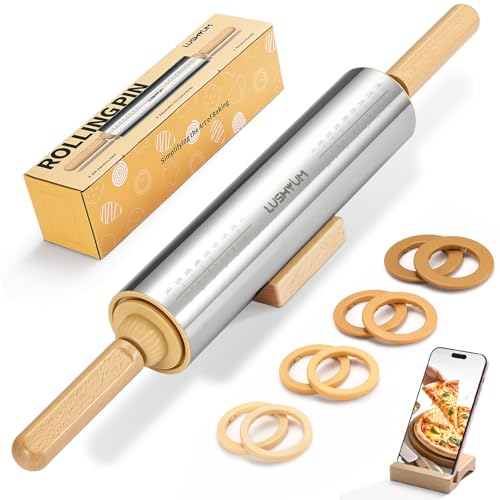
LUSHYUM publishes its ring set the way it should be published. Four pairs, eight rings in total, at 2 mm given as 0.08 in, 3 mm as 0.12 in, 6 mm as 0.24 in and 10 mm as 0.39 in, with the instruction to fit the same size on both ends. Nothing else in this pool gives a decimal inch figure for every ring, and nothing else makes clear that the rings come in pairs.
It is the only listing here that separates the rolling surface from the pin: approximately 20.2 inches in total with a 10.4 inch stainless barrel. It etches inch and millimeter marks along that barrel, advises chilling the barrel before rolling butter based dough, and includes a wooden stand that holds the pin between passes and doubles as a tablet holder. The handles unscrew and store inside the hollow barrel.
Five Steps, Evenly Spaced
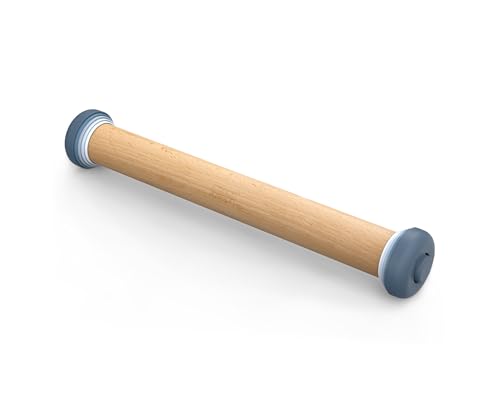
Joseph Joseph publishes five sets of rings at 2 mm, 4 mm, 6 mm, 8 mm and 10 mm, which is the most even ladder in this pool. The 4 mm and 8 mm settings are the ones four ring sets leave out, and they are the gaps a beginner notices: the difference between a thin pizza base and a thick one, or between a cracker and a biscuit. The rings twist off and the beech pin works as a conventional one with none fitted.
At 0.93 lb on a 16.54 inch pin it is the lightest published weight of these five, and being beech it needs no chilling and will not sweat onto dough the way cold metal can. Its one oddity is in the conversions: 4 mm is given as one sixth of an inch, which is arithmetically close and a fraction no other kitchen listing uses. It publishes no markings on the pin.
Where the Conversions Stop Agreeing
An Eighth of an Inch, Twice
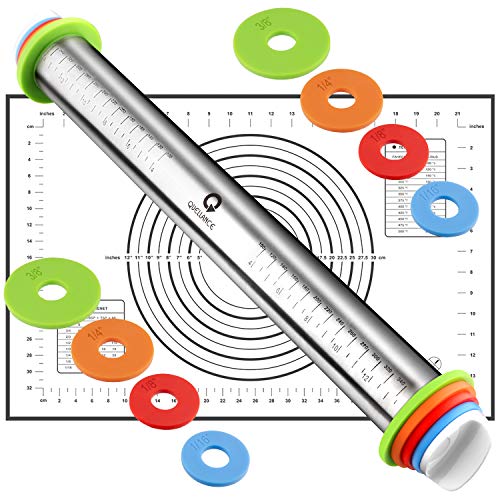
Three listings in this pool publish their second ring as one eighth of an inch and 3 mm. QUELLANCE publishes the same one eighth of an inch as 4 mm. Both cannot be right, and neither listing acknowledges the other convention exists. On pastry the difference is visible, and on a first kit it is the sort of thing that makes a beginner doubt the tool rather than the arithmetic.
What QUELLANCE does bring is the pastry mat, and it is a genuinely good addition for someone starting out. The mat carries its own measurements, so the width and shape of the dough can be controlled as well as the thickness, which is the other half of the problem. The pin is 430 stainless with a satin brushed finish at 17 inches and 1.23 lb, and it works as a plain pin with the rings off.
Three Rings, and One of Them Is Half an Inch
AGIgear is the coarse option and it is the only pin here that reaches beyond 10 mm. Its three detachable rings are an eighth, a quarter and a half of an inch, so the half inch setting is the thickest of these five by a clear margin, and the ladder is the widest spaced. It publishes 19 inches of length in 304 stainless with a satin brushed finish.
The catch is what is missing from the bottom of that range. There is no 2 mm or 3 mm ring, so thin pastry and dumpling wrappers are out of reach, and the ring sizes are given in inches only with no millimeter figure. Its depth field reads 11.0 inches against the stated 19, so the fields are no help. At 1.01 lb it is lighter than the 1.2 lb LUSHYUM and the 1.23 lb QUELLANCE.
A Different Shape, and a Missing Number
Teak, French Style, With a Press
Geesta is the outlier in shape. It is teak, in the handle free French style, with what the listing calls an extra handle press design, and the argument for that shape is control: your hands sit on the barrel itself rather than on handles at the ends, so pressure goes where you put it. It laser etches centimeter and inch markers along the pin and includes a wooden holder to keep it off the counter.
It is also easily the heaviest here at 2.64 lb, which for a wooden pin means a lot of teak, and its dimension fields read 0.5 by 23.0 inches, which cannot describe the object. Five food grade PP rings are supplied, each marked on its own side, and the rings are stated dishwasher safe.
Five Rings and No Thicknesses
And then the listing never says what the five rings are. It says five size options, it says each is marked on the side, it says they slide on to give the exact height you need, and at no point does it publish a single thickness. Every other pin on this page publishes at least three figures and most publish four or five.
That is the one omission on this page that cannot be worked around. Ring thickness is not a nice extra detail on an adjustable rolling pin, it is the entire specification, and a set of five unknown thicknesses is a tool you have to measure yourself before you can use it deliberately. The listing fills the space with a customer survey figure instead, which is not a substitute.
Which One Fits Your Kitchen
Starting out and wanting nothing left to guess. LUSHYUM, eight rings in four pairs at 2 mm, 3 mm, 6 mm and 10 mm with inches given for each, a 10.4 inch barrel in a 20.2 inch pin, marks etched along it and a stand that also holds a recipe.
Even steps between thicknesses. Joseph Joseph, five sets of rings at 2 mm, 4 mm, 6 mm, 8 mm and 10 mm in beech at 16.54 inches and 0.93 lb, usable as a plain pin with the rings off and needing no chilling.
Thick flatbreads and deep pizza bases. AGIgear, a 19 inch 304 stainless pin whose three rings go up to half an inch, further than anything else here. Nothing thinner than an eighth of an inch, so pastry needs another tool.
Controlling the shape as well as the thickness. QUELLANCE, a 17 inch 430 stainless pin at 1.23 lb supplied with a measured pastry mat. Take its 4 mm figure for an eighth of an inch with the other listings in mind.
Rolling with your hands on the barrel. Geesta, teak in the French style with a press design, five marked PP rings, centimeter and inch etching and a wooden holder, at 2.64 lb. You will have to measure the rings yourself.
What We Could Not Verify
Every figure above comes from the maker’s own listing text. These are the things we went looking for and could not source in any of them.
- Geesta sells five ring sizes and never publishes what any of the five thicknesses is.
- Only one listing separates the barrel length from the total length of the pin.
- No listing publishes a barrel diameter, which decides how much dough one pass covers.
- QUELLANCE gives an eighth of an inch as 4 mm where three other listings here say 3 mm.
- No listing states a maximum dough width, only a length that includes the handles.
- No listing says whether the rings fit any pin but their own, so a lost ring is a lost setting.