How the Five Compare on the Numbers
Dishwasher safe is close to free to claim, and most of this pool claims it. That makes the useful question a different one: which makers say something about washing that costs them a sale. On this page two of them do, and the answers are at opposite ends of the category.
One forbids the dishwasher outright and then explains which foods will corrode its own pan. One never mentions washing at all and relies on a ceramic coating to make the question moot. Between them sit three stainless steel purchases, and only one of those three publishes a method for doing the job by hand.
What the table cannot tell you is what happens to a ceramic coating after fifty washes, which is the question the one coated pick needs answered and does not address. Nor does any listing here say whether a dishwasher cycle discolors bare stainless, which it can. Every washing claim in this pool describes the first wash, and nothing describes the fiftieth.
The Two Listings That Break the Pattern
A Maker That Names Its Own Failure
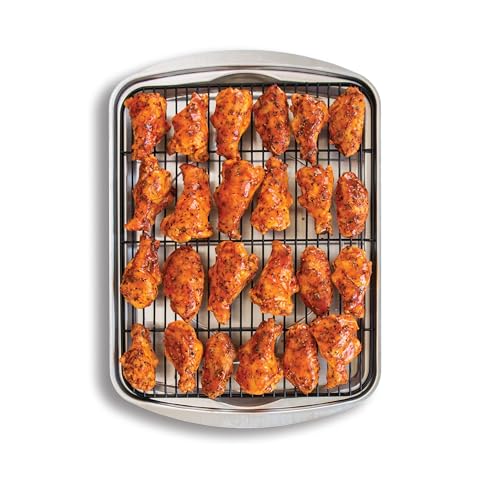
Nordic Ware publishes the sentence nothing else in this pool attempts. Its cleaning bullet says easy clean up, hand wash only, and then continues: aluminum is reactive to acidic ingredients such as vinegar and tomato products, and these foods may darken, pit or corrode the pan after prolonged use. That is a specification, a restriction and a warning in one place.
It is also the only restriction on this page, which makes it both the hardest pick to live with and the easiest to trust. The set is two pieces with two materials: a formed aluminum pan that catches the drippings and a nonstick coated steel rack that elevates the food. One care instruction covers both, and the listing never says whether the coated rack shares the pan’s sensitivity to acid.
A Listing With No Washing Claim At All
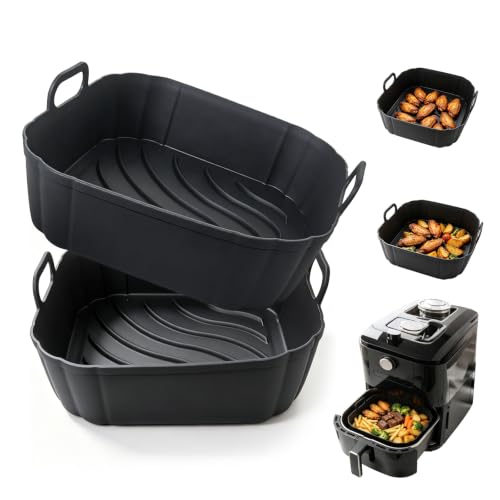
Bakken Swiss is the opposite omission. Across five bullets it never says how to clean the thing, by hand or by machine. What it does instead is argue that the question has been designed out: a ceramic coating is stated to prevent food sticking so there is no messy residue, and raised edges keep oil and juices off the oven floor.
That is a coherent position and it leaves one real gap. A ceramic coating over carbon steel is exactly the surface a dishwasher is known to dull, and a chip in it exposes metal that can rust. The listing publishes the only temperature figure on this page, 450 F, written also as 230 C, and states the coating is free of PFOA, PFOS and PTFE, so the silence is about washing specifically rather than about the surface in general.
Coated, Bare, or Lined
Two Picks Arguing Directly Against Each Other
Leonyo states that it has zero chemical coatings. Bakken Swiss states that a ceramic coating is what keeps food from sticking. Both are arguments about cleaning and they point in opposite directions: a coating gives you less to scrub and something that can fail, and bare steel gives you nothing that can fail and more to scrub.
The same page carries a second direct contradiction. OPENICE includes thirty pre-cut parchment papers so the mess lifts out with the liner. Leonyo’s closing bullet tells you to ditch single-use parchment liners entirely in favour of a reusable rack. Two listings in one pool selling opposite answers to the same evening, and neither is wrong.
The Only Published Method
Leonyo is the only pick of the five that says what to actually do: soak the rack briefly in warm water and scrub gently with a soft brush to remove residue, and then it adds that the rack is fully dishwasher-safe as well. Two routes, one with instructions. OPENICE and Nordic Ware both name a hand route without a method, and Bakken Swiss names neither.
Its figures are the most complete in this pool: 7.7 by 7.7 by 1 inch excluding legs, 0.83 inch stands, a 0.51 by 0.24 inch grid and a 0.9 inch gap when stacked, across three racks. What it has no answer for is grease. With no catch tray, whatever drips off a Leonyo rack lands on the basket or the oven below, which is the one cleaning problem the three tray sets here solve by design.
Where the Instructions Point Elsewhere
Care Instructions That Are Not in the Listing
DONGULI’s cleaning line says to wash and dry the stainless steel components according to the care instructions after use. No care instructions appear anywhere in the listing. A reader is told to follow a document they have not been given, which leaves the dishwasher question open on four pieces of stainless steel that almost certainly tolerate it.
The design compensates. Two baskets at 15.4 by 11.2 inches, each with its own removable tray, means the grease is caught by a separate object from the one the food sat on, so the cooking surface stays comparatively clean and only the trays need real work. Its 2.5 lb weight field is the highest published here and is consistent with four stainless pieces, and its flat carton supports that.
One Field and One Weight That Are Not the Product
Two figures on this page should not be used. OPENICE publishes a carton of 11.61 by 15.59 by 15.71 inches and a weight field of 2.0 lb, which cannot describe an object that size, and the fact sheet flagged it. Bakken Swiss publishes dimension fields of 9.75 by 12.79 by 0.78 inches, which track its 12.80 by 9.65 by 0.79 inch tray rather than the 13.78 by 8.86 by 2.17 inch basket the title names.
Neither is a reason to discount either product. OPENICE is otherwise the most completely measured listing in this pool, giving a figure for the set, the pan, the basket and the parchment, and it is the only purchase here that includes a consumable. The lesson is narrower: a field that contradicts the product is a field, not a verdict.
Which One Fits Your Kitchen
You want to know how to clean it, not just where. Leonyo. A brief soak in warm water and a soft brush, fully dishwasher-safe as well, and the only pick stating it has zero chemical coatings. Three racks, no catch tray.
You would rather not clean it at all. OPENICE, with thirty pre-cut parchment papers at 13.8 by 10.0 inches and every piece measured. Both washing routes named, no method for the hand one.
Grease should never touch the cooking surface. DONGULI, two baskets at 15.4 by 11.2 inches each with its own removable tray. Accept that the care instructions it cites are not in the listing.
Less to scrub in the first place. Bakken Swiss, ceramic over carbon steel, a 12.80 by 9.65 inch tray and a 13.78 by 8.86 inch basket, and the only temperature figure here at 450 F. It makes no washing claim, so treat the coating gently.
You roast nothing acidic and will wash by hand. Nordic Ware, a half sheet pan and rack set at 1.9 lb. The only pick that tells you what will ruin it, which is vinegar and tomato over time.
What We Could Not Verify
These are the specifications we went looking for in all five listings and did not find.
- Whether the Bakken Swiss ceramic coating survives a dishwasher. The listing makes no washing claim either way.
- What DONGULI’s care instructions say. The listing defers to them and does not include them.
- Whether Nordic Ware’s hand wash only rule covers its coated steel rack as well as its aluminum pan.
- A temperature figure from four of the five. Only Bakken Swiss publishes one.
- What non-stick surface OPENICE refers to on a set it otherwise describes as stainless steel.
- What any of these surfaces looks like after fifty washes. Every claim here describes the first one.