How the Five Compare on the Numbers
These five answer the cleaning question in five different ways. Koackl writes out a laundry routine in order. BEABOO asks for a wash before the first loaf. Exircy says machine washable and leaves it at that. GNHUT asks for a wipe with a kitchen towel, because the surface being cleaned is a film rather than a cloth. Mozeat Lens says nothing about cleaning at all.
This page is about that last group, and about what each maker actually tells you to do. Five listings, five different instructions: three ordered steps, a wash before first use, a bare machine washable, a wipe with a towel, and one listing that does not mention cleaning anywhere in its bullets at all.
What the table cannot tell you is how any of these behaves after twenty bakes, because no listing publishes a wash count or a fabric weight. It also cannot tell you a washing temperature: not one of the five gives one, and only Koackl names a cycle at all. For a page about cleaning, that is the boundary of what the published data supports.
The Five Cleaning Instructions
Three Steps, in Order
Koackl publishes the only routine here that reads like care instructions rather than a claim. Shake off the excess flour, wash on a gentle cycle, air dry. Each step matters on a cotton liner: flour left in the weave turns to paste in water, a hot fast cycle shrinks and hardens dense cotton, and tumble drying is what makes a liner rough. The listing also says the liners remain soft afterwards.
It pairs that with the other half of the cycle, which is flouring before use. The easy release bullet says to dust with flour and that the dough then releases after rising, so the same listing describes both ends of one process. That is the difference between a cleaning claim and a working method, and on this page it is the only example of the second.
A Wash Before the First Loaf
BEABOO adds a step nobody else does. Its instructions bullet begins: wash the bread proofing basket cover before the first use. On untreated fabric that is sensible advice, because a new linen cotton blend sheds fibers and sizing into the first thing it touches, and dough is exactly the wrong thing for it to shed into. The same bullet then covers the proofing sequence.
Beyond that first wash the listing is thin on method. It says the liners are untreated and machine washable and leaves the cycle, the temperature and the drying to the reader. It is also the one listing here that states outright that baskets and glass jars are not included, which is a note the other four leave out.
When the Surface Is Not Fabric
A Film You Wipe
GNHUT is the interesting case because it publishes two materials and a method matched to one of them. The cover is natural cotton with a food grade TPU liner inside, and the cleaning bullet says the TPU lining can be wiped clean with a kitchen towel or rinsed with warm water. That is the right instruction for a plastic film and it leaves the cotton outer face unaddressed.
The design argument is elsewhere in the listing: the film creates a relatively confined environment that holds temperature and humidity, which is what plastic wrap does, without the plastic wrap. It is the only pick here that is trying to replace a cover rather than line a basket, and that is why its cleaning sentence looks nothing like the others.
EVA and a Contradiction in the Title
Exircy is a set of four EVA covers with elastic edges, stated machine washable, described as breathable for airflow during proofing and as keeping dough from sticking. At 0.11 lb it is the lightest published weight of these five. EVA is a film rather than a weave, so machine washable is a generous claim and a wipe would probably do.
Its figures need reading twice. The title says 12 inch and the packing bullet says the covers are 11.8 inch, which is the same rounding habit that turns 53.3 into 54 elsewhere. The package fields read 0.12 by 7.87 by 11.8 in, which matches the bullet rather than the title, so 11.8 in is the figure this page uses.
The Silence and What It Costs
A Liner With No Cleaning Line
Mozeat Lens publishes five bullets and none of them mentions washing. There is a fit claim at 10 in, a materials claim of untreated flax linen and cotton, a usage sequence, a note that the pack holds two and that they are reversible, and an environmental argument against plastic wrap and foil. The words durable and long lasting appear. The word wash does not.
On a cloth liner that omission has consequences, because flour and dough go into the weave on every bake and something has to come back out. The material tells you it can be washed, and untreated linen usually takes a gentle wash well, but the listing does not say so and this page will not say it for them.
What Reversible Is Worth
The one thing Mozeat Lens publishes that nothing else here does is that its liners are reversible, which effectively doubles the surfaces in a two pack. For a baker rotating between loaves that is a real advantage, and it is also the feature most likely to hide a problem, because the face that looks clean is the face that has not been used yet.
Its dimension fields are the weakest on this page as well: 9.8 in appears twice with no depth published at all, on a product whose own bullets say 10 in. Between the 9.8 in fields and the 10 in text, the maker’s own sentence is the figure to use, and the fields tell you nothing about how thick the linen is.
Which One Fits Your Kitchen
A baker who wants instructions. Koackl, six dense cotton liners at 9 in with flouring, a gentle cycle and air drying all published, at 0.19 lb. One bullet says three pieces while the title says six, so count what arrives.
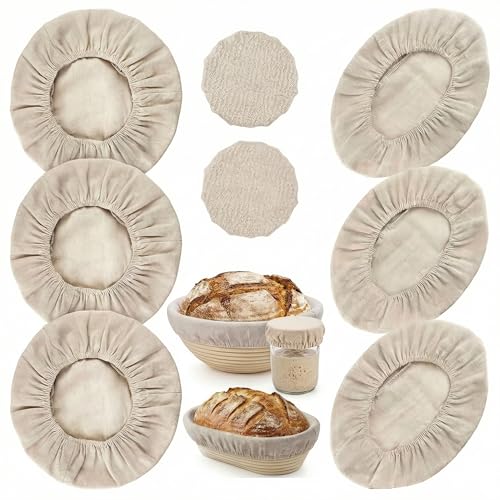
Two basket shapes and a starter jar. BEABOO, six untreated linen cotton liners at 10 in in round and oval plus two jar covers, with a stated wash before first use. It publishes no weight at all.
A cover you would rather wipe. Exircy, four breathable EVA covers with elastic edges at a stated 11.8 in, machine washable, at 0.11 lb. Its title says 12 in, which its own bullet does not support.
Replacing plastic wrap. GNHUT, two oval covers at 10 in in cotton over a food grade TPU liner, cleaned with a towel or a warm rinse, at 0.13 lb. No machine washing is published and no temperature limit for the film.
Two linen faces per liner. Mozeat Lens, two reversible untreated flax linen liners at 10 in, at 0.13 lb. It publishes no cleaning instruction of any kind, which on a floured cloth is the sentence you most want.
What We Could Not Verify
Each of the following is a question these five listings leave open.
- Any washing temperature, which none of the five publishes, and any cycle other than Koackl’s gentle one.
- How Mozeat Lens should be cleaned, since its listing never mentions washing.
- Whether the GNHUT cover can be machine washed, or only wiped and rinsed as its bullet states.
- Whether flour is still needed on the four listings that sell a non-stick surface instead.
- Any fabric thickness or weight per liner, so moisture capacity cannot be compared.
- How the two BEABOO jar covers should be washed, since only the liners are addressed.