How the Five Compare on the Numbers
A bread cloche is a dome over a shallow base, and unlike almost everything else in a baking drawer it has only one orientation. Laid on its side the dome rolls and the base cannot sit inside it. So the figure that decides whether it goes away is the total assembled height, and the published figures across these five run from 5.2 inches to 6.3 for what is essentially the same job.
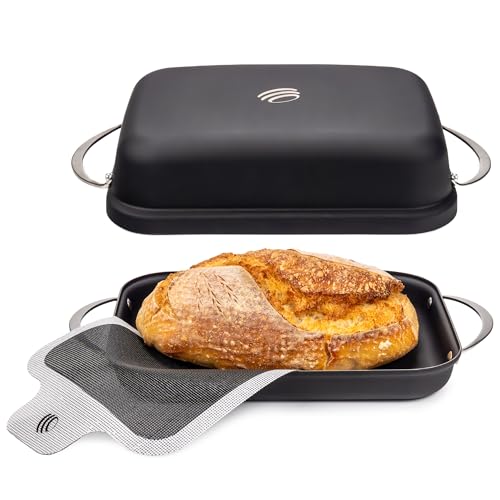
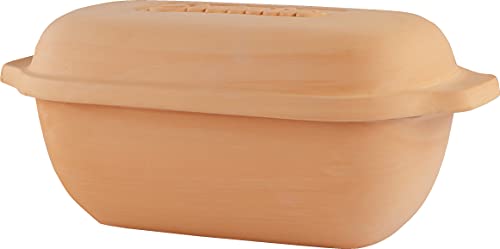
The second figure is the footprint, and it varies more than the height. Bulka publishes 11.3 inches square. Reston Lloyd publishes 11.75 by 6.37 inches, which is a loaf shape rather than a round one. Brod and Taylor publishes 12.5 by 8 inches. Flavehc publishes fields of 12.76 inches square over a stated 9.8 inch dome. A drawer has to take the larger of the two dimensions.
The row almost nobody fills is the one that matters inside the dome. Bulka publishes 3.7 inches of headroom, and it is the only interior figure of the five. Everybody else publishes an outside height and leaves you to guess how much of it is base and how much is air above the loaf, which is the difference between a loaf that springs and one that hits the lid.
The One Listing That Splits the Height
A Lid and a Base Are Two Objects
HAWOK publishes the figure this page wants and no other pick gives: a cast iron dome lid 4.6 inches high plus a base 1.8 inches deep, for a stated total height of 6.3 inches. It states those in inches and in centimeters, 11.6 cm for the lid and 4.5 cm for the base, and gives the diameter twice over as 7.87 inches and 20 cm.
That split changes how the thing stores. Assembled, the HAWOK publishes 6.3 inches, the greatest height of these five. Taken apart, the base is 1.8 inches and the lid 4.6, so the base slides under a tray and the lid goes somewhere else, or inverts over another pan. No other pick lets you plan that, because no other pick publishes the two numbers.
What the Others Leave Out
The other four publish one number and stop. Bulka gives 5.2 inches and 3.7 inches of headroom, so you know the air above the loaf but not where the base ends. Reston Lloyd gives 5.25 inches for a lid and a base it describes separately in words without measuring either. Brod and Taylor gives 5.5 inches for a shell that has no base at all.
Flavehc and HAWOK are the two cast iron picks and they treat the question differently. Flavehc publishes 5.85 inches assembled and says only that its base is shallow. HAWOK publishes the base at 1.8 inches deep and the dome at 4.6 inches high. In a drawer that difference is practical: one of them you can plan around, and the other you have to measure yourself.
Weight, Material and the Drawer Underneath
One Pound to Eight and a Half
The spread across these five is extraordinary for a single job. Brod and Taylor publishes 1.0 pound of aluminum. Reston Lloyd publishes 3.0 pounds of clay. HAWOK publishes 7.43 pounds of cast iron across a lid and a base. Flavehc publishes 7.94 pounds of enameled cast iron. Bulka publishes 8.5 pounds of carbon steel, which it states twice, in the fields and in its own sentence.
Bulka makes the argument explicitly, publishing 8.5 pounds against what it calls a typical 15 to 20 pound cast iron pot, and saying the point is being able to load and lift it safely with a hot loaf inside. On this page the same figure is a drawer load, and 8.5 pounds sliding forward on a runner is a different concern from 8.5 pounds coming out of an oven.
The Shell That Needs No Preheat
Brod and Taylor publishes the most drawer-friendly proposition of the five and does it by removing half the product. There is no base: the shell goes over dough sitting on a stone, a steel or a baking sheet, it needs no preheating where the maker says a Dutch oven wants 30 to 45 minutes, and it publishes 1.0 pound, 12.5 by 8 by 5.5 inches and food-safe aluminum to 550 F.
Reston Lloyd is the opposite trade. Its unglazed clay lid must be soaked before use so the water evaporates into steam during the bake, and the maker states the lid is deliberately not tight-fitting so some steam escapes. That is a genuine method rather than a shortcut, and it is a step before every loaf that none of the other four asks for.
What the Makers Say About Heat and Cleaning
Published Oven Limits
Three of the five publish a temperature. Brod and Taylor states food-safe aluminum to 550 F with no PTFE or PFOA. Reston Lloyd states its clay is microwave and oven safe up to 500 degrees F. Flavehc states enameled cast iron in the oven up to 500 F. Those are the only three figures here, and all three sit above any bread bake.
The two cast iron picks are split on it. Flavehc publishes 500 F; HAWOK publishes no temperature at all, which is unusual for pre-seasoned cast iron, where the seasoning rather than the metal sets the ceiling. Bulka publishes no ceiling either, but it does publish advice: if the base browns too fast, drop the oven about 25 F, or 15 C, and move the rack up a level.
Four of the Five Tell You How to Wash It
Four of the five say something about it. Bulka says to hand wash, dry and bake again, and adds that the nitrided carbon steel is hardened through rather than coated, so there is nothing to season, chip or flake. Flavehc asks for warm soapy water and a nylon brush and warns that metal tools will scratch the enamel. Both are complete instructions.
Brod and Taylor says cleanup is a quick wipe and contrasts that with scrubbing and reseasoning a cast iron pot, which it puts at 20 to 30 minutes after a bake. Reston Lloyd says hand wash and explains that the bottom section is glazed with a glass frit lining to make it easy. HAWOK is the only pick that says nothing about cleaning at all.
Which One Fits Your Kitchen
The drawer gap is the binding constraint. Bulka publishes 5.2 inches of height and 3.7 inches of interior headroom on an 11.3 inch square base. At 8.5 pounds it is the heaviest of these five and the only one to publish what is above the loaf.
A narrow loaf and a light object. Reston Lloyd publishes 5.25 inches on an 11.75 by 6.37 inch clay base at 3.0 pounds and 2 quarts. Soak the lid before every bake.
You want nothing heavy in the drawer. Brod and Taylor publishes 1.0 pound, the lightest of these five, at 12.5 by 8 by 5.5 inches, cleared to 550 F, with no preheating. You supply the flat surface it covers.
A round boule with room to spring. Flavehc publishes 5.85 inches over a 9.8 inch dome in enameled cast iron at 7.94 pounds, with a base the maker says is deliberately shallow. Its footprint fields read larger than its stated size.
You want to store the lid and base apart. HAWOK publishes a 4.6 inch lid and a 1.8 inch base for 6.3 inches assembled, on a 7.87 inch pre-seasoned cast iron cloche at 7.43 pounds.
What We Could Not Verify
Every figure above is a manufacturer’s own published number or sentence. These are the things we went looking for across these five listings and did not find.
- An interior headroom figure for four of the five picks. Only Bulka publishes one, at 3.7 inches.
- A lid height and base depth for four of the five. Only HAWOK splits its total height into the two parts.
- A cleaning statement for HAWOK, the one pick of the five that says nothing about washing its cast iron.
- A resolved footprint for Flavehc, whose fields read 12.76 by 12.76 inches against a stated 9.8 inch size.
- Any mention of storage at all. Not one of the five names a drawer, a cupboard or nesting.
- A drawer or runner load rating anywhere, on five listings whose published weights reach 8.5 pounds.