How the Five Compare on the Numbers
Two of these five tell you which unit system they measured in, because they print both. The other three print inches only, and converting those inches back shows that two of the three were never measured in inches at all. The clearest evidence is a single blade width that appears on three of the five listings, written three slightly different ways, and identical in metric.
All five publish a weight and all five fill at least two dimension fields. Three state a washing route and three describe a measuring scale printed on the blade. What nobody publishes is a plain statement of which figure is the blade and which is the handle, so the unit question has to be answered by arithmetic rather than by reading.
What the table cannot show is that these inch figures are mostly arithmetic. Three of the five publish a width that converts to exactly 12 centimeters, three publish a length that converts to 15.2 centimeters or 15 centimeters, and only two listings say a word about metric. Nothing in the table marks which figures were read off a tool and which were calculated from a drawing.
The Two Listings That Say Which Unit
Both Systems in the Size Row
SURDOCA is the only one of the five to put two unit systems in the size row itself. It reads 12 by 9.5 centimeters with 4.7 by 3.7 inches beside it, and the first bullet repeats the same pair at the end of its sentence. That makes this the only listing on the page where a reader can see the conversion being done rather than having to reverse it.
Its dimension fields are then a third set: 3.54, 4.33 and 0.24 inches. Convert those and they are exactly 9, 11 and 0.6 centimeters, whole numbers again, so the fields are metric too and describe a different object from the one the row measures. With three scrapers in the purchase, the most likely explanation is that the row is one scraper and the fields are another.
Both Systems in the Title
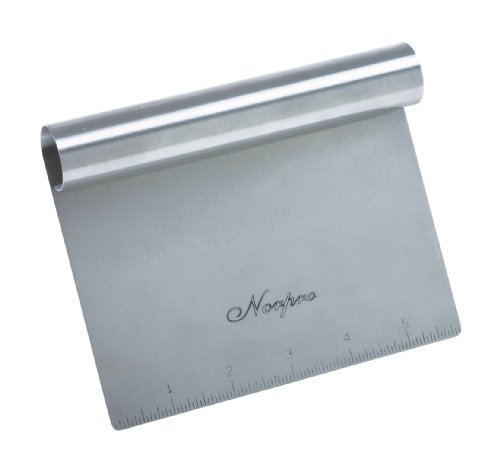
Norpro writes its pair into the title instead, giving 6 inches with 15 centimeters and 4 inches with 10 centimeters, and its size row then carries only the 6 inches. Its width field reads 6 inches and its height field reads 4 inches, so the fields are the inch halves of the pairs and the metric halves are the rounded ones.
That makes Norpro the one listing here whose figures are native to inches: a 6 by 4 inch blade stated in round inches and converted outward, rather than a metric figure converted in. Its depth field reads 1 inch, which is not a credible thickness for a stainless blade, and the pool’s median height field is so small that its real 4 inch figure gets flagged as the odd one out.
One Blade Width, Three Spellings
Twelve Centimeters, Written Three Ways
SURDOCA states that 12 centimeters is 4.7 inches. Anmarko’s width field reads 4.72 inches. MS WGO’s own bullet gives 4.74 inches. Those three figures are the same measurement, and SURDOCA’s declared pair is what proves it, because a listing that prints both systems removes the guesswork from the two that print one.
Three unrelated sellers publishing one metric figure as three different inch readings is a strong signal about where these numbers come from. None of the three measured a tool to two decimal places in inches. One rounded to one decimal, one rounded the division, and one rounded differently, and all three were working from a 12 centimeter drawing. The width is the same on all three scrapers.
The Length Does the Same Thing
SAPID publishes 5.98 by 4.3 inches in its size row and again in a bullet, and its depth field holds the 5.98. Convert it and you get 152 millimeters, with 109 millimeters for the other figure. Those are whole millimeters, not whole centimeters and certainly not round inches, which puts SAPID’s drawing on a millimeter grid.
Norpro’s 15 centimeters and Anmarko’s 6 inch depth field both sit in the same neighborhood, and neither is the same number. So the category has a blade length somewhere near six inches that different sellers have written as 15 centimeters, as 6 inches and as 152 millimeters. A buyer comparing two decimal places across these listings is comparing rounding decisions.
The Two Rows That Carry No Size at All
A Thickness in the Size Slot
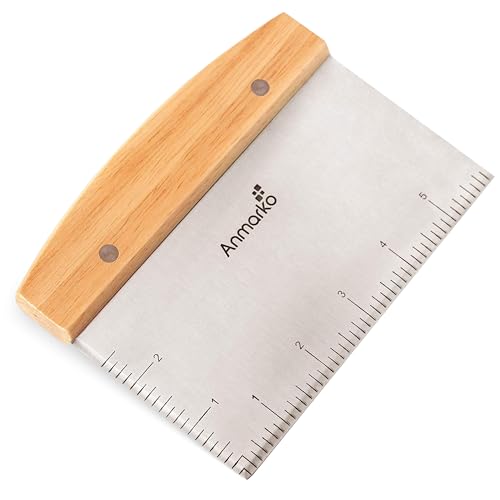
Anmarko puts a blade thickness in its size row, expressed as a fraction of an inch, and repeats the same fraction in its second bullet as the thickness of the metal. That is a real and useful specification, and it is the only thickness figure stated in words on this page. It is also not a size, so the row answers a question nobody asked of it.
Its actual figures are in the fields: 4.72 inches, which SURDOCA’s own conversion identifies as 12 centimeters, and 6 inches, which is a round inch. One slot metric, one slot imperial, on a listing that publishes a scale marked in inches. The height field was discarded as a near zero figure, so the fraction in the row is the only thickness this listing really has.
A Material in the Size Slot
MS WGO puts the words stainless steel in its size row, which is a material rather than a measurement. Its fourth bullet does publish a triple, 5.75 by 4.74 by 1 inches, and those are inch figures with one exception: the 4.74 is 12 centimeters, the same width SURDOCA names and Anmarko carries in a field.
Its dimension fields disagree with all of that. They read 7.09, 6.69 and 1.18 inches, which convert to exactly 18, 17 and 3 centimeters. Three whole centimeters, all three larger than the figures in the bullet, which is what a package usually looks like. The bullet is the tool and the fields are something the tool came in.
Which One Fits Your Kitchen
The buyer who wants the conversion done for them. SURDOCA is the pick. Its size row gives 12 by 9.5 centimeters and 4.7 by 3.7 inches together, so neither unit has to be worked out. Three flexible food grade PE plastic scrapers arrive, with a curved edge, a straight edge and sharp corners, and warm water or a dishwasher are both cleared.
The buyer who trusts round inches. Norpro is the only listing here whose figures were native to inches, 6 inches by 4 inches, with the metric in its title as the derived half. It has an integral rounded handle, a straight sided rectangular blade and a measuring guide on the blade, and at 0.1 lb it is the lightest of the five.
The buyer scraping a griddle as well as a bench. Anmarko publishes a blade thickness in a fraction of an inch and is the only one of the five to do so in words, which is the figure that matters on a tool pushed across cast iron. Its field figures are 4.72 inches and 6 inches, it has a non-slip wooden handle, and the blade is marked in inches.
The buyer dividing dough into equal pieces. MS WGO publishes 5.75 by 4.74 by 1 inches in a bullet, a measuring scale for portioning, mirror polished heavy duty stainless, and both a dishwasher clearance and a rinse and wipe instruction. Use the bullet figures and set aside its dimension fields, which are 18, 17 and 3 centimeters and describe something larger.
The buyer who does not want metal in the bowl. SAPID is silicone over a stainless steel core, so it flexes to a bowl wall without scratching it, and the same tool has a flat edge for cutting. It publishes 5.98 by 4.3 inches, which are 152 millimeters and 109 millimeters, two pieces per purchase, a dishwasher clearance and a hanging hole.
What We Could Not Verify
Six questions went looking for a figure on these listings and came back without one.
- Which of the three SURDOCA scrapers the size row describes and which the dimension fields describe, where the row gives 12 by 9.5 centimeters and the fields give 9 by 11.
- Why the Norpro depth field reads 1 inch, which cannot be the thickness of the stainless blade the listing describes.
- What the Anmarko blade measures from end to end, where its fields give 4.72 inches and 6 inches and nothing says which is the blade.
- What the MS WGO fields of 7.09, 6.69 and 1.18 inches measure, since its own bullet publishes 5.75 by 4.74 by 1 inches instead.
- A thickness for SURDOCA, Norpro, MS WGO or SAPID, where only one listing of the five states one in words.
- A washing route for Norpro or Anmarko, where neither mentions a dishwasher, a hand wash or a temperature.