How the Five Compare on the Numbers
The published capacities on this page run from 0.65 quarts to 9 quarts, a factor of about fourteen for the same job. For one loaf at a time that spread is the whole decision, and each of these five describes it in a different way: a quart figure, a split quart figure, a diameter, and in one case the amount of flour the cloche is sized for.
The five below cover the ladder from end to end, in five different materials: pre seasoned cast iron, ceramic, enameled cast iron, anodized aluminum and enameled steel. Four publish a weight. Two publish a figure their own bullets contradict, and one gives a flour quantity instead of a volume, which is the only one of the five to do so.
The comparison the table cannot make is between a quart and a cup of flour, and that is exactly the gap in this category. Four of the five publish a volume or a diameter and one publishes the amount of flour it is sized for. Nobody publishes an internal diameter at the base separately from the rim, which is the figure a shaped boule actually has to fit.
The Capacity Ladder, and the One Flour Figure
Two Thirds of a Quart, or Nine
HAWOK publishes 0.65 quarts and is the most precisely described piece on this page. Its own bullets give a diameter of 7.87 inches, a total height of 6.3 inches, a dome lid height of 4.6 inches and a base depth of 1.8 inches, each with a metric equivalent. For a single small round loaf that is a complete specification and nothing else here matches it.
At the other end LoafNest publishes 9 quarts, split as a 4 quart base and a 5 quart dome, with a stated 12 inch inner length. Armorbear publishes 5 quarts with a 4.92 inch dome lid and LemonRoad publishes 6 quarts. Those are sized for a full boule with room to spring, and on a small batch they are mostly empty air to heat.
Three Cups of Flour
Emile Henry does the one thing no other pick on this page attempts. Instead of a volume it states that the cloche is sized for a round loaf made with 3 cups of flour, which is a quantity a baker measures out rather than a number they have to translate. It is the most useful sentence among these five for anyone deciding whether a cloche suits their recipe.
Everything else has to be converted in your head. A 0.65 quart cast iron base and a 5 quart enameled one are both described as shallow, and neither tells you what dough weight fills them. For a small batch project the flour figure is the one that transfers directly from a recipe to a purchase.
Weight, and Two Listings That Disagree With Themselves
Fifteen Pounds in a Field, Twelve in a Bullet
LoafNest publishes 15.0 lb in its weight field and states in its own last bullet that the weight is a fine tuned 12 lbs, heavy enough to retain heat but not heavy enough to be difficult to move. That is a three pound gap inside one listing, and on a dish you lift in and out of a hot oven it is a gap that matters.
LemonRoad has the same shape of problem in the opposite direction and much smaller. Its field reads 1.93 lb and its bullet says under 2 pounds, which agree. What it also claims is that the dome is 85% lighter than cast iron, and the only cast iron weight published here is HAWOK’s 7.43 lb, against which 1.93 lb is a smaller saving than 85 percent.
A Ceramic Cloche Measured Two Ways
Emile Henry publishes dimension fields of 5.2 by 4.41 by 2.76 inches and states 13.2 by 11.2 by 7 inches in its own title and bullet. A cloche sized for a loaf from 3 cups of flour is not five inches long, so the fields cannot be the object. This page used the stated figure, and the fields are reported above exactly as published.
The rest of that listing is unusually complete. It publishes a maximum of 270 C, a minimum of -20 C, and states that the ceramic can go from a freezer straight into a hot oven at 250 C or 500 F. It also carries a ten year warranty and includes a recipe and instruction booklet, which no other pick here does.
What Happens Before the Loaf Goes In
One Cloche Needs No Preheating
LemonRoad is built around skipping a step. It states that no preheating is required, that this saves 30 to 45 minutes a bake, and that the routine is three moves: preheat a stone, place the shaped dough, cover with the dome. The anodized aluminum is rated to 550 F, the highest oven figure on this page, and it doubles as a bread dome on a counter afterwards.
The cast iron and ceramic picks work the other way, gaining their crust from mass that has to be brought up to temperature first. None of them publishes a preheat time, so the 30 to 45 minutes LemonRoad cites is its own estimate of what the alternative costs. It is a claim about other products rather than a measurement of this one.
Proofing in the Same Dish You Bake In
Emile Henry states that the bell shaped cover lets you proof the bread directly in the cloche, which removes a transfer and a banneton from a small batch. That is the only proofing claim among these five, and it fits the freezer to oven rating: the same ceramic that survives a cold start is the ceramic you can leave dough sitting in.
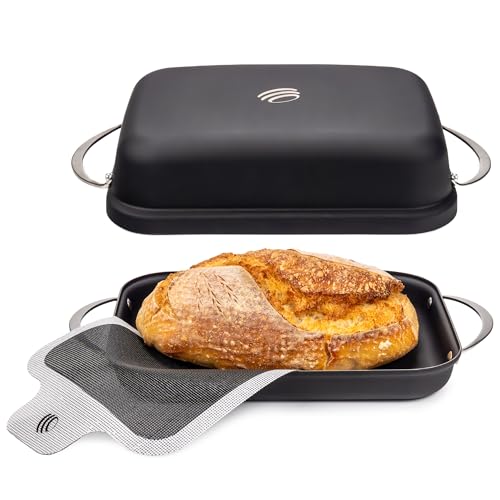
The others solve the transfer differently. Armorbear includes a bread sling and describes a raised ring on the base for release. LoafNest supplies a stainless wire mesh tray for lowering dough in, plus a water tray for steam and a built in oven thermometer. HAWOK simply states a shallow base so the dough can be placed without degassing it.
Which One Fits Your Kitchen
One small round loaf. HAWOK, a published 7.43 lb of pre seasoned cast iron at a stated 0.65 quarts, 7.87 inches across and 6.3 inches tall, with a 4.6 inch dome and a 1.8 inch base depth, and a ridged base the listing says can also be used for grilling.
Matching the cloche to a recipe. Emile Henry, a published 6.5 lb of ceramic stated at 13.2 by 11.2 by 7 inches and sized for a round loaf from 3 cups of flour, rated to 270 C, freezer to oven safe, dishwasher safe, with a booklet and a ten year warranty.
Skipping the preheat entirely. LemonRoad, a published 1.93 lb of anodized aluminum at a stated 13 by 5.5 inches and 6 quarts, rated to 550 F, needing no preheating and saving a stated 30 to 45 minutes a bake, and doubling as a countertop bread dome.
A sling and a shallow base. Armorbear, a 5 quart enameled cast iron oven published at 12.6 by 12.6 by 7.28 inches with a stated 4.92 inch dome lid, a raised ring on the base and a bread sling included, rated to 500 F. It publishes no weight.
Controlling steam and temperature. LoafNest, a 9 quart enameled steel dish as a 4 quart base and a 5 quart dome, with a stated 12 inch inner length, a built in oven thermometer, a 304 stainless water tray and a wire mesh tray for lowering dough.
What We Could Not Verify
Every figure above comes from the maker’s own listing text. These are the things we went looking for and could not source in any of them.
- LoafNest publishes 15.0 lb in its weight field and 12 lbs in its own bullet, so neither figure anchors anything here.
- The Emile Henry dimension fields describe an object about five inches long against a stated 13.2 inches.
- Only Emile Henry states a dough quantity, and it does so in cups of flour while the other four use a volume or a diameter.
- No listing publishes an internal base diameter, which is the figure a shaped boule actually has to fit.
- Armorbear publishes no weight, so the 5 quart enameled pick cannot be compared on how heavy it is to lift hot.
- No cast iron or ceramic listing publishes a preheat time, so the saving one rival claims cannot be checked.