How the Five Compare on the Numbers
A bench scraper is a sheet of steel, and what separates a tool from a sheet is whether the maker gives you something to hold. Three of these five name a handle in their own words. The other two do not, and one of them is a flexible silicone scraper that was never meant to be pushed through dough on a counter.
What decides this page is whether the maker says the word at all. Amazon Basics publishes a comfortably contoured nonslip handle, OXO a soft non-slip grip, Boorika a non-slip handle on a stainless bench scraper. Ecavria publishes a 6.6 by 4.7 inch steel scraper and never mentions how you hold it. SAPID publishes 5.98 by 4.3 inches and says only that it is a suitable size to grip.
The third dimension is the row to read twice. A bench scraper blade is a sheet of steel, so a published height of 1.26 inches on Amazon Basics and 1.75 inches on OXO is not blade thickness, it is the molded handle standing up off the blade, and those are the two listings that describe one. Boorika publishes no third figure at all and SAPID’s was a near zero placeholder that the fact sheet discarded. What the table cannot tell you is how long any of these handles are, because not one listing publishes that, and the grip length is the whole reason a handle matters.
What Counts as a Handle Here
Three Listings Publish One
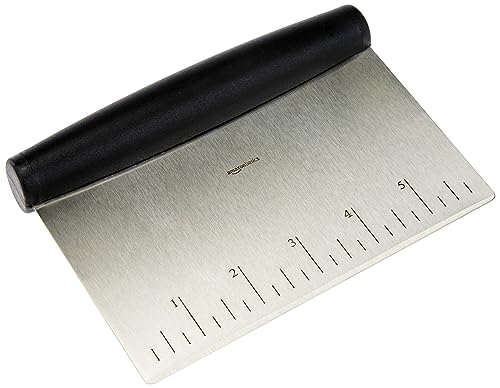
Amazon Basics is the most specific: a comfortably contoured, nonslip handle on a broad rectangular stainless steel blade with a square edge, published at 6.1 by 4.33 inches in the maker’s own bullet. OXO publishes a soft, comfortable, non-slip grip and a stainless steel blade, and at 0.82 lb it is the heaviest of the five by a wide margin. Boorika publishes a non-slip handle and an ergonomic design for long sessions.
Those three are the page. A scraper with a handle is a different tool from a scraper without one, because the handle is what lets you drive the blade down through a mass of dough with your weight behind it rather than pushing it along with your fingers. None of the three publishes the handle’s length, its material, or whether it is molded on or bonded, which for the part you actually hold is a strange silence.
Two Are Sheets You Hold Directly
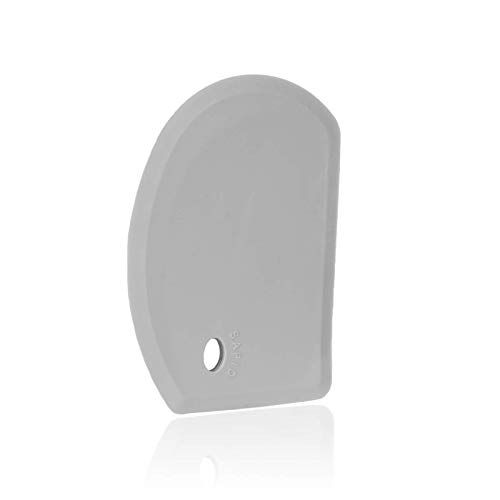
SAPID is a silicone bowl scraper with a stainless steel sheet implanted inside it, published at 5.98 by 4.3 inches and 0.22 lb, the lightest of the five. Its own bullet calls that a suitable size to grip, which is a description of the whole object rather than of a handle. It is on this page as the honest alternative: flexible, curved, and made for following the inside of a bowl rather than cutting on a bench.
Ecavria is the odd one. It publishes an extra thick 430 stainless steel bench scraper at 6.6 by 4.7 inches with a measuring scale, plus two flexible PE plastic bowl scrapers, and across five bullets it never once says how the steel scraper is held. A bench scraper of that size almost certainly has a folded or riveted top edge to grip, but the listing does not say so and this page will not say it for them.
Why the Height Field Is Worth Reading
1.26 Inches and 1.75 Inches Are Not Thickness
Both of the listings that publish a real third dimension are listings that publish a handle. Amazon Basics gives 1.26 inches and OXO gives 1.75 inches, on blades published at 6.1 by 4.33 and 6.25 by 4.0 inches. Steel that thick would not be a scraper, so the figure is the grip standing proud of the blade, and OXO’s figure is the greater of the two.
The weights agree with that reading. OXO publishes 0.82 lb, Amazon Basics 0.36 lb, and SAPID, which is a silicone sheet with steel inside it, publishes 0.22 lb. A molded grip is most of the mass on a tool this small, which is why OXO, at 1.75 inches and 0.82 lb, sits above Amazon Basics at 1.26 inches and 0.36 lb on both figures. Neither maker says what the grip is made of.
Where the Fields Collapse to Nothing
SAPID’s height field arrived as 0.04 inches, which the fact sheet discarded as a near zero placeholder rather than a measurement, so the only figures it has are 5.98 by 4.3 inches from its own bullet. Boorika publishes 6.0 by 4.5 inches and then nothing: no third dimension, no weight, and a size field that reads only L, with no key anywhere in the listing to say what L means.
Ecavria is a set of three items, so its dimension fields were treated as the shipping carton and set aside, correctly. The carton reads 6.6 by 6.6 by 0.04 inches, which is not a believable box either, and the only figure worth anything is the 6.6 by 4.7 inches the maker writes for the steel scraper in its first bullet. That sentence is the only published size for the tool this page cares about.
Marks on the Blade and What Comes in the Box
Measuring While You Divide
Four of the five publish some form of scale and only two publish the interval. Amazon Basics states marks every quarter inch along the blade edge for creating even portions. OXO states markings every inch on the blade. Boorika states precisely calibrated measurement guides without naming a spacing, and Ecavria states a measuring scale without naming one either. SAPID publishes no markings at all.
For dividing a batch of dough into even pieces, a quarter inch scale and an inch scale are genuinely different tools, and a scale with no stated interval is a photograph rather than a specification. This is the clearest case on the page of two listings publishing a number and two publishing a word for the same feature, and it is why the criteria below weight the marks separately from the handle.
One Tool or a Set
Amazon Basics, OXO and SAPID each sell a single scraper. Ecavria sells three pieces, one steel bench scraper and two plastic bowl scrapers, and its published 0.44 lb covers all three, so no weight exists for the steel scraper alone. Boorika’s listing talks throughout about a scraper set, with stainless steel and plastic scrapers both named, while the size field reads L and no count appears anywhere.
That matters if the handle is what you came for. In a set, the piece with the handle is one item among several and its own figures get folded into a box total, which is exactly what happened to Ecavria’s weight. The single tools publish figures you can attach to the thing in your hand, and on a page about how a scraper is held that is worth more than the extra pieces.
Which One Fits Your Kitchen
Even portions off a bench. Amazon Basics, published at 6.1 by 4.33 inches with marks every quarter inch, a contoured nonslip handle, 1.26 inches of grip standing off the blade and 0.36 lb, and stated dishwasher safe.
The most tool in the hand. OXO, at 0.82 lb and a published 1.75 inches of soft non-slip grip above a 6.25 by 4.0 inch stainless blade with markings every inch. It publishes no blade size in its own words, only in its fields.
A long shaping session. Boorika, for a non-slip handle and an ergonomic design stated for prolonged baking, on a stainless blade published at 6.0 by 4.5 inches. Accept that no weight, no third dimension and no piece count are published.
A bench scraper and bowl scrapers together. Ecavria, three pieces for one published 0.44 lb, with an extra thick 430 stainless steel scraper stated at 6.6 by 4.7 inches. Nothing in the listing says how that scraper is held.
Getting dough out of a bowl. SAPID, a flexible silicone scraper with a steel sheet inside, published at 5.98 by 4.3 inches and 0.22 lb. It has no handle and does not claim one, and it is the wrong tool for cutting on a bench.
What We Could Not Verify
Every figure above comes from the maker’s own listing text. These are the things we went looking for and could not source in any of them.
- Not one of the five listings publishes a handle length, so how much of the top edge you can actually hold is unknown on every pick.
- None of the three listings that name a handle says what it is made of, whether it is molded on, or whether it can be removed.
- Boorika publishes no weight and no third dimension, and its size field reads only L with no key anywhere in the listing.
- Ecavria’s 0.44 lb covers three pieces, so the weight of the steel bench scraper on its own is not published.
- Boorika and Ecavria both state a measuring scale without stating the interval, so only two of the five can be compared on what the marks are worth.
- Blade thickness is not published by any of the five, and on a tool that has to be pushed under stuck dough it is the figure that decides whether the edge slides or catches.