Lush Food & Drink

Buying Guide ·Knives

Best Bread Knives for Slicing Homemade Loaves

The deciding specification is blade length, which ranges from 8 to 10 inches across these five models.

By the Lush Editorial Team·Researched & Compared

  • Researched & ComparedSpecs pulled from the manufacturer listing
  • Like-for-LikeSame measures across every model
  • No Paid PlacementsNobody pays to appear here

I compared the published specifications and features of five bread knives from a fact sheet, focusing on blade length, steel type, and handle design.

Our shortlist

Five products, one set of published numbers.
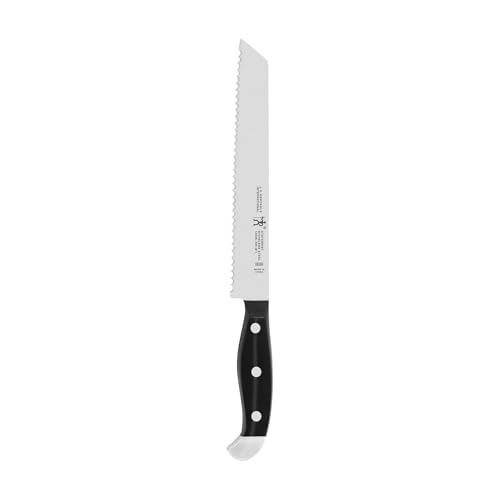
  1. HENCKELS Statement 8-Inch Bread Knife
    Best for all-purpose slicing

    HENCKELS Statement 8-Inch Bread Knife

    8-inch blade with German engineering and dishwasher-safe cleanup.

    • HENCKELS
    • 8"
    • 0.4 lb
  2. Orblue Serrated Bread Knife with Upgraded Stainless ...
    Best one-piece design

    Orblue Serrated Bread Knife with Upgraded Stainless ...

    Continuous stainless steel construction with no plastic or wood parts.

    • Orblue
    • 8"
    • Weight not listed
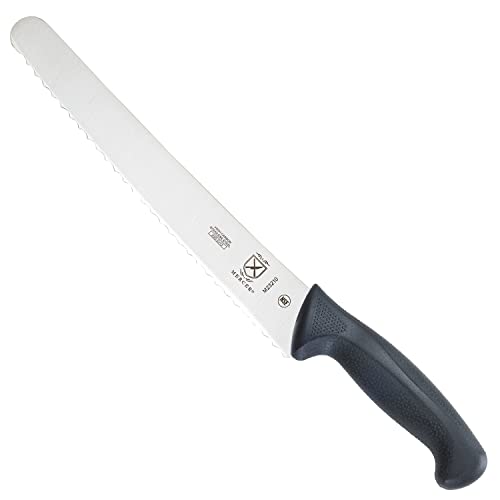
  3. Mercer Culinary M23210 Millennia Black Handle
    Best for large loaves

    Mercer Culinary M23210 Millennia Black Handle

    10-inch wavy edge blade with a non-slip ergonomic handle.

    • Mercer Culinary
    • 10"
    • 0.3 lb
  4. Omesata Bread Knife
    Best lightweight option

    Omesata Bread Knife

    At 0.2 pounds, the lightest knife in this comparison.

    • Omesata
    • 8"
    • 0.2 lb
  5. KEEMAKE 10 Inch Bread Knife for Homemade Bread
    Best for sourdough

    KEEMAKE 10 Inch Bread Knife for Homemade Bread

    10-inch blade with deep serrations for thick crusts.

    • KEEMAKE
    • 10"
    • 0.51 lb

Side by side

Blank means the maker does not publish it.
ModelBrandSize (capacity)WeightBest for
HENCKELS Statement 8-Inch Bread Knife HENCKELS 8" 0.4 lb Best for all-purpose slicing
Orblue Serrated Bread Knife with Upgraded Stainless ... Orblue 8" not published Best one-piece design
Mercer Culinary M23210 Millennia Black Handle Mercer Culinary 10" 0.3 lb Best for large loaves
Omesata Bread Knife Omesata 8" 0.2 lb Best lightweight option
KEEMAKE 10 Inch Bread Knife for Homemade Bread KEEMAKE 10" 0.51 lb Best for sourdough

Each pick in detail

What the listing says for it, and against it.
1 Best for all-purpose slicing

HENCKELS Statement 8-Inch Bread Knife

8-inch blade with German engineering and dishwasher-safe cleanup.

  • For it
  • 8-inch blade suits a range of bread sizes
  • Lightweight at 0.4 pounds
  • Dishwasher safe for easy cleanup
  • German engineered according to the maker
  • Against it
  • Width and depth are 3.5 by 15.75 inches, which may require storage space
  • No mention of a blade guard
2 Best one-piece design

Orblue Serrated Bread Knife with Upgraded Stainless ...

Continuous stainless steel construction with no plastic or wood parts.

  • For it
  • One-piece stainless steel design
  • 8-inch blade with a 5-inch handle
  • Wavy edge technology for sharpness retention
  • Ergonomic handle for comfortable grip
  • Against it
  • Weight is not published
  • No blade guard included
3 Best for large loaves

Mercer Culinary M23210 Millennia Black Handle

10-inch wavy edge blade with a non-slip ergonomic handle.

  • For it
  • 10-inch blade for large loaves
  • High-carbon Japanese steel
  • Textured finger points for a non-slip grip
  • Hand wash recommended for longevity
  • Against it
  • Not dishwasher safe
  • Heavier than some at 0.3 pounds
4 Best lightweight option

Omesata Bread Knife

At 0.2 pounds, the lightest knife in this comparison.

  • For it
  • Lightest at 0.2 pounds
  • Full tang construction for safety
  • Ergonomic handle with non-slip grip
  • 304 stainless steel blade
  • Against it
  • 8-inch blade may be short for very large loaves
  • No blade guard mentioned
5 Best for sourdough

KEEMAKE 10 Inch Bread Knife for Homemade Bread

10-inch blade with deep serrations for thick crusts.

  • For it
  • 10-inch blade for single-motion slicing
  • Deep serrations for crusty breads
  • German steel with 58 HRC
  • Offset design for knuckle clearance
  • Against it
  • Dimensions and weight are not published
  • No blade guard included

Our verdict

For most home bakers, the HENCKELS Statement 8-Inch Bread Knife offers a balanced 8-inch blade and a lightweight 0.4-pound build. The Orblue Serrated Bread Knife provides a one-piece stainless steel design with a wavy edge. The Mercer Culinary M23210 has a 10-inch wavy edge blade for larger loaves. The Omesata Bread Knife is the lightest at 0.2 pounds. The KEEMAKE 10 Inch Bread Knife features deep serrations and a 10-inch blade for sourdough.

“Blade length and steel type set these knives apart.”

Lush Editorial Team

What separates these five

Blade length Blade lengths range from 8 inches on the HENCKELS, Orblue, and Omesata to 10 inches on the Mercer Culinary and KEEMAKE.
Steel type Steels include German engineered, high-carbon Japanese, 304 stainless, and high carbon stainless with 58 HRC.
Handle design Handles vary from ergonomic shapes to textured finger points and one-piece construction.
Care instructions The HENCKELS is dishwasher safe, while the Mercer Culinary recommends hand washing.
Included accessories Only the Cuisinart includes a blade guard, but it is not among the five picks.

How we chose

Priorities, not a computed score. The inputs are published specifications, so we rank by what matters most and say how much.

  1. 30% Blade lengthThe primary factor in matching a knife to the size of your loaves.
  2. 25% Steel and edge retentionDetermines how long the knife stays sharp and resists corrosion.
  3. 20% Handle design and comfortA comfortable, non-slip grip improves safety and control.
  4. 15% Care requirementsDishwasher-safe options offer convenience, while hand-wash-only may last longer.
  5. 10% Weight and balanceA lighter knife can be easier to handle for some users.

How the Five Compare on the Numbers

Blade length is the most immediate difference among these five bread knives. The HENCKELS Statement, Orblue, and Omesata all have 8-inch blades, while the Mercer Culinary M23210 and KEEMAKE 10 Inch Bread Knife have 10-inch blades. That two-inch difference affects how easily you can slice through a large sourdough boule in one stroke. Weight also varies: the Omesata is the lightest at 0.2 pounds, and the KEEMAKE is the heaviest at 0.51 pounds. The Orblue does not publish a weight.

Steel types are not directly comparable because the manufacturers describe them differently. HENCKELS says German engineered, Mercer Culinary uses high-carbon Japanese steel, Omesata specifies 304 stainless steel, and KEEMAKE states high carbon stainless steel at 58 HRC. The imarku, not among the five picks, lists carbon and chromium percentages. Handle designs range from ergonomic shapes to textured finger points, and care instructions differ: only the HENCKELS is dishwasher safe, while the Mercer Culinary requires hand washing.

Specification HENCKELS Statement Orblue Serrated Mercer Culinary M23210 Omesata Bread Knife KEEMAKE 10 Inch
Blade length 8 inches 8 inches 10 inches 8 inches 10 inches
Weight 0.4 lb not published 0.3 lb 0.2 lb 0.51 lb
Steel type German engineered Stainless steel High-carbon Japanese steel 304 stainless steel High carbon stainless steel (58 HRC)
Handle material not published Stainless steel Black handle not published not published
Dishwasher safe Yes not published No not published not published
Blade guard included No No No No No
Edge type Razor-sharp Wavy edge Wavy edge Wavy edge Deep serrations
Full tang not published Yes (one-piece) Tang provides balance Yes not published

The table does not tell you how these knives feel in the hand or how they perform over time. It also leaves out blade thickness, handle materials for some models, and country of origin. Those details are not published on the fact sheet. What the table does show is that blade length and steel type are the clearest points of comparison, and care instructions vary enough to matter for daily use.

Blade Length and What It Means for Your Loaf

8-Inch Blades: HENCKELS, Orblue, and Omesata

An 8-inch blade is a common size for home bread knives. The HENCKELS Statement, Orblue Serrated, and Omesata Bread Knife all use this length. For standard sandwich loaves, bagels, and cakes, an 8-inch blade provides enough reach without feeling unwieldy. The Omesata is the lightest of the three at 0.2 pounds, which may appeal if you slice several loaves in one session. The HENCKELS is 0.4 pounds, and the Orblue does not publish a weight.

Each of these three has a different steel story. HENCKELS says German engineered, Orblue uses stainless steel in a one-piece design, and Omesata specifies 304 stainless steel. The Orblue and Omesata both describe wavy edges, while HENCKELS says razor-sharp without detailing the edge. If you prefer a one-piece knife with no plastic or wood parts, the Orblue is the only one of the three that states that construction.

10-Inch Blades: Mercer Culinary and KEEMAKE

A 10-inch blade gives you more length for large boules and artisan loaves. The Mercer Culinary M23210 and KEEMAKE 10 Inch Bread Knife both use this size. The Mercer Culinary weighs 0.3 pounds and has a wavy edge with textured finger points for a non-slip grip. It is not dishwasher safe, so hand washing is required. The KEEMAKE weighs 0.51 pounds and features deep serrations for thick crusts, plus an offset design for knuckle clearance.

The KEEMAKE’s steel is high carbon stainless at 58 HRC, and the maker states a 12 to 15 degree hand-sharpened edge. The Mercer Culinary uses high-carbon Japanese steel. Both are designed for sourdough and crusty breads, but the KEEMAKE’s deeper serrations are specifically described for penetrating thick crusts. If you regularly bake large sourdough boules, the extra length and aggressive serrations of the KEEMAKE may be an advantage.

Steel, Edge, and Handle Design

Steel Types and Edge Retention

The fact sheet lists different steels for each knife. HENCKELS says German engineered, which is a broad description. Orblue uses stainless steel and states the blade is 2.2 mm thick. Mercer Culinary uses high-carbon Japanese steel for edge maintenance. Omesata uses 304 stainless steel. KEEMAKE specifies high carbon stainless steel at 58 HRC, which is a measure of hardness. Higher HRC generally means better edge retention but more brittleness.

None of the manufacturers publish the exact carbon or chromium percentages for these five knives, except for the imarku, which is not among the picks. That makes direct steel comparisons difficult. What is clear is that all five are designed to resist rust and maintain sharpness. The KEEMAKE provides the most specific hardness figure, while the others rely on descriptive terms. For a buyer, the practical difference may come down to care and handle feel rather than steel composition.

Handle Comfort and Safety Features

Handle designs vary. The HENCKELS does not describe its handle material. The Orblue has a one-piece stainless steel handle with no separate parts. The Mercer Culinary has a black handle with textured finger points for a non-slip grip. The Omesata has an ergonomic handle with a non-slip grip. The KEEMAKE does not detail its handle material but mentions an offset design for knuckle clearance. A comfortable, secure grip is important for control when slicing crusty bread.

Safety features are limited. None of the five picks include a blade guard. The Omesata and Orblue mention full tang or one-piece construction for safety and durability. The Mercer Culinary notes a tang for balance. If storage safety is a concern, you would need to purchase a separate guard or use a knife block. The fact sheet does not list any additional safety accessories for these five models.

Which One Fits Your Kitchen

If you want an all-purpose knife with easy cleanup: the HENCKELS Statement is dishwasher safe and has an 8-inch blade. It weighs 0.4 pounds and is described for bread, biscuits, cakes, and vegetables.

If you prefer a one-piece design with no separate parts: the Orblue Serrated Bread Knife is made from a single piece of stainless steel. It has an 8-inch blade and a 5-inch handle, and the maker states it is built to last for years.

If you bake large loaves and need extra reach: the Mercer Culinary M23210 has a 10-inch wavy edge blade. It weighs 0.3 pounds and has a non-slip handle, but it requires hand washing.

If you want the lightest option for quick slicing: the Omesata Bread Knife weighs 0.2 pounds. It has an 8-inch blade, a full tang, and an ergonomic handle. It is designed for homemade bread and sourdough.

If you regularly slice thick-crusted sourdough: the KEEMAKE 10 Inch Bread Knife has deep serrations and a 10-inch blade. It weighs 0.51 pounds and features an offset design for knuckle clearance. The maker states it is forged from German steel at 58 HRC.

What We Could Not Verify

The fact sheet leaves several details unpublished. These are the facts we looked for and could not find.

  • The exact blade thickness for the HENCKELS, Mercer Culinary, Omesata, and KEEMAKE knives is not stated.
  • The handle materials for the HENCKELS, Omesata, and KEEMAKE are not specified.
  • The Rockwell hardness for the Orblue, Mercer Culinary, Omesata, and HENCKELS blades is not provided.
  • The country of origin for all five knives is not listed.
  • Dishwasher safety for the Orblue, Omesata, and KEEMAKE is not published.
  • The weight of the Orblue knife is not published.
Frequently asked questions

What is the difference between a serrated and a wavy edge bread knife?+

A serrated edge has sharp teeth that saw through crust, while a wavy edge has a scalloped pattern that can be easier to sharpen. The Orblue and KEEMAKE feature wavy edges, while the Mercer Culinary and Omesata describe wavy or serrated edges. The HENCKELS does not specify the edge type beyond 'razor-sharp'.

Can I put a bread knife in the dishwasher?+

The HENCKELS Statement is dishwasher safe according to the manufacturer. The Mercer Culinary M23210 explicitly recommends hand washing with warm water and mild soap, and not placing it in the dishwasher. The other three knives do not state dishwasher safety on the fact sheet, so it is best to hand wash them to preserve the edge.

What blade length should I choose for homemade bread?+

An 8-inch blade, like on the HENCKELS, Orblue, and Omesata, works well for standard loaves and bagels. A 10-inch blade, like on the Mercer Culinary and KEEMAKE, allows single-motion slicing through large sourdough boules. Consider the size of your typical bake to decide.

Are these knives suitable for cutting cakes and pastries?+

Yes, many are versatile. The HENCKELS is listed for biscuits, cakes, and large fruits. The Orblue is ideal for cake and pastries. The Mercer Culinary is good for angel food cake. The Omesata and KEEMAKE also mention cakes and pastries. All can handle soft baked goods.

Do any of these knives come with a blade guard?+

None of the five picks include a blade guard according to the fact sheet. The Cuisinart 8-Inch Stainless Steel Bread Knife, which is not among the five picks, includes a matching blade guard. For the five picks, you would need to purchase a separate guard or store them safely.

What is the weight of each knife?+

The HENCKELS weighs 0.4 pounds, the Mercer Culinary 0.3 pounds, the Omesata 0.2 pounds, the KEEMAKE 0.51 pounds, and the imarku 0.46 pounds. The Orblue's weight is not published. The Omesata is the lightest among the five picks.

Specifications come from the manufacturers' own published listings. Lush Food & Drink may earn a commission if you buy through a link on this page, at no extra cost to you. How we research.