How the Five Compare on the Numbers
Seven live pages already rank this pool: by published weight, by a named food safe plastic with a second size, by what each maker says about cleaning, by sheet size against the loaf, by how many designs arrive and whether one carries a message, by the application method, and by whether a sheet keeps its own shape in a drawer. The last of those reaches for the same 0.12 inch acrylic figure this page uses. What none of them does is read all five listings against each other on the material itself, which on a stencil is the thing being sold.
Nineteen listings sit in this pool and the fact sheet shows sixteen of them. Exactly one of those publishes a thickness. Among these five, three name a material in a bullet, one names it only in the title, and one does not name it anywhere. That spread is what the table below is built on, because the difference between a 3 mm acrylic plate and an unnamed flexible sheet is the difference between two different tools.
What the table cannot tell you is how thick the four silent listings are, and the dimension fields are no help. A 0.2 inch figure sits as the third figure on thirteen of the sixteen listings the fact sheet shows, on products that ship flat and products that ship boxed. A number that identical across that many listings is a form default, so we have left it out of the thickness row entirely rather than treat it as a measurement.
The Two That Name Acrylic, and the One That Measures It
A Thickness Figure Nobody Else Publishes
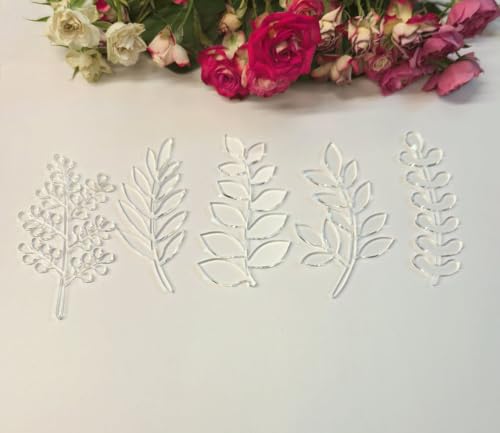
YongPan’s botanical set opens its first bullet with a number: made from 0.12 inch, or 3 mm, food-contact-safe clear acrylic. That is the only thickness written into a sentence anywhere in these sixteen listings. It also happens to be the figure that settles what kind of tool you are buying, because 3 mm of acrylic does not bend and a stencil that does not bend sits proud of a domed crust.
The same listing is the only one here that publishes a width range rather than a square: five leaf patterns at a stated 4.5 inches long, with widths from 1.3 to 2.6 inches. Those are proportions for a batard. The listing then undercuts itself slightly by calling the product a set of 10 in its title while the bullet counts five patterns, and nothing in the five bullets resolves that.
What See-Through Is Actually For
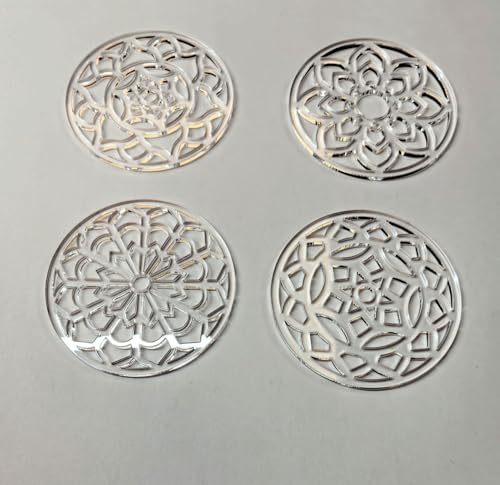
The mandala set from the same brand does not publish a thickness but makes the clearest case for the material. It states food-grade acrylic that is non-porous and hygienic, will not absorb flour, moisture or odors, and is more sanitary than wood and easier to clean. That is the only listing in the five that addresses what a stencil is actually exposed to rather than how it looks.
Its other argument is placement. The transparent design is stated to let you align a pattern on dough, cake or foam, with the explicit promise of no more crooked flour art. On a round loaf with a hand-shaped seam, being able to see what is underneath is worth more than a design count, and only the two acrylic listings here offer it at all.
Flexible Sheets Against Rigid Plates
PP, Plastic, and a Listing That Names Nothing
Guduling is the only one of the five that names a polymer. Its second bullet says premium PP that is flexible and safe for direct food contact, wiped clean and reusable hundreds of times. Flexible is the operative word: a PP sheet will follow the dome of a boule where a 3 mm acrylic plate will not, and the listing states that property directly rather than leaving it to be inferred.
Maison Fare names plastic in its title and then retreats to food-grade materials in its bullets, while being specific about what it is not: warp resistant, strong, and explicitly not flimsy film. LÉ ÉCLAT publishes a bullet headed reusable flexible material and never says what the material is, which leaves washable, lightweight and flexible as the whole of its specification.
Tabs, Stacking and the Storage Claims
Maison Fare is the only set here with a positioning aid built into the stencil. Its second bullet states that built-in tabs make positioning simple and mess-free: place the stencil on shaped dough, dust flour or cocoa with a finger or a sifter, lift off using the tabs, and bake. That is a complete method, published, and it does not depend on being able to see through anything.
It is also the only one of the five to make a storage claim with a shape behind it: stack flat for easy storage. LÉ ÉCLAT says easy to store after use. Neither YongPan set says anything about storage, which is a small irony given that one of them is a rigid plate 3 mm thick and ten of them stacked is a real object in a drawer.
Counts, Sizes and the Figures Worth Ignoring
Four Designs or Twenty Four
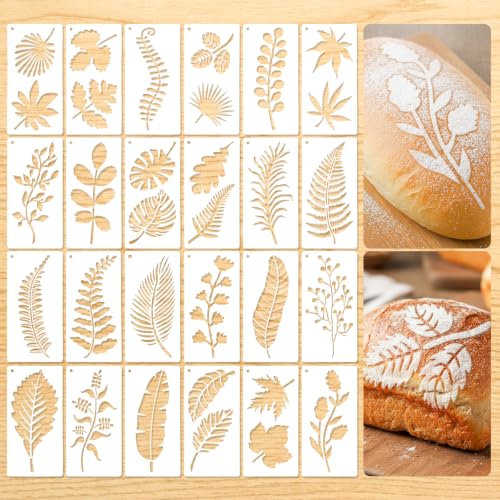
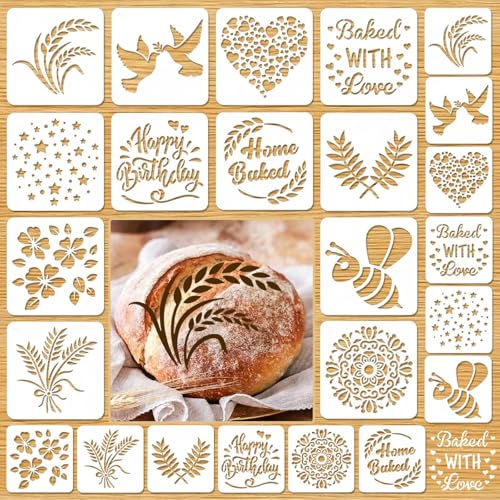
The piece counts run from four to twenty four and they are not interchangeable. Maison Fare ships four stencils at 4 by 4 inches and YongPan’s mandala set ships four designs at 3.54 inches. Guduling ships six at 5.12 inches with the patterns itemized: wheat sheaves, geometric grids, hearts, florals and minimalist lines. LÉ ÉCLAT ships twenty four tropical leaf patterns.
A high count is not automatically better here, because a stencil set is bought for the one or two designs you will actually use on a weekly loaf. What the count does change is the footprint of the stack, and only two listings publish a weight to go with it: 0.02 lb for Maison Fare’s four and 0.06 lb for Guduling’s six. YongPan’s botanical set and LÉ ÉCLAT publish none.
The 0.2 Inch Field, and Why It Is Not a Thickness
Thirteen of the sixteen listings the fact sheet shows carry 0.2 as their third figure. Flat four-packs carry it, twenty four piece sets carry it, and so do sets whose other two fields describe a shipping carton rather than a stencil. No bullet on any of those listings repeats it. A figure that identical across that many separate products is what a form puts there when nobody filled the box in.
So the thickness row on this page has one entry in it, and four cells that say nothing. That is an honest picture rather than a gap in the research: four of these makers have not told you how thick their stencils are, and reading a default out of a dimension field would have produced five identical-looking numbers and one real one, all presented the same way.
Which One Fits Your Kitchen
You bake batards and want the pattern straight. YongPan’s botanical set. A stated 0.12 inches of clear acrylic, five leaf patterns at 4.5 inches long and 1.3 to 2.6 inches wide, and you can see the dough through it while you aim.
Round loaves and a lot of flour dust. YongPan’s mandala set, four designs at a stated 3.54 inches in food-grade acrylic the maker calls non-porous and says will not absorb flour, moisture or odors. It publishes no thickness.
You keep smudging the lift-off. Maison Fare. Built-in tabs, four stencils at 4 by 4 inches, dishwasher safe, made in the USA, stated to stack flat. At 0.02 lb for the set it is the lightest weight field here.
A domed boule, or latte art as well as bread. Guduling, the only set that names its polymer as PP and states it is flexible. Six pieces at 5.12 inches, listed for crusty bread, cookies, pie crusts, cake tops and coffee foam.
You want range and will accept an unnamed sheet. LÉ ÉCLAT, twenty four tropical leaf patterns at 3.94 by 7.87 inches, the only rectangular format here. Its material bullet says reusable, flexible, washable and lightweight and nothing more.
What We Could Not Verify
These are the specifications we went looking for in all five listings and did not find.
- A thickness for Maison Fare, Guduling, LÉ ÉCLAT or YongPan’s mandala set.
- What LÉ ÉCLAT’s sheets are made of. No title, bullet or field names a material.
- Whether YongPan’s botanical set holds five patterns or ten pieces.
- A weight for YongPan’s botanical set or for LÉ ÉCLAT.
- The width of the cut lines on any of the five, which is what decides how crisp a dusted edge looks.
- Whether the 0.2 inch dimension field on four of these listings describes a stencil, a stack or a carton.