How the Five Compare on the Numbers
Three of these five publish an adjustable blade angle. JACYAO’S states you set the blade straighter for decorative cuts or add more curve for ears and baguettes. Bake Choice publishes an adjustable tilt for distinctive slashes. Junclyptic publishes an adjustable-angle lame alongside scoring templates. Breadsmart publishes two fixed ends instead, one straight and one curved, and RICCLE publishes one fixed geometry.
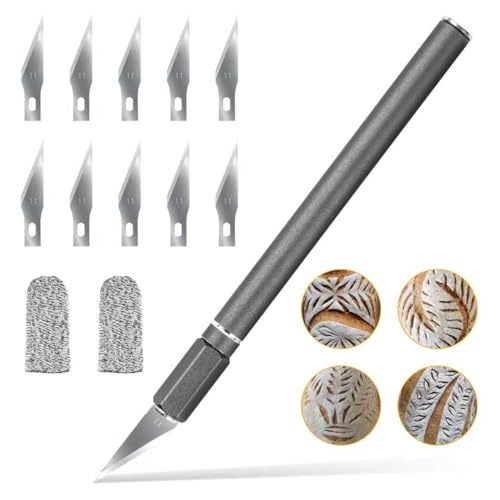
Blade counts are published three times out of five. Junclyptic publishes eleven, JACYAO’S ten with a metal box, and Breadsmart ten four-corner blades with numbered corners. Weights are published four times, at 0.1 lb for Junclyptic and Breadsmart, 0.13 lb for RICCLE and 0.15 lb for JACYAO’S. Bake Choice publishes no weight at all.
None of the five publishes the blade angle as a figure. Adjustable is a word here, not a range in degrees, and no maker states the span the blade moves through or where the useful settings are. The three published figures on three of these tools are also unlabeled, so which one is the length of the handle cannot be read out of them.
Setting the Blade Before the Cut
What each adjustment is said to change
JACYAO’S makes the clearest case and ties the setting to an outcome: straighter for decorative cuts, more curve for sourdough ears and baguettes, with both styles available in one tool. On a small loaf that distinction is the whole decision, because a decorative pattern and a single ear-forming slash want different geometry and there is only room for one.
Bake Choice publishes an adjustable blade tilt and names sourdough, baguettes and artisan breads as the targets. Junclyptic publishes an adjustable-angle lame and goes further than either by supplying scoring templates, naming wheat stalks and geometric patterns as the techniques they are for. Templates on a small loaf are more useful than on a large one, because the margin for error is smaller.
The two fixed geometries
Breadsmart solves the same problem differently and arguably better for a nervous baker: a straight blade at one end and a curved blade at the other, so the tool is turned around rather than set. There is nothing to drift mid-cut and nothing to tighten. The listing names intricate patterns and dramatic ears as the two things those two ends are for.
RICCLE publishes one fixed geometry with a handcrafted wood handle on a non-slip stainless stick, and makes its case on control rather than versatility: confident precision cuts for novices and experts alike. On a small loaf a single reliable angle is a defensible choice, and the listing does not pretend to offer more.
Blades, Corners and Changing Them
How much cutting each set supplies
Junclyptic publishes eleven surgical-grade blades, the highest count on this page. JACYAO’S publishes ten replaceable razor blades together with a metal storage box, so the spares have somewhere to live. Breadsmart publishes ten spare blades and then publishes something nobody else does: each blade has four numbered cutting corners, used in sequence until dull.
That detail changes the arithmetic. Ten blades with four corners each is forty cutting edges, which for a baker making one small loaf at a time is a long supply. Bake Choice publishes spares without a count, and RICCLE publishes no count at all with the tool, so for two of these five the running supply is unstated.
Getting the old blade out
Junclyptic publishes the most mechanical answer, a chuck-type clamp that you turn to close or open, which the maker says makes installing or changing blades much easier. Bake Choice publishes a guard that prevents contact with the blade during installation, plus spares wrapped in double-layered paper so the packet itself is safe to handle.
JACYAO’S states a shortened top makes blade changes easier and also reduces drag through dough, which is one design decision serving two purposes. RICCLE publishes quick flipping of standard double-edged blades for complete utilization. Breadsmart avoids the question by rotating to the next corner, which is a change without a change.
Where the Tool Lives Between Bakes
Four published storage answers
A lame is a razor on a stick, so where it goes matters as much in a small kitchen as how it cuts. JACYAO’S publishes a metal box that holds the handle and the spare blades together. Bake Choice publishes a custom-fit storage container stated to keep the tool dust-free and prevent accidental scratches and loss.
Junclyptic publishes a magnetic docking station, which is the only solution here that keeps the tool out and reachable rather than away. Breadsmart publishes a safety cap specifically so it can be kept safely in drawers, and RICCLE publishes a leather cover. Five tools, five different answers, all published rather than implied.
What each does about fingers
JACYAO’S publishes a raised safety base that keeps the blade off the counter, lifts the handle for easier pickup and gives fingers a stopping point to reduce slipping. That is three functions from one piece of metal and it is the most thought-through safety feature in this group.
Junclyptic publishes silicone finger shields, Bake Choice a blade guard during installation, Breadsmart a safety cap and RICCLE a leather cover. Those last two protect the blade in storage rather than the hand in use, which is a different kind of safety and worth separating when choosing.
Which One Fits Your Kitchen
Baker alternating patterns and ears. JACYAO’S publishes an adjustable blade set straight or curved, solid 304 stainless, a raised safety base, ten blades and a metal box, at 0.15 lb.
Baker nervous about changing blades. Bake Choice publishes an adjustable tilt, a guard that prevents contact during installation, spares wrapped in double-layered paper and a custom storage container with a manual.
Baker learning pattern work. Junclyptic publishes an adjustable angle, eleven blades, scoring templates, silicone finger shields and a magnetic docking station, at 0.1 lb and 0.8 by 5.4 by 0.4 inches.
Baker who wants nothing to adjust. Breadsmart publishes a straight end and a curved end, ten blades with four numbered corners each, and a safety cap for drawer storage, at 0.1 lb.
Baker who wants a wooden handle. RICCLE publishes a handcrafted wood handle on a non-slip stainless stick with quick blade flipping and a leather cover, at 0.13 lb and 2 by 7.75 by 1.1 inches.
What We Could Not Verify
These are the figures a single short cut would be planned around, and the listings do not carry them. Nothing below has been estimated or borrowed from another listing.
- No pick publishes a blade angle in degrees, so adjustable is a word rather than a range.
- No pick publishes a cutting depth, so how deep any of these scores a loaf is unstated.
- Bake Choice publishes no weight and no blade count, only that spares are included.
- Breadsmart and Junclyptic name no handle material at all.
- Three of the five publish no washing instruction, including the one with a wooden handle.
- The three published size figures are unlabeled, so the handle length cannot be read from them.