How the Five Compare on the Numbers
Two of these five publish a figure about the fruit rather than the tool, which is the number that decides whether it works on the cherries you bought. Makmzoon states cross shaped piercing heads for cherries from 15 mm to 25 mm. KITCHENDAO states 28 mm of clearance between its working panel and its splash shield, and claims that is 5 mm more than rival tools. Nobody else measures a cherry at all.
Throughput splits the group three ways. Makmzoon and SCHVUBENR both pit seven at a press, OXO up to six, and KITCHENDAO and Fanlory one. Makmzoon is the heaviest of the four that publish a weight, at 0.68 pounds, which follows from its seven stainless steel press rods. SCHVUBENR is 0.55 pounds with plastic prongs, Fanlory 0.29 pounds, and KITCHENDAO publishes no weight.
What the table cannot tell you is how much of a pound of cherries any of these will actually get through before the pits back up, because only OXO quantifies its tray and none of the others quantifies its catcher. It also cannot tell you how much force a press needs, which is the real difference between pitting a bowl and pitting a crate, and no listing publishes anything about it.
Six or Seven at a Time, or One
Three Multi Pitters and How They Differ
Makmzoon and SCHVUBENR both claim seven cherries a press and take opposite approaches to the part that does the work. Makmzoon says all seven of its pitting rods are food grade stainless steel and argues directly against the plastic rods it says most budget tools use. SCHVUBENR says food grade plastic with durable ABS prongs, and answers with a spring loaded retractive mechanism instead.
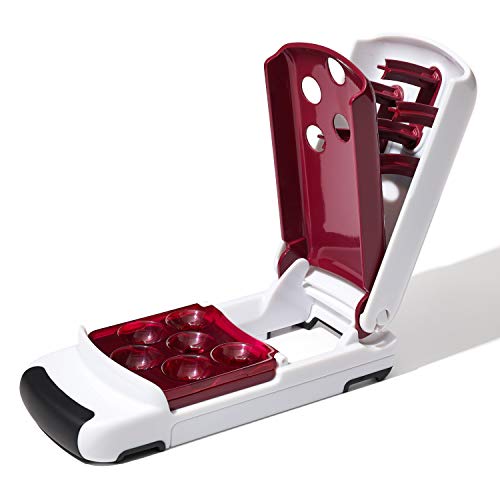
OXO does six and solves a different problem. Its base is adjustable so the whole tool sits over a range of bowl sizes, so the pitted fruit drops straight into the bowl while an accessible tray catches pits for up to a pound of cherries. That is the only capacity figure in this pool, and it is about how long you can work before emptying it.
The Two Handheld Tools
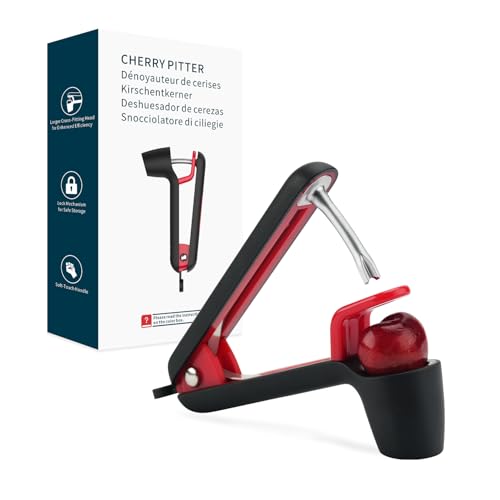
KITCHENDAO and Fanlory are one cherry at a time, and both use the same locking arrangement: press a tab to unlock, drop the cherry in the cup, press down. Fanlory publishes its size consistently, 8.07 by 1.49 by 3.14 inches in both its size field and its dimension fields, and states stainless steel with food grade silicone.
KITCHENDAO publishes no weight, and its shape reaches us only as dimension fields, 3.54 by 6.53 inches with a 0.1 inch height that cannot be the tool. It spends the listing on the working end instead: a larger cross shaped piercing head, a zinc alloy needle it says resists bending, a soft non slip TPE handle, and a safety lock for storage. Between the two, Fanlory tells you what you are getting and KITCHENDAO tells you how it works.
The Only Two Listings That Measure a Cherry
A Stated Range of Fruit Sizes
Makmzoon publishes the figure that matters most and nobody else gives: its piercing heads handle cherries from 15 mm to 25 mm. That is a real range covering small sour cherries through to large sweet ones, and it means the tool can be matched to the fruit before it arrives rather than after. It also claims a 3.86 inch wide palm press to spread the load across your hand.
The reason a range matters is that a pitter fails at both ends. Too small a cherry rattles in the cup and is pierced off center, and too large a cherry will not sit under the rod at all. Every other listing here describes its tool as suitable for cherries in all sizes, or for cherries and olives and dates, without putting a millimeter figure to any of it.
Clearance Above the Working Panel
KITCHENDAO measures the tool instead of the fruit, publishing 28 mm between the working panel and the splash shield and claiming that is 5 mm more than other products. That is the same problem from the other direction: clearance is what a large cherry needs to fit under the head. It is a comparative claim against unnamed rivals, so the 5 mm part cannot be checked, but the 28 mm can.
Put the two figures together and they roughly agree on what a large cherry is. Makmzoon tops out at 25 mm of fruit and KITCHENDAO offers 28 mm of room, which leaves a little headroom. Neither is verified here, but they are the only two numbers in this category that speak to the thing people complain about most, which is a pitter that will not take the cherries they have.
Materials, Cleaning and One Weight That Cannot Be Right
Stainless Rods, ABS Prongs and Zinc Alloy Needles
The part that pierces the fruit is where these five differ most and where two of them publish nothing. Makmzoon is stainless steel across all seven rods and Fanlory is stainless steel with silicone. KITCHENDAO uses a zinc alloy needle, stated to pierce smoothly and resist bending, which is a softer metal than steel but is cast rather than formed.
SCHVUBENR is the only pick to admit plastic on the working end, ABS prongs on a food grade plastic body, and it compensates with a two year warranty and a 720 day money back guarantee, the only refund promise in this pool. OXO never states what its pitting mechanism is made of, and two of its feature lines are cut off mid word on the listing.
An Adjustable Base and a Weight of 0.12 Pounds
OXO publishes 0.12 pounds. That is under a quarter of the 0.55 pounds SCHVUBENR publishes for a comparable multi pitter, and under half the 0.29 pounds of a single handheld tool. A device with six pitting mechanisms, a pit tray and an adjustable extending base cannot weigh less than a handheld pitter, so the figure is describing something other than the assembled tool.
Its size statements have the same trouble. The size field reads 7.8 by 3.7 by 2.5 inches, which is a sensible shape for this tool, while the dimension fields give 7.6 by 13 inches with no height at all. The size field is the one used here, and OXO’s weight is left out of every comparison on this page.
Which One Fits Your Kitchen
You want to know it fits your cherries. Makmzoon is the only pick that publishes a fruit size range, 15 mm to 25 mm, with all seven press rods in stainless steel, a 3.86 inch palm press, a built in clear pit catcher and five years of return and exchange.
Pitting straight into a mixing bowl. OXO releases up to six pitted cherries directly into a bowl, with an adjustable base that extends to fit different bowl sizes and a tray that holds pits for up to a pound of fruit, the only capacity figure here. Ignore its published weight.
You want money back if it fails in July. SCHVUBENR pits up to seven at a press with a spring loaded retractive mechanism, breaks into three pieces for washing, sits on a non slip base, and carries a two year warranty with a 720 day money back guarantee.
Large cherries and a comfortable grip. KITCHENDAO publishes 28 mm of clearance between panel and splash shield, a larger cross shaped piercing head, a zinc alloy needle and a soft TPE handle, with a safety lock for the drawer. It publishes no weight.
A small tool you can put in a bag. Fanlory is 8.07 by 1.49 by 3.14 inches and 0.29 pounds, stainless steel with food grade silicone, with a press tab lock and dishwasher safe cleaning. Its size field and its dimension fields agree exactly.
What We Could Not Verify
Six things a cherry pitter buyer would want from these listings and cannot get.
- Three of the five publish nothing about what size cherry they fit, and one of those describes itself as suitable for cherries in all sizes without a figure.
- OXO publishes 0.12 pounds for a six cherry pitter with a tray and an extending base, which is lighter than a single handheld tool here, so the figure is not credible.
- Only one listing quantifies its pit catcher, at up to a pound of cherries. The other three catchers are described as transparent or built in with no capacity.
- No listing publishes how much force a press takes, which is the difference between pitting a bowl of fruit and pitting a crate of it.
- Two of the five leave the size field empty and a third fills it with the word Multiple, and two of the dimension sets carry a 0.1 inch height that cannot be the tool.
- OXO’s feature text is cut off mid word in two places, and its dimension fields give a 13 inch figure with no height beside a size field of 7.8 by 3.7 by 2.5 inches.