How the Five Compare on the Numbers
A pour over is a recipe with a weight in it. Twenty grams of beans, three hundred grams of water, and a grinder that holds and delivers that reliably. So the specification this page turns on is the bean charge each maker publishes, and the first thing you notice is that no two of them chose the same unit to publish it in.
Across sixteen listings the bean capacity appears as grams, as ounces, as cups of brewed coffee and, on one listing, as two thirds of a cup of beans. Four of these five make a cup claim and exactly one says what a cup is. Two of them publish the same 50 gram charge and then disagree, by five cups, about what it produces.
What the table cannot tell you is how uniform any of these grinds is. Two of the five are burr grinders and three are blades, and no listing in this pool publishes a particle distribution, a burr diameter for the manual grinder, or any measurement of consistency. The words uniform and consistent appear in almost every listing and nowhere with a figure behind them.
Fifty Grams, Two Different Answers
Seven Cups or Twelve
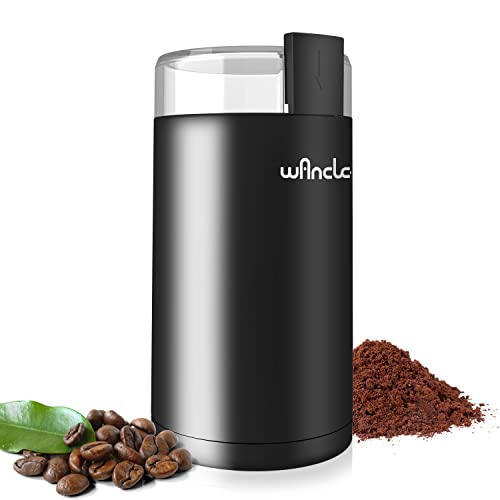
DR MILLS publishes the most careful capacity statement in this pool. Its grinding cup holds 50 grams, given also as 1.8 ounces, and the listing says that yields enough grounds to brew approximately 7 cups of coffee. It then goes further than anything else here and states that the included scoop holds approximately 5 grams, or 0.18 ounces, of beans per scoop.
Secura publishes the same bean figure and a very different outcome. Its final bullet describes a compact 50 gram size that makes enough for 12 cups. Both listings are describing a blade grinder with a stainless bowl, both are quoting a bean weight in grams, and their brewed claims differ by five cups. Nothing in either listing reconciles them, so this page reports both.
The One Listing That Defines a Cup
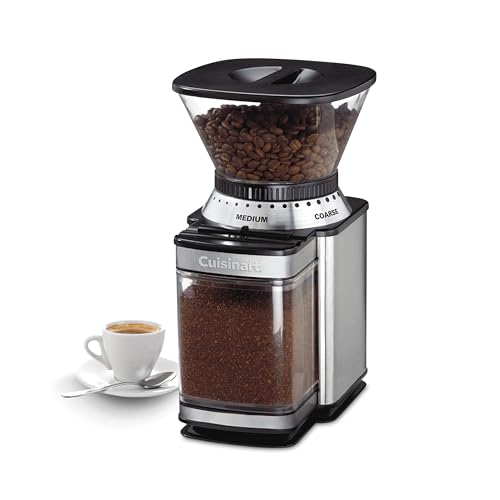
Cuisinart solves the problem by refusing to leave the unit vague. Its grind chamber bullet states the chamber holds enough ground coffee for 4 to 18 cups, and then adds, in its own asterisked note, that a cup equals approximately 5 ounces and varies by brewing technique. That is the only definition of a cup anywhere on this fact sheet of sixteen listings.
It matters because four of these five make a cup claim. Once you know one maker means roughly 5 ounces, the 7 cup and 12 cup claims from the same 50 grams become readable as two different assumptions rather than as a contradiction about the coffee. What they are not is comparable, and no listing except Cuisinart gives you what you need to compare them.
What a Pour Over Dose Actually Needs
Grams Are the Only Useful Unit
A pour over recipe is written in grams, which makes two of these five directly usable and three a conversion problem. KINGrinder publishes a hopper volume of 25 to 35 grams, which is a single generous pour over in one fill and nothing wasted. DR MILLS publishes 50 grams with a 5 gram scoop, so a 20 gram dose is four scoops without a scale.
KRUPS publishes 3 ounces and Cuisinart 8 ounces, both with no gram equivalent, and both of those figures describe a hopper or bowl rather than a dose. Neither is a bad specification; both are simply in the wrong unit for the brew method this page is about, and converting a volume of whole beans to a weight needs a density nobody publishes.
Adjustment by the Micron
Pour over wants a repeatable medium grind, and only one listing in this pool publishes the resolution to deliver one. KINGrinder states 16 microns per click, with 60 clicks per rotation of the external adjustment nut and up to 4 full rotations of travel. That is a coordinate you can write down, and it is a manual grinder with a stainless burr set and dual bearings.
Cuisinart’s 18 position slide dial from ultra fine to extra coarse is the electric equivalent, and it is a count rather than a measurement. The three blade grinders publish no setting at all: DR MILLS says hold the button, Secura says pulse it, KRUPS says adjust grind time and names pour over while doing so. That is a technique instruction standing in for a specification.
Figures That Do Not Describe the Grinder
A Hand Grinder Measured at Under Three Inches
KINGrinder’s published dimension fields read 0.81 by 0.85 by 2.63 inches. A manual grinder with a 25 to 35 gram hopper, a burr set, dual bearings and a straight handle is not an object that size. Its size field is no more help, reading 7×11 with no unit attached at all, and no weight is published anywhere in the listing.
So this pick earns its place on adjustment detail and capacity, and its size is simply unknown here. That is worth stating plainly rather than dressing up, because a hand grinder’s real dimensions matter to anyone choosing one for a small kitchen, and the listing that publishes microns per click does not publish how long the thing is.
Cups of Beans and a Weight That Cannot Be
The wider fact sheet has the same trouble in other forms. One listing publishes its bean capacity as two thirds of a cup, which is a volume of whole beans and the fourth unit this specification appears in. Several listings publish only a brewed cup range, with no bean figure of any kind to dose against.
An AROMA listing publishes a weight field that the sheet itself flags as too light for the body size beside it, so that figure cannot be the machine. Its stated 40 gram capacity is perfectly usable; the weight field is not, and a page that ranked on weight would have put it first. That is one reason this page ranks on the bean charge instead.
Which One Fits Your Kitchen
The brewer who wants to dose without a scale. DR MILLS publishes a 50 gram cup, 1.8 ounces, with a scoop stated at about 5 grams, so four scoops is roughly a pour over. A 150 watt motor, SUS304 blades and cup, cord storage, and a stated limit of under 30 seconds a cycle.
The early riser in a shared home. Secura publishes 63 decibels average, the only noise figure in this pool, on a 50 gram stainless blade grinder with pulse control, a lid interlock and an anti splash design. Fields of 3.6 by 3.7 by 6.9 inches at 1.72 pounds. Its 12 cup claim from 50 grams is the outlier here.
The kitchen that washes everything. KRUPS publishes a 3 ounce bowl for up to 12 cups, a 175 watt motor, and a removable stainless grinding bowl stated dishwasher safe with a storage lid supplied. Fields of 4.02 by 4.33 by 8.46 inches at 2.43 pounds. It names pour over and tells you to adjust by time.
The brewer who wants the same grind every day. KINGrinder publishes 16 microns a click, 60 clicks a rotation and 4 rotations of travel, on a stainless burr set with a 25 to 35 gram hopper that dismantles by hand. No weight is published and its dimension fields cannot be the product.
The household brewing for several people. Cuisinart publishes an 8 ounce hopper, a grind chamber for 4 to 18 cups, an 18 position dial, and the only definition of a cup in this pool at approximately 5 ounces. Hopper, bean chamber and grind chamber all remove. Heaviest of the four here that publish a weight, at 4.5 pounds.
What We Could Not Verify
Everything above comes from the makers’ own listings. These are the things a pour over brewer needs and the published data does not supply.
- DR MILLS claims about 7 cups from 50 grams and Secura claims 12 from the same 50 grams, and neither says what a cup is.
- Only Cuisinart defines a cup, at approximately 5 ounces, so every other brewed cup claim in this pool is an undefined unit.
- KRUPS and Cuisinart publish capacity in ounces with no gram equivalent, which is the unit a pour over recipe is written in.
- KINGrinder publishes no weight, and its dimension fields of 0.81 by 0.85 by 2.63 inches cannot be a hand grinder with a 25 to 35 gram hopper.
- No listing in this pool publishes a burr diameter for the manual grinder or any measure of grind uniformity, despite every listing using the word.
- Only DR MILLS publishes a run time limit, so how long the other electric grinders may be held down before the motor objects is unstated.