How the Five Compare on the Numbers
Sixteen pod organizers sit on this page’s fact sheet, and the five below were chosen on one test: can a shelf close over it. The ones left off are counter furniture, including an open coffee bar station and revolving carousels that have to be looked down into, and a cabinet shelf takes away the one thing each of those needs. What remains is three drawers, a basket and one carousel.
What decides this page is the pair of figures a cabinet fixes for you: how tall the organizer is and how wide. The spread is extreme. Mind Reader publishes 2.5 in of height and EVERIE 2.7 in, both low enough to disappear onto a shelf. BLACKSMITH publishes 13.13 in, which is taller than most shelf gaps. Only two of the five mention a cabinet at all.
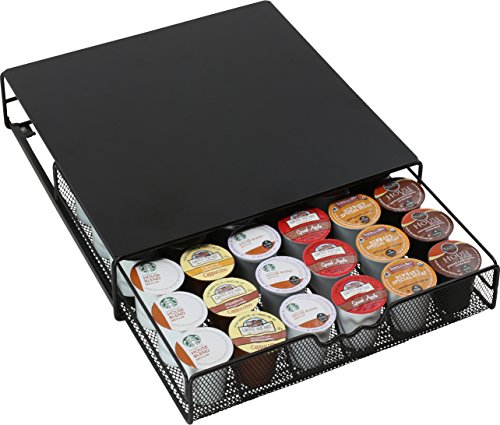
Two of these five publish their size twice and the two readings do not match. Deco Brothers has fields of 12.5 by 13.2 by 3.1 in and a bullet giving 13 by 13.25 by 3.25 in. Mind Reader has fields of 10.55 by 12.6 by 2.5 in and a bullet giving 10.5 by 12.75 by 2.5 in. Where they disagree this page uses the maker’s own sentence, which is the larger figure in both cases, because a shelf that fits the smaller reading and not the larger one is a returned parcel. The table cannot tell you how much clearance a drawer needs in front of it to open, which on a cabinet shelf is a separate measurement nobody publishes.
The Two Figures a Cabinet Actually Limits
Height Is the Figure That Rules Things Out
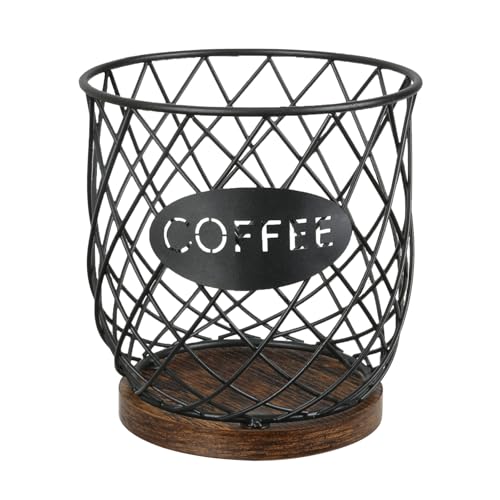
A cabinet shelf gap does not negotiate. Mind Reader publishes 2.5 in of height and EVERIE 2.7 in, and either will slide onto almost any shelf with room to spare above. Deco Brothers publishes 3.25 in in its own words. YINMIT publishes 7 in, which still fits a standard shelf but fills it. BLACKSMITH publishes 13.13 in, and that is a counter product being considered for a cabinet it will not enter.
That spread is the whole page. The difference between 2.5 in and 13.13 in is not a refinement, it is two different answers to where coffee pods live. A drawer style organizer is designed to be slid under something, which makes a low profile the point rather than a compromise. A carousel is designed to be looked at, which makes height cheap for the maker and expensive for a cabinet.
Width, Depth and the Door Opening
BLACKSMITH publishes a 6.13 in base and calls it out directly, describing a small footprint of 6-1/8 in by 6-1/8 in and claiming it takes less space than most carousels. YINMIT publishes 6.7 in across. Those two are the ones that pass through a narrow opening. EVERIE publishes 7.2 in of width against 13 in front to back, so it enters a cabinet narrow edge first and then needs the depth behind it.
The two wide drawers are a different problem. Deco Brothers gives 13.25 in by 13 in in its own bullet and Mind Reader gives 12.75 in by 10.5 in. Both will sit on a deep shelf and neither will go through a narrow face frame opening without being turned, and a drawer that has to be turned to get in is a drawer that cannot be opened once it is there.
Where the Fields and the Makers Disagree
Two Listings Publish Two Different Sizes
Deco Brothers publishes 12.5 by 13.2 by 3.1 in in its dimension fields and 13 by 13.25 by 3.25 in in a feature bullet. Mind Reader publishes 10.55 by 12.6 by 2.5 in in its fields and 10.5 by 12.75 by 2.5 in in its own sentence, and also gives a metric conversion of 32.39 by 26.67 by 6.35 cm. Neither gap is large, and on a cabinet shelf a fifth of an inch is sometimes the whole margin.
This page uses the maker’s sentence in both cases, which happens to be the larger reading each time. That is the safer direction: an organizer that turns out to be smaller than planned still fits, and one that turns out larger does not. Anyone measuring a real shelf should work from 13.25 in for the Deco Brothers drawer and 12.75 in for the Mind Reader, and treat the field values as the optimistic version.
The Weight Field and the Weight in the Bullet
Mind Reader is the only pick here where the weight is published twice as well. Its field reads 2.18 lb and its own bullet reads 2.36 lb alongside a metric 1.07 kg. The bullet wins for the same reason the dimensions do. EVERIE publishes 1.74 lb, YINMIT 1.5 lb, the lightest published weight here, BLACKSMITH 2.6 lb, and Deco Brothers 4 lb, the heaviest here.
One figure on this page is not a weight at all and it is worth flagging. EVERIE states that its ABS body supports up to 40 lbs so a coffee machine can stand on it. That is a load rating for the lid, not the mass of the organizer, and BLACKSMITH separately states a capacity of 40 pods. Two unrelated forties in one pool is exactly the kind of thing that ends up in the wrong column.
What You Give Up Inside a Cabinet
Capacity Against the Space It Takes
The low profile picks hold the least. EVERIE holds 18 pods in three sections of six at 2.7 in of height. Mind Reader holds 30 in five fixed rows at 2.5 in. Deco Brothers holds 36 in one drawer at 3.25 in in its own words, which is the best capacity to height ratio among the drawers. YINMIT holds 35 in an open basket 7 in high, and BLACKSMITH holds 40 at 13.13 in.
Read as a column of numbers that looks like a straight trade, and it is not quite. Deco Brothers holds twice what EVERIE does at barely half an inch more height, because it spends its capacity on width instead, 13.25 in of it. In a cabinet, width is usually the cheaper of the two to give up, which makes the 13.25 in drawer the better cabinet buy rather than the worse one.
Reaching the Pods With a Shelf Above
This is where the form matters more than any figure. A drawer works with a shelf directly above it, because everything comes out horizontally: EVERIE, Mind Reader and Deco Brothers all describe a drawer sliding in and out. An open basket needs headroom to reach down into, so YINMIT’s 7 in of height is really 7 in plus a hand. A carousel needs to be spun and looked down on, which a cabinet makes impossible.
None of the five publishes the clearance a drawer needs in front of it to open fully, and on a cabinet shelf that is a real measurement: a 13 in deep drawer pulled out to reach the back row wants most of that 13 in in front of it. EVERIE comes closest by stating that the drawer slides freely even with a machine sitting on top, which is a statement about load rather than about reach.
Which One Fits Your Kitchen
A cabinet shelf under a small brewer. EVERIE, at 2.7 in of height and 7.2 in of width, the only pick stating outright that it fits in kitchen cabinets, holding 18 pods in three sections of six and rated to carry 40 lbs on top.
Somebody who wants to be told to measure. Mind Reader, at 2.5 in of height and, in the maker’s own words, 12.75 in by 10.5 in. It holds 30 pods in five rows with 2 in spacing and explicitly advises checking vertical clearance first.
The most pods per inch of shelf height. Deco Brothers, holding 36 pods in one drawer at 3.25 in of height in its own bullet, with rubber feet and a claim to slide under most Keurig makers. It publishes 4 lb, the heaviest here.
A short shelf with a narrow opening. YINMIT, at 6.7 in across and 7 in of height, holding 35 pods in an open iron wire basket with wood panels. At 1.5 lb it is the lightest published weight on this page.
A counter beside the cabinet instead. BLACKSMITH FAMILY, whose base is 6.13 in square against YINMIT’s 6.7 in, but whose 13.13 in of height rules out most shelves. It holds 40 pods on a base that spins 360 degrees.
What We Could Not Verify
Every figure above comes from the maker’s own listing text. These are the things we went looking for and could not source in any of them.
- No listing publishes the clearance a drawer needs in front of it to open fully, which on a cabinet shelf is a separate measurement from the depth.
- Only EVERIE and Mind Reader mention a cabinet at all, so three of the five give a buyer no guidance on the use this page is about.
- Deco Brothers and Mind Reader each publish two different sizes, and neither says which reading is the product, so the larger one had to be assumed.
- No listing states whether the pods have to be the standard K-Cup shape, so the stated capacities cannot be checked against a deeper espresso pod.
- Only EVERIE publishes a load rating, so the other four cannot be compared on whether a brewer may stand on them even where the listing suggests it.
- YINMIT publishes a diameter and a height but no clearance for reaching into an open basket, which is what a shelf above it actually consumes.