How the Five Compare on the Numbers
Food safe is a phrase anybody can print. What separates these five is the kind of evidence each maker is willing to put behind it. One names a standards body. One states outright that the plastic is safe for direct food contact and then names two different plastics in two different bullets. One rates the polymer against heat and chemicals instead. One claims the surface releases nothing. One prints the alloy and says nothing about food at all.
Rubbermaid publishes break resistant polycarbonate and NSF Certified. TCP Global publishes BPA free food grade polypropylene and the words safe for direct food contact. Groz publishes food grade clear polypropylene rated to 250 degrees F. Anchor Hocking publishes hardened soda lime glass and a surface stated not to release harmful substances. KSENDALO publishes the grade and leaves the food question alone.
What the table cannot tell you is which of these is actually safer, because only one listing points at anybody outside itself. NSF Certified is a claim a reader can go and check. BPA free is a claim about one substance among many. A surface that does not release harmful substances names no substance at all. And an alloy number is a specification about steel rather than about food. Three of the five publish no dimension fields either, so three of these jugs cannot be planned against a shelf.
The One Certification on This Page
Rubbermaid Names a Standards Body
Rubbermaid is the only pick here that cites anything outside its own copy. Its listing ends with NSF Certified, and the durability bullet states break resistant polycarbonate that withstands drops and spills and is commercial dishwasher safe. That is a different order of evidence from a phrase: a certification is a thing a buyer can look up, and nothing else on this page offers one.
It is also the only pick that publishes a full temperature range rather than a ceiling, a versatile -40 to 212 degrees Fahrenheit, and one of only two that publish dimension fields, at 6.75 x 7.75 x 9.5 in. It publishes 1.0 lb and a 16 cup capacity stated also as 4 qt, against 64 oz for KSENDALO, 32 oz for Groz and 150 ml for Anchor Hocking.
What It Will Not Say
What it never states is anything about a substance. Polycarbonate is named as the material and the listing makes no BPA statement either way, where TCP Global states BPA free in plain words. A reader who came to this question because of one specific chemical will not find it answered here, and the certification does not answer it in their place: the two claims are about different things and this page does not pretend otherwise.
It is also silent on how the scale is applied. The visibility bullet states clear construction for superior measurement visibility and never says whether the graduations are molded, printed, etched or embossed, which is the one detail that decides whether a scale survives a dishwasher. Three of these five publish that detail and Rubbermaid, the pick cleared for a commercial dishwasher, is not one of them.
Two Polypropylene Jugs, Two Different Arguments
TCP Global States Direct Food Contact
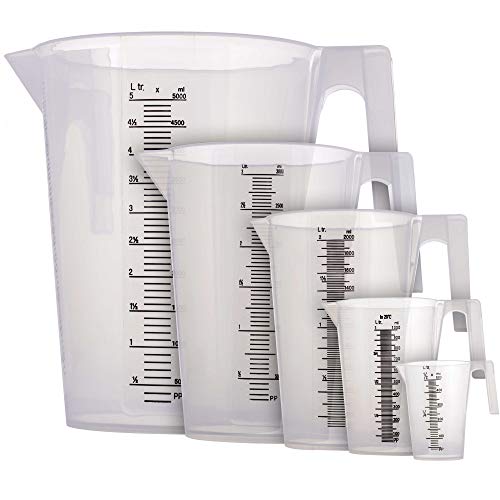
TCP Global makes the most explicit food claim on the page. Its material bullet states that the pitchers are made with BPA free, food grade polypropylene plastic, so they are safe for direct food contact and for use in the kitchen for mixing and measuring wet or dry ingredients. Nothing else here says direct food contact. It arrives as five vessels of 500, 1000, 2000, 3000 and 5000 ml, at 1.98 lb for the set.
The problem is two bullets up. The chemical resistance bullet states that the durable PET plastic has a high chemical resistance to a wide variety of chemicals, which names a different polymer for the same five jugs. One listing, two materials, no explanation of which bullet describes the vessel you receive. This page reports both and builds nothing on either, because a material claim that contradicts itself cannot anchor a comparison.
Groz Rates the Material Instead
Groz answers the question with a number. Its build bullet states that the jug is molded from food grade clear polypropylene that stands up to acids, bases and solvents, and holds shape in microwaves and autoclaves up to 250 degrees F, which it also gives as 121 C. An autoclave permission is a stronger statement about a polymer than any adjective, because it describes steam under pressure rather than a warm sink.
It names no substance it excludes and no certification, and it publishes no dimension fields at all, only 32 oz and 0.22 lb, the lowest published weight among these five. The listing states the jug is engineered to nest and stack on shelves and benches, so the thing a reader most needs to check that claim, a height and a diameter, is the thing the listing does not give.
Glass and Steel, Each Answering Differently
Anchor Hocking Claims the Surface Releases Nothing
Anchor Hocking is the only pick that is not plastic or steel, and its material bullet is specific: hardened soda lime glass, stated particularly stable and durable in daily use, which does not absorb odors or taste and does not change color. Naming soda lime glass rather than writing glass is the same kind of precision as naming a polymer, and it is the only pick that identifies its material by composition.
Its care bullet carries the release claim: the smooth glass surface does not release harmful substances, leaves no residue and can be cleaned by hand or in the dishwasher. No substance is named, so this is a claim in the same family as food grade rather than in the family of BPA free. It publishes 2.25 x 3.5 x 2.25 in, 0.25 lb, and a 150 ml capacity its own last bullet restates as 5 ounces.
KSENDALO Prints the Grade and Stops
KSENDALO publishes a material specification and no food claim whatsoever. The words food grade and food safe do not appear. What appears instead is a grade, twice and not identically: the title states SUS304 and the first bullet states sturdy 18/10 stainless steel with embossed measurement markings inside the cup. Those are two different descriptions of a steel in one listing, and the page reports them as published rather than choosing between them.
The rest is the most generous policy here. It publishes a lifetime warranty with no hassle free replacement, which no other pick on this page publishes at all, plus dishwasher permission and the only graduation interval stated on this page, at 100 ml. Its own third bullet then offers a choice of 500, 1000 and 1500 ml on a jug the title sells as 2 liter, so the sizes it names are not the size it is.
Which One Fits Your Kitchen
You want evidence you can check yourself. Rubbermaid publishes NSF Certified alongside break resistant polycarbonate, -40 to 212 degrees Fahrenheit and commercial dishwasher permission. At 16 cup and 1.0 lb it is the one vessel here sized for a whole batch of batter.
You want the words food contact in writing. TCP Global states BPA free food grade polypropylene safe for direct food contact, across five jugs of 500 to 5000 ml at 1.98 lb for the set. Read its chemical bullet too, which names PET instead.
You want the polymer rated rather than described. Groz states food grade clear polypropylene that holds shape in a microwave and an autoclave to 250 degrees F and resists acids, bases and solvents. At 0.22 lb and 32 oz it is the lightest published pick here.
You do not want plastic at all. Anchor Hocking publishes hardened soda lime glass with a surface stated not to release harmful substances, at 150 ml, 0.25 lb and 2.25 x 3.5 x 2.25 in. It is a small vessel for finishing liquids rather than mixing a batch.
You want steel and a warranty. KSENDALO publishes SUS304 in its title and 18/10 stainless in its bullet, 64 oz, 1.43 lb, embossed interior marks from 100 ml and a lifetime free replacement warranty. It makes no food safety claim at all.
What We Could Not Verify
Six things a reader buying on material would want, and no listing among these five supplies.
- Which material the TCP Global jugs are actually made of, since one bullet names polypropylene and another names PET.
- Whether the KSENDALO steel is the SUS304 of its title or the 18/10 of its first bullet.
- Any named substance behind the Anchor Hocking claim that the surface does not release harmful substances.
- Any BPA statement from Rubbermaid, Groz, Anchor Hocking or KSENDALO, where TCP Global states BPA free.
- A dimension figure for Groz, TCP Global or KSENDALO, where Rubbermaid publishes 6.75 x 7.75 x 9.5 in.
- How the Rubbermaid scale is applied, on the one pick cleared for a commercial dishwasher.