How the Five Compare on the Numbers
Six live pages already sort this pool by aperture and thickness, by footprint, by cleaning method, by what the box holds and by published weight. Not one of them asks what the steel is. On a station several people share, where a screen gets lifted hot, rinsed in a hurry and sometimes put in a machine, the alloy is the specification that decides how long it stays flat and unstained.
Three grades are named across these five and one listing names none. MEET GREAT publishes 316L, the only L grade in the whole pool. HOUTRIDA and DRMBIGA publish 316. NVAAV publishes 304. SiliFine publishes food-grade stainless steel and stops there, which on a set of five screens and a walnut stand is the one figure you cannot look up.
What the table cannot tell you is whether any of these grade claims has been tested, because none of the five publishes a corrosion test, a shot count backed by a method, or a thickness tolerance. HOUTRIDA is the only listing that puts a number on longevity at all, and it is written as more than 500 shots rather than as a measured figure.
What the Grade Numbers Actually Claim
316, 316L and 304 Are Not Marketing Tiers
These are three different alloys and the listings treat them as a ladder. HOUTRIDA states that its 316 is far more corrosion-resistant than ordinary 304. YLAOSIOA, elsewhere in this pool, calls 316 upgraded from standard 304. MEET GREAT states 316L and describes it as high temperature resistant and not easy to corrode. NVAAV states 304 and calls it premium food-grade without comparing it to anything.
Only one of those four sentences is a comparison you can check against the other listings, and it is the one disparaging a grade that two products in this pool are made from. Nobody publishes what the difference amounts to in a home machine, at nine bars, with a screen rinsed daily. The grade is real information. The ranking built on top of it is the makers’ own.
The Listing That Names No Grade
SiliFine publishes five screens, a four-slot walnut stand measured in both centimeters and inches, a thickness of 1.7 mm and a 150 μM mesh. It never says which stainless steel. On a five-piece set that is a strange omission, because the stand dimensions are given to two decimal places while the alloy, which is the only part that meets hot acidic coffee, is left as stainless steel.
That set also publishes five screens and a stand with four slots, so one screen has nowhere to sit. It is a small thing, but it is the kind of small thing that tells you how carefully the rest of the listing was written. Read against MEET GREAT, which names 316L and publishes no dimensions at all, the two listings are incomplete in opposite directions.
Where These Listings Contradict Themselves
HOUTRIDA Publishes Two Diameters
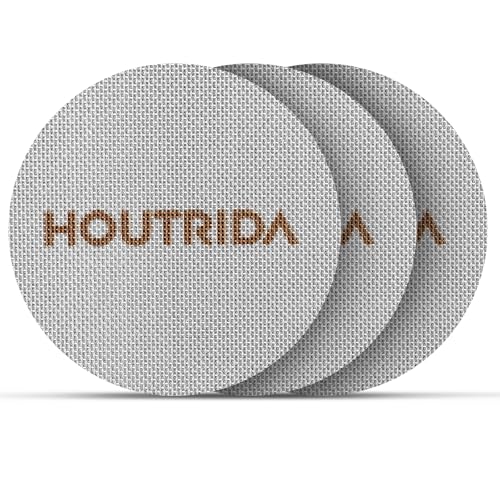
Its title says 53.3mm. Its first bullet says three 53.5mm espresso puck screens, its second calls it a 53.5mm portafilter puck screen, and its third gives 1.7mm thick steel with a 150μm mesh. A puck screen is chosen by diameter to the tenth of a millimeter, so a listing that publishes both 53.3mm and 53.5mm has not answered the only sizing question that matters.
I have given both figures in the table rather than picking one, because the listing gives no basis for choosing. SiliFine states 53.5 mm and nothing in its text conflicts with that, so the two sizes do both exist in this pool. If your portafilter is tight, the safer reading of HOUTRIDA is the larger figure, since that is the one written twice.
Three Millimeter Figures on One Screen
DRMBIGA publishes an advanced 1.2mm aperture design, an ultra-fine 0.15mm mesh layer and reinforced 0.8mm edges, all in the same listing, and its size field reads 53.3MM/0.8MM. Three of those numbers are millimeters describing three different things: a hole, a second finer layer and the rim. None of them is the overall thickness of the assembled screen.
The 0.15mm figure is worth pausing on, because it is 150μm written in millimeters, which is the same aperture MEET GREAT, HOUTRIDA and SiliFine all publish in microns. So four of these five screens may filter to the same fineness while only one of them says so in units you can compare at a glance. DRMBIGA’s title compounds it by saying 54mm, which is the portafilter and not the screen.
Living With Them on a Shared Bench
Getting a Hot Screen Out
NVAAV is the only one of the five to publish a solution. It includes a sapele wood magnetic handle and tells you to wait five to seven seconds after removing the portafilter before lifting the screen out with it. Nothing else here publishes a handle, a tool or a warning about heat, and a screen sits directly under the group at brew temperature.
That matters more on a family station than in a single-user setup, because the person clearing up is often not the person who pulled the shot. MEET GREAT, HOUTRIDA, DRMBIGA and SiliFine all describe rinsing and none describes retrieval. The pool’s wider listings show the same split: magnetic pickup tools appear in the multi-piece kits and nowhere else.
Cleaning Claims That Are Not Equivalent
NVAAV is also the only one of the five to state dishwasher safe. HOUTRIDA goes furthest the other way, naming a rinse, a steam wand or Cafiza for a deeper clean. MEET GREAT names water and the steam wand. SiliFine names warm water after each use. DRMBIGA says only to rinse with water and let it dry.
A screen that goes through a dishwasher is a screen that survives a shared kitchen, and it is the 304 one that claims it. That inverts the grade ladder the other listings imply, which is the most useful contradiction on this page: the alloy the pool treats as the lower tier carries the most demanding cleaning claim of the five.
Which One Fits Your Kitchen
The station where nobody babies the equipment. NVAAV. It is the only one of these five stated dishwasher safe, the only one with a magnetic wooden handle for lifting a hot screen, and it publishes 0.8mm and 304 steel.
The cook who wants the best alloy claim. MEET GREAT. It publishes 316L, the only L grade in the pool, with 1.7mm thickness and a 150μm mesh, and it warns about protruding screws on the brew head.
The bench that needs spares in rotation. HOUTRIDA. Three screens per set at 1.7mm and 150μm, with rinse, steam wand and Cafiza all named, though its title and bullets disagree on diameter.
The setup where headroom above the puck is tight. DRMBIGA. It publishes 0.8mm reinforced edges instead of 1.7mm, plus a dual construction with a 1.2mm aperture layer and a 0.15mm mesh layer.
The station that wants everything on a stand. SiliFine. Five screens at 1.7 mm and 150 μM with a walnut stand published at 2.44 x 1.2 x 1.2 inch, if you can accept a listing that never names the steel.
What We Could Not Verify
All of the above is from the makers’ own listings. These six things I looked for and none of these five publishes.
- Any steel grade for SiliFine, which says only food-grade stainless steel.
- Any mesh aperture for NVAAV, the only pick with no filtration figure.
- Which of HOUTRIDA’s two published diameters, 53.3mm or 53.5mm, is correct.
- The overall assembled thickness of DRMBIGA, whose three millimeter figures describe other things.
- Any weight for MEET GREAT, in a field or a bullet.
- Any test behind the corrosion and longevity claims, including HOUTRIDA’s 500 shots.