How the Five Compare on the Numbers
Eight products came up under this search and one of them is a spoon. The zhuohai listing is a 2 in 1 stainless measuring spoon with a rounded bottom said to press coffee, and it is not a tamper: it publishes no base diameter that matches a portafilter basket, and nothing at all about applying even pressure across a coffee bed. Two more were left out: the WYLOSUA duplicates the Maclia position with less published, and the Y-Step is a second 30 pound kit with no dimensions and no weight at all.
What separates the five that remain is whether the pressure comes from a spring or from your arm. Normcore, Apexstone and Reoszeank are spring loaded. Maclia and Ezebesta are flat plates you push. Only two of the three spring tampers publish the pressure they hold, which on a calibrated tool is the entire specification.
What the table cannot give you is the one number a tamper buyer most wants from a manual tamper: how hard to press. Maclia and Ezebesta both describe an even, dense puck and neither states a target, because a flat plate cannot enforce one. The three spring tampers can, and only two of them say what it is, so on this page the pressure column has two real figures and three blanks of different kinds.
Spring Loaded, and What Calibrated Actually Promises
Three Springs Against One Fixed Setting
Normcore is the only tamper here that lets you change the pressure. It ships with 15, 25 and 30 pound springs and the listing says to swap them for different beans, grind sizes and roast levels. That is a workflow claim rather than a comfort claim, and it is the reason this tamper costs more attention than the rest of the page.
Reoszeank fixes its spring at 30 pounds, which is the top of Normcore’s range, and describes it as applying consistent pressure to pre-leveled grounds. Both are honest positions. One says pick your force, the other says here is the force most people want. Neither claim can be checked from a listing, but both are at least stated.
The Calibrated Tamper That Publishes No Calibration
Apexstone calls itself a calibrated spring loaded 51mm tamper in its own title and never states the pressure the spring holds. Its bullets give the base diameter, the steel grade, the height as 3-1/2 inch, a weight of about 0.66 pounds, a cleaning method and a warranty, and no pound figure for the tamp.
That is the gap worth knowing before buying. Calibrated means repeatable, not correct: a spring that returns the same pressure every time is useful even if you do not know what that pressure is, but you cannot match it to a recipe or compare it with the 30 pound tampers on this page. The word is doing work the listing does not back.
Fitting the Basket You Actually Own
51 mm, 53.3 mm and a Tamper With Two Ends
Three of these five are 51 millimeter tampers: Apexstone, Reoszeank and Maclia. Normcore is 53.3 millimeters and its listing explains why, because it is built for Breville and Sage 54 millimeter portafilters and names six machines by model. Ezebesta takes the other approach and puts 51 millimeters on one end and 58 on the other.
Only two listings name a machine. Normcore names the Barista Express, Pro, Touch, Bambino Plus, Infuser and Duo-Temp Pro. Reoszeank names Delonghi, CASABREWS CM5418 and 3700, and atatix. The other three publish a diameter and leave you to measure, and the two listings this page did not pick, the WYLOSUA and the Y-Step, are the ones that say in as many words to check the basket first.
The Dual Ended Compromise
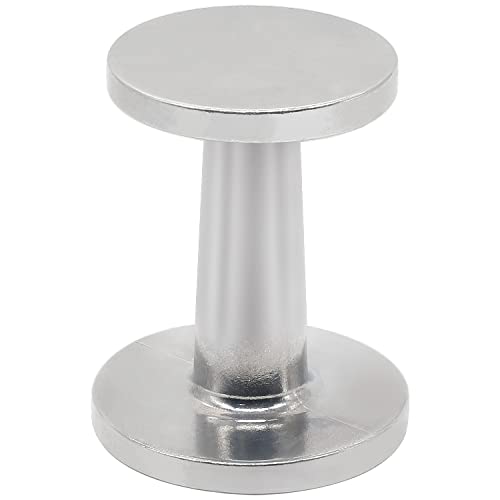
Ezebesta covers 51 and 58 millimeters with one tool and is the lightest of the five at 0.28 pounds. Its trade is that neither end has a handle: the body is cast aluminum alloy, and the end you are not using is what you hold. The listing makes a point of having no chemical coating, which it says resists the acids in coffee.
It is also the only tamper here that rules out a dishwasher in writing, asking for a hand wash and a thorough dry. For an uncoated aluminum alloy that is consistent rather than restrictive, and it pairs with a lifetime satisfaction guarantee, the longest commitment anyone on this page makes.
Where the Published Figures Break Down
Normcore’s Fields Are Millimeters and Grams
Normcore’s dimension fields read 53.3 by 53.3 by 97.0 and its weight field reads 396. Those are not inches and pounds. The 53.3 is the base diameter in millimeters, quoted correctly in the title, the 97 is a height in millimeters, and the 396 is a mass in grams. Read as inches and pounds they describe an object just over 8 feet tall.
So no weight comparison can include this tamper, and nothing on this page is called the heaviest, because the only figure that would win is in the wrong unit. The maker’s own bullets give a usable figure instead, the 15 pound spring, which is about force and not mass. The other four publish fields that behave.
Apexstone Disagrees With Itself by a Small Margin
Apexstone’s weight field says 0.62 pounds and its own third bullet says about 0.66 pounds. The word about is doing the work there, and the maker’s sentence is the one to trust because it is the only place the figure is explained. The same bullet gives the height as 3-1/2 inch, which matches its 3.5 inch field exactly.
Reoszeank’s fields are a different problem: 3.15 by 4.72 by 1.57 inches describes a kit containing a distributor, a tamper and a dosing funnel, so none of those three numbers is the tamper. It publishes no weight at all, which leaves three of the five with a figure you can hold up against another.
Which One Fits Your Kitchen
A Breville or Sage machine and a recipe you are tuning. Normcore is 53.3 millimeters for 54 millimeter portafilters, with 15, 25 and 30 pound springs, a self leveling guide and a stand. Ignore its dimension fields entirely: they are millimeters and grams in inch and pound slots.
A 51 millimeter basket and a want for repeatability. Apexstone is spring loaded 304 stainless, 3-1/2 inch tall, about 0.66 pounds, taking apart for cleaning with a one year warranty behind it. It never states its pressure, so treat it as consistent rather than as a known force.
Leveling the grounds before pressing them. Reoszeank is the only pick that arrives with a distributor and a magnetic dosing funnel alongside a 30 pound calibrated tamper, and the only one naming Delonghi and CASABREWS machines. Its published dimensions describe the whole kit.
A tamper that takes apart in the sink. Maclia is a manual 51 millimeter flat base with a waxed solid wood handle that unscrews from the base, so both pieces wash separately. At 0.43 pounds with a 3.15 inch height it is the plainest tool here and the easiest to keep clean.
Two machines, or a machine you are about to change. Ezebesta puts 51 millimeters on one end and 58 on the other in uncoated cast aluminum alloy, at 0.28 pounds, the lightest of the five. Hand wash only, and a lifetime satisfaction guarantee stated on the listing.
What We Could Not Verify
Every figure above comes from the makers’ own listings. These are the things we went looking for and could not source.
- Apexstone calls itself calibrated and publishes no pressure figure, so what its spring holds is unknown.
- Normcore’s dimension and weight fields are millimeters and grams, so it cannot take part in any weight comparison here.
- Reoszeank publishes no weight, and its dimension fields describe the kit rather than the tamper inside it.
- No listing states a base thickness or how flat the base is machined, which is what a flat tamper is actually judged on.
- Only Normcore says its springs can be swapped. No other listing says whether a spring can be replaced when it tires.
- Three of the five name no espresso machine at all, so fitment rests on you measuring your own portafilter.