How the Five Compare on the Numbers
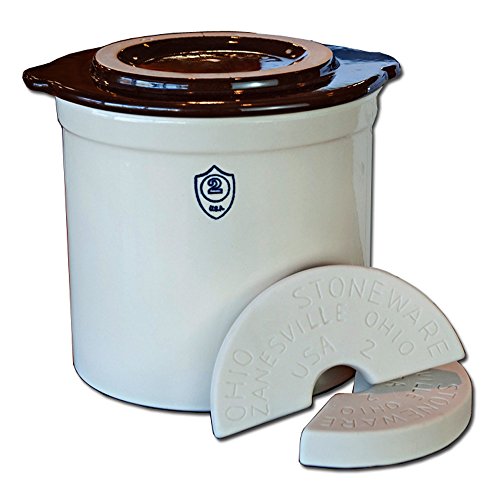
Capacity is the first number that separates these five. The Kenley is published as holding up to 3.2 pounds of vegetables in a 1/2 gallon vessel. The Mojoberry is 7 liters, or 1.8 gallons. The Seeutek is 5 liters, or 1.3 gallons. The Ohio Stoneware kit is 2 gallons. The Folinstall set is two jars of 1.5 gallons each. Only the Kenley listing converts capacity into a weight of vegetables.
Weight and dimensions are published unevenly. The Ohio Stoneware kit is 22.05 pounds, the Folinstall is 11.13 pounds, the Seeutek is 10.6 pounds and the Kenley is 4.5 pounds. The Mojoberry does not publish a weight. Heights run from 11 inches for the Mojoberry to 12 inches for the Kenley, with the Seeutek at 11.82 inches and the Folinstall at 11.8 inches.
The table does not tell you how any of these vessels performs. Nobody at Lush has used them, and the listings do not publish fermentation times, brine ratios or temperature ranges. It also does not tell you whether a weight fits a given crock, because only the Folinstall publishes a mouth opening. Treat the numbers as fit and capacity figures, not as results.
Capacity and Batch Size
What each published capacity means in practice
The Kenley is the smallest pick at 1/2 gallon, and its listing is the only one that states a vegetable weight: up to 3.2 pounds. That makes it the pick for a first batch or a single jar of kimchi. The Mojoberry at 7 liters, or 1.8 gallons, is the largest of the three water seal crocks, and its listing describes 5 to 7 whole heads of cabbage and up to 12 jars of sauerkraut or kimchi per batch. Those are the maker’s stated yields, not measured results.
The Seeutek at 5 liters sits between the two. The Ohio Stoneware kit is 2 gallons, the largest published capacity of the five, though its listing describes no seal. The Folinstall set is different in shape: two jars of 1.5 gallons each, so the total is 3 gallons across two vessels rather than one. Two smaller vessels let you run two recipes at once, which one large crock cannot do.
Matching capacity to how often you ferment
If you ferment once or twice a season, the Kenley’s 1/2 gallon is the smallest commitment and the lightest to move at 4.5 pounds. If you want a standing supply, the Ohio Stoneware kit publishes the largest capacity here at 2 gallons and the Mojoberry’s 7 liters is the largest of the sealed crocks. The Ohio Stoneware 2 gallon kit is the middle option for a household that goes through cabbage steadily.
The Folinstall set is the outlier because it splits capacity across two jars. Its listing names sourdough starter, mead and wine alongside vegetables, so the two jars can run different projects at the same time. The Seeutek at 1.3 gallons is the closest single-vessel match to one Folinstall jar, and it includes a water-sealed lid rather than an airlock.
Seals, Weights and What Comes in the Box
Water seals versus airlocks
The Kenley, Mojoberry and Seeutek all use a water seal. The lid sits in a channel of water, and the listings state that fermentation gas escapes while outside air is kept out. The Mojoberry listing adds that the wide channel means less evaporation and fewer top-ups. The Folinstall uses a different system: a silicone gasket, a metal clasp and three airlocks, described as leak-proof.
The Ohio Stoneware listing does not describe a seal at all. Its published features cover lead-free construction, American manufacture and the kinds of food it can make. If a water seal matters to you, that listing does not state one. The other four each describe how their seal works in the maker’s own words.
Weights, tampers and accessories
The Kenley includes unglazed weighting stones and a pounder. The Mojoberry includes two ceramic weights and a wooden tamper, plus a printed care guide and access to online recipes. The Seeutek includes weighting stones and a pickle tamper. All three listings describe the same job: keeping vegetables under the brine.
The Ohio Stoneware listing does not mention weights or a tamper. The Folinstall set does not either, but it does include two stainless steel handles, two silicone bases, three airlocks and two instruction manuals. If you already own weights, the Folinstall set covers the rest. If you do not, the Kenley, Mojoberry and Seeutek each ship with them.
Material, Footprint and What Sits on the Counter
Ceramic, porcelain, stoneware and glass
Four of the five are fired clay and one is glass. The Mojoberry states A-grade porcelain fired at 1260 degrees C from premium kaolin clay, with thick walls it says resist cracking and steady temperature swings. The Kenley states natural stoneware under a food-safe coating, the Seeutek high-grade ceramic with a lead and cadmium free glaze, and the Ohio Stoneware kit states lead free, food safe stoneware made in Zanesville, Ohio.
The Folinstall is the glass exception, and its listing turns that into a feature: the jar body carries scale markings in ml and fl.oz so the level can be read without opening anything. The Mojoberry makes the opposite argument in its own words, that opaque ceramic blocks sunlight and buffers ambient temperature where a glass jar does not. Both of those are maker claims and neither has been tested here.
Footprint on a counter
The published footprints differ more than the capacities do. The Folinstall jars are 6.5 by 6.5 inches and the Kenley is 7 by 7, so either will sit in a corner behind a kettle. The Mojoberry is 9.8 by 9.8 inches and the Seeutek 10.63 by 10.63. The Ohio Stoneware kit is 12 by 13 inches, which wants a clear stretch of counter or a pantry shelf of its own.
Heights sit within an inch of one another. The Mojoberry states 11 inches, the Ohio Stoneware kit 11.3, the Folinstall 11.8, the Seeutek 11.82 and the Kenley 12, a spread of 1 inch across the five. Lifting a lid clear of a water seal needs headroom above that figure, and the pounder or tamper that three of these picks ship needs more again. None of the five states how long its pounder is.
Which One Fits Your Kitchen
First-time fermenter. The Kenley is the smallest and lightest pick at 4.5 pounds, and it is published as holding up to 3.2 pounds of vegetables. It ships with weights and a pounder, so nothing else is needed for a first batch.
Large household. The Mojoberry publishes 7 liters, or 1.8 gallons, the largest of the three water seal crocks here. Its listing describes 5 to 7 heads of cabbage per batch and up to 12 jars of finished sauerkraut or kimchi. It includes two weights and a tamper.
Middle ground. The Seeutek at 1.3 gallons is the single-vessel option between the Kenley and the Mojoberry. It uses a water-sealed lid and includes weighting stones and a tamper, and it is published at 10.6 pounds.
American stoneware. The Ohio Stoneware kit publishes the largest capacity of the five at 2 gallons, is made in the USA and is published at 22.05 pounds. Its listing covers lead-free construction and the foods it can make, and it does not publish a seal, weights or a tamper.
Sourdough and mead. The Folinstall set is two 1.5 gallon glass jars with airlocks, handles and silicone bases. Its listing names sourdough starter, mead and wine, and the 4.3 inch mouth opening is published so you can check it against your tools.
What We Could Not Verify
Several figures that would help a buyer are absent from the manufacturer listings. These are the ones we went looking for and could not source.
- The Mojoberry listing does not publish a weight for the crock.
- The Ohio Stoneware listing does not publish a seal type, weights or a tamper.
- The Kenley, Mojoberry, Seeutek and Ohio Stoneware listings do not publish a mouth opening diameter.
- The Seeutek listing does not publish the weight of its stones or tamper.
- The Folinstall listing does not publish the weight of one jar on its own.
- None of the five listings publishes a fermentation time, brine ratio or temperature range.