How the Five Compare on the Numbers
A dehydrator occupies a socket for eight hours or more. A kitchen short of sockets has one appliance that already dries food, and it is the oven. That reframes what a liner has to publish: not just whether it suits a dehydrator, but how hot it can get and whether the maker will say an oven is acceptable.
On the first question three of these five publish a figure, at 446 degrees F twice and 428 degrees F once. On the second, two of the five state oven use in words. The remaining two publish neither, and one of them is stainless steel, which is the material that would have the least to worry about.
What the table cannot settle is the lowest setting of any oven these were tested in. An oven’s floor is usually well above a dehydrator’s ceiling, and no listing in this pool publishes a lowest oven temperature it has been used at. The ceilings tell you the sheet will survive. They do not tell you the food will dry rather than bake.
The Two Listings That Mention an Oven
SUCISENI Names It Outright
SUCISENI is the only listing in this pool to use the phrase home ovens. Its first bullet states that the six 10.6 x 7.5 inch mats fit its own dehydrator series and are also compatible with most dehydrators and home ovens, and its material bullet publishes a range of minus 40 to 446 degrees F. That is a permission and a figure in the same listing, which is what this page is looking for.
It also publishes the figure most of this pool leaves out: the edge height, 0.2 inches, described as an anti overflow design for fruit and vegetable purees. And it is honest about the catch. The mats must be placed on a dehydrator tray or a hard baking pan before use, and the metal tray must not be smaller than the sheet.
YGKATING Publishes the Widest Band
YGKATING publishes minus 86 to 446 degrees F, which is the widest band on this page by a long way at the cold end. Its oven statement is less direct than SUCISENI’s but it is there: the mats are described as great for baking Swiss rolls and layer cakes and as working flexibly with an oven, alongside fruit leathers, eggs, tomato and banana puree.
Its four mats are stated at 11.8 x 10.6 inches with a raised lip high enough to stop liquid spilling, and it names the two machines it particularly fits. Like SUCISENI it states that the silicone is soft and cannot stand up on its own, so a rigid tray goes underneath. It publishes no thickness for the mat itself.
The Figures Published and the Figure Missing
GUCUJI Prints Its Ceiling Twice
GUCUJI publishes the only conversion in this pool. Its safety bullet gives minus 40 to 220 degrees C and then minus 40 to 428 degrees F for the same sheet, and the two agree. It is a small thing that says something about the listing: a figure printed twice in two units is a figure somebody checked.
It publishes more detail than anything else here as well. Silicone coated mesh at 12.6 inch diameter, 0.8 mm thick, given again as 30 mil, with mesh holes around 1 x 1 mm, stated fine enough to keep blueberries and raspberries from falling through while liquid still drains. Nine machine models are listed by name, and the sheets can be cut. At 0.32 lb it is the lowest published weight of the five, for a pack of five.
Lova Publishes No Temperature At All
Lova’s heat statement is a sentence, not a number: rated for standard dehydrator temperatures. That is the whole of it. On a page about whether a liner can go in an oven, a listing that will not name a ceiling has ruled itself out of the question, whatever the sheet could actually take.
Everything else about the listing is unusually careful. Twelve sheets pre cut to 14 x 14 inches to line every rack in one batch, trimmed with household scissors, top rack dishwasher safe, with an instruction to measure the tray before ordering and a plain warning that mesh is for solid foods and purees need a solid liner instead. It is the most honest listing here about what it is not.
The Tray That Is Not a Liner
Steel, and No Figure Behind It
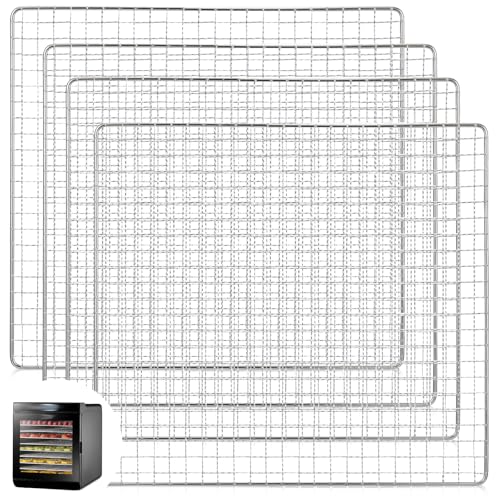
Baderke supplies four 304 stainless steel trays stated at approximately 12 x 13 inches, compatible with one dehydrator model only, at 1.51 lb for the pack. It is the one pick that needs nothing underneath it, because it is the rigid tray the two silicone mats ask for. In an oven that is a real advantage.
And it publishes no temperature. The listing says nothing about an oven in either direction, so it offers no support at all for the use this page is about, and a buyer is left to judge a bare metal tray on their own. Its compatibility statement names one model and nothing else, where every other pick here lists several machines or says most.
What Has to Go Under a Soft Mat
Two of the five cannot be used alone. YGKATING states that the silicone is soft and will not stand up on its own, and instructs you to put the sheet on the stainless steel tray first and only then add the liquid. It adds a tip of its own: the steel tray must not be smaller than the silicone mat. SUCISENI states the same requirement and names either a dehydrator tray or a hard baking pan.
Neither publishes the pan size it assumes, which is the gap that matters in an oven rather than a dehydrator. The Baderke trays are one answer to it. They are stated at approximately 12 x 13 inches for the CP267-FD, the same machine YGKATING names its mats for, and a mat stated at 11.8 x 10.6 inches sits inside 12 x 13 with room on every side.
Which One Fits Your Kitchen
Drying in an oven, with permission. SUCISENI, six solid silicone mats stated at 10.6 x 7.5 in with a 0.2 inch edge, published minus 40 to 446 degrees F and stated compatible with most dehydrators and home ovens, on a tray or hard pan.
A freezer and an oven both. YGKATING, four solid mats stated at 11.8 x 10.6 in with a raised lip, published minus 86 to 446 degrees F, dishwasher safe, described as working with an oven for cakes as well as fruit leather.
Berries and herbs with air beneath. GUCUJI, five silicone coated mesh rounds of 12.6 inch diameter and 0.8 mm thickness with 1 x 1 mm holes, published 220 degrees C and 428 degrees F, cuttable, at 0.32 lb.
Lining every rack in one run. Lova, twelve fine mesh sheets pre cut to 14 x 14 inches that trim with scissors, top rack dishwasher safe, for solid foods only, with no temperature figure published anywhere.
A rigid tray rather than a liner. Baderke, four 304 stainless steel trays stated at approximately 12 x 13 inches at 1.51 lb, needing nothing underneath, for one dehydrator model only, with no temperature published.
What We Could Not Verify
Every figure above comes from the maker’s own listing text. These are the things we went looking for and could not source in any of them.
- Two of the five publish no temperature figure at all, in either unit.
- Lova’s only heat statement is that it suits standard dehydrator temperatures.
- The stainless steel trays publish no temperature, and say nothing about an oven in either direction.
- No listing publishes a lowest oven setting it has been used at.
- No listing publishes a per sheet weight: every figure here covers the whole pack.
- Neither mat that requires a rigid tray publishes the pan size it assumes.