How the Five Compare on the Numbers
A glass container is bought by volume, and four of these five put a volume in the size entry rather than a measurement. Only one puts a dimension there at all. That makes the capacity figure the one a buyer actually reads, and it also makes it checkable, because every one of these five states its capacity in at least two units somewhere on the listing.
Converted at eight fluid ounces to the cup, three of the five agree with themselves to the nearest unit and two do not. Three of the five fill a dimension field, the other two publish a carton instead, and four of the five publish a weight that covers the whole purchase rather than one container.
What the table does tell you is where these listings line up without being asked. Four of the five name borosilicate glass. Four of the five say in writing that the lid does not go where the glass goes. And two of the five, written by unrelated sellers, publish the same cold figure of minus 4 F, which is a sign that the number is describing a real property rather than being invented for the listing.
When the Entry Carries a Measurement Too
A Capacity, Two Units, and Two of Three Axes
Liuruiyu is the only one of these five that puts a dimension in the size entry. It gives 36 oz with 1065 ml beside it and then 7.6 inches long by 2.5 inches high, with both axes marked. The first bullet repeats the capacity pair, and 1065 ml is the conversion of 36 fluid ounces to the nearest milliliter, so that part of the listing is exact.
What the entry leaves out is the width, and its own fields supply it: 5.2 inches, between the 7.6 and the 2.5. So two of three axes are published where a buyer looks and the third is one slot away. At 6.61 lb the weight field covers all eight containers, and the listing names no glass type and no temperature figure at all.
The Only Figure Here That Says Whether the Lid Is In It
Razab writes 2700ml and 91 Oz in its entry, metric first, and 2700 milliliters converts to just over the 91 ounces it states, so that pair holds. Its title then adds 11.5 Cups, and at eight fluid ounces to the cup that figure sits above the 91 Oz written beside it, so one of the two has been rounded in the wrong direction.
Its first bullet does something nothing else on this page attempts. It gives 9 inches long by 8 wide by 5.6 high and then says those figures include the lid, which is the single most useful clarification available on a stacking product. The fields carry the same three numbers. It publishes the largest capacity here, a hinged lid with an easy grip handle, a removable silicone seal, and minus 4 F to 450 F.
When the Entry Is Only a Volume
Thirty Six Ounces, and a Cup Figure That Checks Out
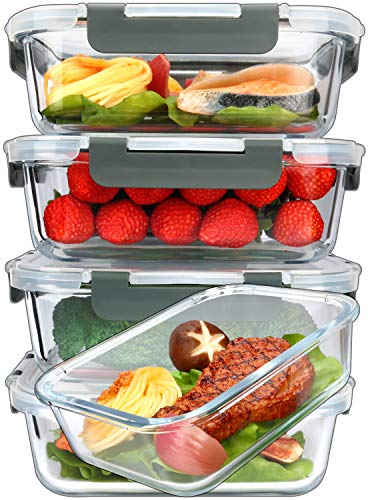
M MCIRCO writes 36 Ounce and a pack count, and nothing else. Its title gives 4.5 Cups alongside the same 36 oz, and at eight fluid ounces to the cup that is exactly right, which makes this the cleanest pair of capacity figures on the page. The listing is also specific where others are vague: five containers, single compartment, borosilicate glass.
What it never publishes is a size. No dimension field is filled, no bullet gives a measurement, and the only triple on the listing is the 6.5 by 8.0 by 3.0 inch package that five containers ship in. Snap lock lids with silicone seals, a stackable design, and a flat statement that the plastic lid cannot go in a microwave or an oven. 8.31 lb for the five.
Eight Cups and Sixty Three Ounces Cannot Both Hold
Snuvid puts 8 Cups in its size entry and 63oz in its title. A cup is eight fluid ounces, so those two figures describe containers a full ounce apart, and the listing never notices. Its first bullet then gives 63oz with 1860ml beside it, and that pair is consistent, which points at the cup figure in the entry as the loose one.
Everything else about it is the best documented here on heat. It publishes minus 4 F to 752 F, restated as minus 20 C to 400 C, and both halves of that conversion are exact. Borosilicate glass, a removable silicone sealing ring, a lockable lid, and microwave use with the lid removed. Four containers at 9.77 lb, with no dimension field filled and a 6.5 by 9.0 by 3.42 inch package instead.
When the Entry Is a Word
Large, Defined Only by a Cup Figure in the Title
GENICOOK writes a size word and no figure. The title supplies 4.4 Cup and a bullet supplies 4.4 cup with 35 oz beside it, and at eight fluid ounces to the cup that ounce figure is the cup figure rounded down, so the pair is sound. The word itself is calibrated against nothing, because no small, no medium and no other GENICOOK size appears anywhere on the listing.
Its dimension fields are filled at 5.7, 7.5 and 2.8 inches and no bullet repeats them, so the figures exist without a second source. It is the only pick here with no weight at all, and the only one whose cold figure is minus 40 F, with no upper figure to go with it beyond the words high heat oven use. A removable colored silicone sleeve is named for grip and burn protection.
What These Listings Agree On Without Trying
Four of these five name borosilicate glass, and the fifth names no glass type at all, only that its materials are free of BPA. On a category where the glass is the product, that is a meaningful split and it took reading five listings to find it rather than one.
Two of the five, Razab and Snuvid, publish minus 4 F as their cold limit, written independently by two sellers who share nothing else. Snuvid restates it as minus 20 C, which is the exact conversion, so the figure has a source. Four of the five also say plainly that the lid does not go where the glass goes, which is the one instruction on these listings a buyer will use every week.
Which One Fits Your Kitchen
Eight containers with a stated footprint. Liuruiyu. The only entry here with a dimension in it, at 7.6 inches long by 2.5 high, with 5.2 inches of width in the fields. 36 oz and 1065 ml, an exact pair. Eight containers at 6.61 lb, oven, microwave, freezer and dishwasher.
Roasting and batch cooking in one dish. Razab. The largest capacity here at 2700ml and 91 Oz, and the only measurement on this page that states whether the lid is included: 9 inches long by 8 wide by 5.6 high, lid in. Minus 4 F to 450 F, a hinged lid, a grip handle, 3.6 lb.
Five identical borosilicate boxes. M MCIRCO. 36 Ounce with 4.5 Cups in the title, which is exactly right. Five single compartment containers at 8.31 lb, snap lock lids with silicone seals, stackable, with the plastic lid refused for the microwave and the oven. No dimension of a container is published.
Freezer to oven in one container. Snuvid. Minus 4 F to 752 F, restated as minus 20 C to 400 C, the widest temperature range on this page. Four borosilicate containers at 9.77 lb with a removable silicone sealing ring. Its entry says 8 Cups and its title says 63oz, which do not meet.
A silicone sleeve and a grip. GENICOOK. Five containers at 4.4 Cup, or 35 oz, with fields of 5.7, 7.5 and 2.8 inches and a removable colored silicone sleeve for grip and burn protection. Minus 40 F is published with no upper figure, and no weight is published.
What We Could Not Verify
Everything above is read off each maker’s own listing text. These are the things those listings leave open, and this page does not fill them in.
- Whether a Snuvid container holds 8 Cups or 63oz, since a cup is eight fluid ounces and those two figures do not meet.
- Whether a Razab container is 91 Oz or 11.5 Cups, since the same title gives both and they do not convert into each other.
- Any dimension for an M MCIRCO or a Snuvid container, where both publish a package triple and no container figure.
- How many containers the Razab 3.6 lb weight covers, because the listing never states a count.
- An upper temperature figure for GENICOOK, which publishes minus 40 F and then only the words high heat oven use.
- What the GENICOOK size word is measured against, since no other size of that container is named on the listing.