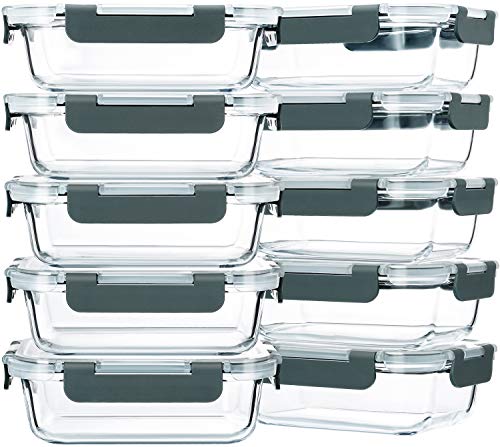
How the Five Compare on the Numbers
Three listings were left out. Rubbermaid is StainShield plastic with latches and never mentions silicone at all. Prep Naturals sells borosilicate glass and also never uses the word, describing airtight leak resistant lids with nothing named inside them. KOMUEE publishes a weight of 0.26 pounds for ten 30 ounce glass containers, which is not a figure any page should build on.
That leaves five, and on this question they are not equal. One listing tells you plainly that a hot dishwasher will deform the silicone strip and asks you to wash the lids by hand. Two state the seal comes off the lid. Two name silicone and say nothing else about it. Nobody publishes a durometer, a temperature rating for the seal, or a replacement.
What the table cannot tell you is how long any of these seals lasts. No listing publishes a hardness, a temperature rating for the silicone itself as distinct from the glass, a service life, or a replacement seal you could buy. Two of the five do not even say whether the seal comes off the lid, which is the first thing you would want to know before washing it.
The Silicone Is the Part That Fails
One Listing Says So Out Loud
SOACOAKO publishes two bullets that most makers would leave out. The first states that the lids are not oven or microwave safe and that you should remove them before heating, to avoid deformation of the lid and the silicone strip. The second states that it is safe to wash the lids in the dishwasher, but that high temperatures over a long period can deform the silicone sealing strip at the edge of the lid.
It then asks you to wash the lids by hand as much as possible. That is a maker naming the failure mode of its own product, and it is the most useful sentence on this page. Every other listing here either claims dishwasher safety without qualification or bans the lids outright, and none of them explains what is actually at risk.
Two Seals You Can Take Off
A removable seal is the difference between a lid you can clean properly and one that grows a dark line in a groove. FIT Strong and Healthy states a removable silicone ring alongside corner protection on its snap locking lid. Skroam states removable silicone seals and goes further, publishing a tip that if the rubber seals arrive stuck to the containers you should install them back onto the lids.
That tip is worth reading twice, because it is also where Skroam’s own vocabulary slips: the same listing calls the part a silicone seal in one bullet and a rubber seal in another, without saying which it is. SOACOAKO, HOMBERKING and M MCIRCO all describe a seal fixed to the lid and none of the three says whether it can be taken out.
Where the Lid Can and Cannot Go
Nobody’s Lid Goes in the Oven
All five listings agree on one thing: the lid comes off before heat. M MCIRCO states you take off the lids before placing the container in the oven or the microwave. Skroam states the glass goes to 752 F but not the lids. HOMBERKING puts the exclusion in its own headline. SOACOAKO explains why, naming deformation of the lid and the silicone strip as the risk.
FIT Strong and Healthy is the only one that permits the microwave with a qualification rather than a ban, stating the containers move from freezer straight to microwave with the lid off. In practice that is the same instruction. What none of the five publishes is a temperature the lid itself can take, which is the figure the whole rule depends on.
Four Different Dishwasher Rules
The machine is where the five diverge. HOMBERKING states the containers are dishwasher safe instead of hand washing, which is the strongest claim here. M MCIRCO lists the dishwasher alongside the microwave, freezer and oven with no exclusion for the lids. FIT Strong and Healthy states lids on the top rack or hand wash, which is a middle position and a sensible one.
Skroam bans the lids from the machine outright, stating dishwasher safe but not the lids. SOACOAKO permits them and then argues against it. So a buyer reading five listings for the same kind of product gets four different answers about the same silicone part, and only one of the five explains its reasoning.
Glass Is the Easy Half
Two Publish a Temperature Range
The glass is where the figures actually appear. SOACOAKO and HOMBERKING both publish -4 F to 752 F, and both state the container can go from freezer to oven without thawing. Skroam publishes an upper figure only, 752 F or 400 C. FIT Strong and Healthy and M MCIRCO both state borosilicate glass and publish no range at all.
Every one of the five names borosilicate, and M MCIRCO argues it is stronger than the glass in cheaper containers. So the body of the container is the well documented part and the seal is not, which is the wrong way round for a part that touches food, sits in a groove and is the only thing between a soup and a work bag.
Three Sets Left Out, and Why
Rubbermaid never mentions silicone. It is StainShield plastic with crystal clear lids and bases, a leakproof seal, secure latches and built in vents for microwaving with the lid on and the latches open, in five 2.85 cup two compartment containers at 2.91 pounds. It is a good container and it is not a silicone question.
Prep Naturals is borosilicate glass and also never uses the word silicone, describing airtight leak resistant lids with nothing named inside them, across five 34 ounce three compartment containers at 10.01 pounds. KOMUEE does name silicone seals on snap lock plastic lids, but its published weight of 0.26 pounds cannot describe ten 30 ounce glass containers, so its figures cannot be trusted here.
Which One Fits Your Kitchen
You want the failure mode published. SOACOAKO states that a hot dishwasher over a long period can deform the silicone sealing strip and asks you to wash the lids by hand, alongside -4 F to 752 F glass, six three compartment containers at 34 oz, a published 8.2 by 6.2 by 2.6 inches, and nesting storage when not in use.
You want a seal you can take out and refit. Skroam states removable silicone seals on upgraded snap locking lids and publishes a tip for refitting a seal that arrives stuck to the glass, with ten single compartment containers at 22 OZ, glass to 752 F or 400 C, and a plain statement that the lids do not go in the dishwasher.
You want two and three compartments in one purchase. FIT Strong and Healthy ships two 2 compartment and two 3 compartment containers at 32 oz, a published 8 by 6.5 by 2.7 inches, 2.0 pounds for four, a snap locking lid with corner protection and a removable silicone ring, and lids that go on the top rack or are washed by hand.
You want the most food in one container. HOMBERKING publishes 36 oz, stated as 980 ml and split into about 19 oz and 17 oz, across eight two compartment containers at 15.76 pounds, with premium silicone seals in a 4 side locking mechanism, -4 F to 752 F glass, and a claim of dishwasher safety instead of hand washing.
You want the container measured. M MCIRCO publishes 6.7 by 4.9 by 2.1 inches for each of its ten 22 oz single compartment containers, with silicone seals on snap lock lids stated to stop leaking, borosilicate stated stronger than cheaper glass, use in the microwave, freezer, dishwasher and oven, and 11.97 pounds for the ten.
What We Could Not Verify
The glass in this pool is documented and the silicone is not.
- No listing publishes a hardness, a temperature rating or a service life for the silicone itself, only for the glass.
- No listing offers a replacement seal, though four of the five depend on one for the airtight claim.
- SOACOAKO, HOMBERKING and M MCIRCO do not say whether the seal comes off the lid at all.
- Skroam calls the same part a silicone seal in one bullet and a rubber seal in another.
- Five listings for the same kind of product give four different dishwasher rules for the lids.
- HOMBERKING’s size bullet is cut off after 8.1 by 6.1 inches, so its third dimension is missing.