How the Five Compare on the Numbers
Three of these five load the bottle from the bottom and two from the top, and that is the only specification all five agree to publish. Everything else useful appears on exactly one listing: one gives its heating and cooling wattage, one gives its dispensing rate, one names its compressor. No two of the five publish the same secondary figure, so this page is largely about reading one listing for each fact.
Weight is published on two of the five. Brio is 40.5 pounds and Avalon 38.1. Tehanld, Frigidaire and EUHOMY publish none at all, on units between 36 and 38.21 inches tall by their own fields. A floor standing cooler has to be carried through a door and up a stair once, and three of these five decline to say what that involves.
What the table cannot tell you is how cold the cold water gets, because not one of the five publishes a temperature in degrees. Avalon publishes the watts it uses to cool and EUHOMY publishes the liters it pours per hour, but neither publishes the result. On a machine bought specifically for hot and cold water, no listing here commits to a figure for either.
Bottom Loading Against Top Loading
What the Bottom Loaders Buy You
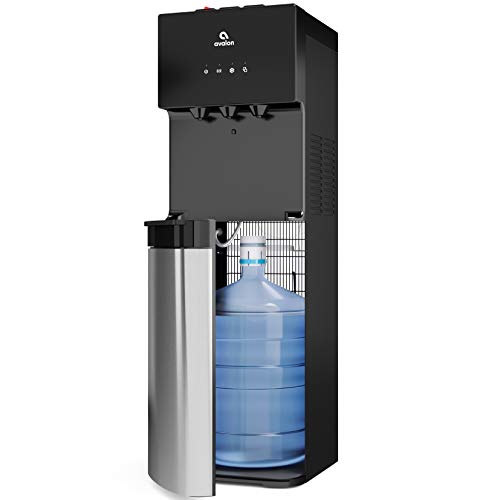
Avalon, Brio and Tehanld all hide the bottle inside a cabinet, so a full 5 gallon jug slides in at floor level instead of being hoisted overhead. Avalon states the point directly, that bottom loading eliminates the strain of lifting and reduces spills. All three then need a way to tell you the bottle is empty, since you cannot see it, and all three publish one.
They differ in how. Brio publishes an LED display with an empty bottle alert, which is the clearest of the three. Avalon publishes an indicator light built into its nightlight arrangement. Tehanld publishes a smart reminder with no mechanism described. All three are also the taller units here, between 38.21 and 42.52 inches by their own fields, because the cabinet has to be a bottle high before anything else.
Why Two Are Still Top Loaded
Frigidaire and EUHOMY both put the bottle on top and both make the same argument for it: you can see how much water is left. EUHOMY adds a second advantage that no bottom loader can match, that the top lid comes off for cleaning, which on a machine whose water sits still for days is worth more than it sounds.
They are also the two smallest cabinets here, at 36 and 36.5 inches against 38.21 and above on the bottom loaders, though with a bottle sitting on top that advantage disappears. Frigidaire is the only pick with two temperature settings rather than three, ice cold and steaming hot with no room temperature option, which simplifies the front panel to two push buttons and two spigots and removes a use some households want.
One Figure Each, and No Two the Same
The Only Wattage and the Only Flow Rate
Avalon is the only listing here to publish power: 420 W of heating and 100 W of cooling, given separately. That is a genuinely useful pair, because it tells you the hot tank is doing four times the work of the cold one, which is why hot water recovers faster than cold on almost every machine of this kind.
EUHOMY publishes the other half of the equation and nobody else touches it: cold water at 2.5 liters per hour and hot at 5 liters per hour. That is a rate, not a tank volume, and it is the closest thing on this page to an answer about how long a queue of coffee drinkers will wait. Between them these two listings publish four figures the other three publish none of.
The Only Named Compressor
Tehanld is the only listing to name what does the cooling: an R134a compressor, described as energy saving, durable and low noise. It also states that its side panels are metal rather than plastic and that they are vented for heat dissipation. Those are three specific engineering claims and no other listing here makes any of them.
Avalon answers a different question nobody else asks, publishing a BioGuard antimicrobial coating on high contact areas, alongside UL and Energy Star approval. It is the only pick with a named safety listing, which in an office is often the line that decides whether an appliance is allowed on site at all.
The Listing That Names Somebody Else
A Bullet Copied and Not Read
Tehanld’s second bullet invites you to customize your drinking experience with the Brio Essential water dispenser. Brio is a different brand, and it is the brand of another product on this very page, whose own bullet uses the same phrase about the Brio Essential. The sentence has been copied from one listing into the other with the rival’s product name left in place.
The rest of the Tehanld listing follows the same pattern. Its bottom loading bullet, its two step safety lock bullet and its smart maintenance bullet all track the Brio bullets closely in structure and phrasing. Only the final bullet, about the R134a compressor and the metal sides, contains anything the Brio listing does not, and that bullet is also the most specific one on the page.
What to Do With That
It does not make the Tehanld a bad machine and it is not evidence that the two are the same unit. Their published dimensions differ, Brio is 42.52 inches tall against 38.21, and Brio publishes a weight where Tehanld publishes none. What it does mean is that most of the Tehanld sheet is not a description of the Tehanld, so only the compressor bullet can be relied on.
The practical rule is the one this page follows throughout: where a listing’s own words are borrowed, the figures in its fields and the one original bullet are all you have. Tehanld earns its place here on the strength of that single bullet, which happens to publish the only compressor model named anywhere in this comparison.
Which One Fits Your Kitchen
The office that needs the paperwork. Avalon publishes UL and Energy Star approval, 420 W of heating and 100 W of cooling, a stainless cabinet, a nightlight, an empty bottle indicator and a BioGuard antimicrobial coating on contact areas. At 38.1 pounds it is the lighter of the two published weights.
Knowing the bottle is empty before the cup is. Brio publishes an LED display with an empty bottle alert on a bottom loading cabinet taking 3 or 5 gallon jugs, three temperatures and a two step hot lock. At 40.5 pounds and 42.52 inches it is the largest unit here.
A queue of tea drinkers. EUHOMY is the only pick to publish a rate, 2.5 liters per hour cold and 5 hot, with a removable top lid for cleaning, a removable catch tray, a rear switch for choosing temperature and a one year warranty. It publishes no weight.
The slimmest panel and the simplest controls. Frigidaire publishes 11.5 by 11 by 36 inches, two temperature settings rather than three, two push buttons on two separate spigots, a stainless steel weld tank and a removable drip tray. It publishes no weight and no room temperature option.
A named compressor and metal sides. Tehanld is the only listing to publish what does the cooling, an R134a compressor it calls low noise, with metal side panels rather than plastic and a vented design. Most of the rest of its copy was written for another brand.
What We Could Not Verify
These six things decide how a water cooler behaves in daily use, and the listings settle none of them.
- Water temperature at either spout. Not one of the five publishes a figure in degrees for hot or cold, on machines sold specifically on those two words.
- Tank volumes. No listing states how much hot or cold water is held in reserve, so nothing says how many cups arrive before the machine has to recover.
- Weight on three of the five. Tehanld, Frigidaire and EUHOMY publish none, on floor standing cabinets that have to be moved at least once.
- Power draw on four of the five. Only Avalon publishes heating and cooling wattage, so running cost cannot be compared across the rest.
- Noise. Only one listing mentions it, and only as an adjective attached to a compressor model, with no figure anywhere.
- How much of the Tehanld sheet describes the Tehanld. Its bullets name a rival brand’s product and follow that rival’s copy closely, leaving one original bullet.