How the Five Compare on the Numbers
Five indoor grills sit in this shortlist and they are not the same class of machine. Two are commercial style flat top griddles built to be left on a counter and loaded with food. Three are domestic grills with a lid, plates that come out, and a footprint meant for a worktop that also has to hold other things. The published figures follow that split closely.
Published maximum temperature is the specification every maker here treats as the headline, and it is the one figure that separates these five cleanly. Three of the five also publish wattage. Only two publish an actual cooking surface measurement, which is the figure that decides how much food goes on at once, so the table below shows a run of blanks where you would most want a number.
What the table cannot tell you is how any of this behaves once food is on the plate. A published maximum is the top of a dial, not a promise about recovery after a cold steak lands on it, and none of these makers publish a recovery figure or a preheat time in minutes. The two figures a cook would most want, usable cooking area and time to temperature, are the two most often missing.
Heat, Wattage and What the Makers Actually State
Where the Published Maximums Come From
The Dyna-Living publishes the widest stated span, 122°F to 572°F, and the Besococina publishes a peak of 536°F reached by an electronic knob with a color chart printed beside it. Those two are the only figures on this page that come with any description of how the setting is reached, which matters more than the number itself when nobody states accuracy.
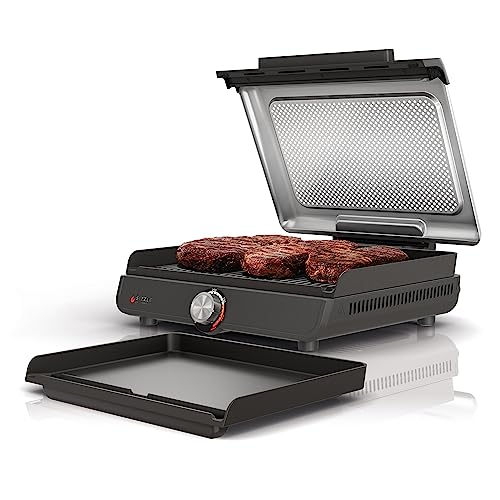
The Ninja states 500°F as a maximum and compares itself to another brand’s smokeless grill to make the point. The Hamilton Beach states 450°F for searing and, unusually here, publishes the full range it adjusts across, 200°F to 450°F. The T-Fal publishes no maximum at all, because its selling point is that you do not set one.
Wattage Is Not a Cooking Speed
Three of the five publish wattage: 3000W for the Dyna-Living, 1800W for the T-Fal, 1650W for the Besococina. The Ninja and the Hamilton Beach publish none. It is tempting to read those figures as heating speed, but none of these makers states a preheat time to put beside the wattage, so the comparison stops at the electrical draw.
Wattage also has to be read against the mass being heated. The Dyna-Living’s 3000W is warming an 8 mm steel panel on a 39.68 pound body, while the Besococina’s 1650W is warming a 5 mm panel. Neither maker says how long either takes. The George Foreman in the same pool claims elements that preheat 35 percent faster, but gives no baseline, so the claim cannot be placed on this table.
Plates, Panels and the Cleanup Question
Removable Plates Against a Fixed Panel
The three domestic grills all take their cooking surfaces out. The Ninja ships two, a grill plate and a griddle plate that swap, which is the reason it is here. The Hamilton Beach has one removable nonstick plate the maker states is PFAS free. The T-Fal has removable nonstick plates and inclined plates with a juice tray underneath.
The two griddles work differently. The Besococina describes a detachable structure whose removable components go in a dishwasher, and a surface with no coating on it at all, which is the opposite approach to every other pick. The Dyna-Living publishes an oil leak hole and a removable oil collecting box, but says nothing about whether its 8 mm panel comes off.
What Dishwasher Safe Covers Here
Four of the five say something specific about the dishwasher. The Ninja names its plates and its mesh lid. The Hamilton Beach names its grill plate. The T-Fal names its plates. The Besococina names all removable components and adds that they dry quickly. Each of those is a maker statement about a named part, not about the whole appliance.
The Dyna-Living is the exception and describes cleaning by hand instead: the nonstick panel wipes down and the grease box lifts out. That is the honest reading of a commercial style flat top, which is not going anywhere near a dishwasher at 39.68 pounds. A coating free steel surface like the Besococina’s also asks for different care, and the maker does not spell out what.
Counter Space, Weight and Who Lifts It
The Two Flat Top Griddles
The Dyna-Living is the heaviest of the five at 39.68 pounds and publishes a 21.3 by 11.8 inch cooking surface with a 22 inch overall size. It needs a permanent spot with clearance around it and a socket that will carry 3000W on 110V. In exchange it is the only pick here that publishes how much cooking area you actually get.
The Besococina publishes its size as 475 by 360 by 90 millimeters, and the inch fields carry the same three figures in a different order, so this page does not say which of them is the width. At 18 pounds it can be put away between uses, and the maker calls it portable and suitable for a balcony or a dining table as well as a kitchen.
The Three Grills With Lids
The Ninja Sizzle is the lightest of the five at 7.8 pounds, with 14 inch plates the maker says feed four to six people, and a perforated mesh lid meant to hold smoke down. The Hamilton Beach is close behind at 8.14 pounds and is the only pick with a window in the lid, which is a small thing that stops you opening it to look.
The T-Fal sits at 11.5 pounds and is the one built around not thinking. Nine automatic programs cover burgers, poultry, fish and sandwiches, the maker states it measures ingredient thickness and adjusts, and it claims up to 6 to 8 servings. It doubles as a panini press, which is a fair reason to pick it over a flat top if counter space is scarce.
Which One Fits Your Kitchen
The batch cook. The Dyna-Living is the pick if you are feeding a crowd or a stall, because it is the only one here that publishes a real cooking area, 21.3 by 11.8 inches, and the only one with a 3000W draw behind it.
The cook who wants no coating. The Besococina publishes a coating free SUS450 steel surface, 5 mm thick, with a peak of 536°F and a color chart on the knob. At 18 pounds it stores away, which a flat top usually does not.
The one appliance household. The Ninja Sizzle swaps between a grill plate and a griddle plate, hits 500°F, and is the lightest of the five at 7.8 pounds, so pancakes in the morning and steak at night come off the same machine.
The careful searer. The Hamilton Beach publishes the full dial, 200°F to 450°F, and puts a window in the lid plus separate power and preheat lights. If you want to see and set what is happening, that is more useful than a higher maximum.
The reluctant cook. The T-Fal OptiGrill XL has nine automatic programs and adjusts for thickness itself, and claims 6 to 8 servings. Pick it if you would rather press a button than watch a dial, and accept that it publishes no maximum temperature.
What We Could Not Verify
These are the figures we went looking for in the manufacturer listings and did not find. Nothing below was estimated, and no figure anywhere on this page was measured by us.
- Cooking surface area for the Besococina, the Hamilton Beach and the T-Fal is never stated, so three of five cannot be compared on capacity.
- Preheat time in minutes is published for none of the five, and the one preheat claim in the pool is a percentage with no baseline.
- Maximum temperature for the T-Fal OptiGrill XL is not published, so it cannot be placed in the heat ranking at all.
- Wattage for the Ninja Sizzle and the Hamilton Beach is not published, which leaves the wattage row two thirds complete.
- Smoke output is claimed in relative terms by two makers and quantified by neither, so the low smoke claims cannot be compared.
- Which published dimension is the width, the depth or the height is not stated by any of the five, and the Besococina’s fields hold its millimeter figures in a different order.