How the Five Compare on the Numbers
A published weight is one of the few figures on a bakeware listing that a buyer can act on without interpretation, and in this category it is usually describing something other than the pan. Ten of the sixteen listings in this pool are sold as two packs or four packs, and the weight field covers everything in the carton. That single fact decides which products can appear here.
What is left is six single pans, one of which publishes no weight at all. The five that do run from 0.35 to 1.8 pounds, a fivefold spread across an object the size of a sheet of paper, and the split falls almost exactly along the material line. Two silicone molds sit at the bottom and three metal pans at the top.
What the table cannot tell you is how any of these weights breaks down. Only one of the five states a metal thickness, none states a cavity size, and none states how much batter a cavity takes. So the weight column is the honest comparison and the reason behind it is largely the material, which is the one thing every listing does declare.
Why Only Single Pans Are on This Page
Ten of Sixteen Weigh the Box
Bellemain publishes 0.9 pounds and sells two pans. BreadTalk publishes 0.95 for two. Waylenbo publishes 0.74 for two. Shinsin publishes 2.03 for two. BIGOWL publishes 0.49 for four. CHENZORVAX and LORGVEXN both publish 1.49 for two, and ZEENEEK 1.45 for two. Every one of those is a real figure describing a real purchase, and none of them describes a pan.
That is not a small technicality on a page about weight. Waylenbo’s 0.74 pounds for two pans sits below Fox Run’s 1 pound for one, and a reader scanning a column would put Waylenbo first. The comparison would be measuring how the product was packed rather than how it was made, so the multipacks are named here and left out of the ranking.
One Maker Lets You Check Its Own Arithmetic
Vinino is the exception that proves the rule useful. The same silicone mold is listed on its own at 0.73 pounds and as a pair at 1.41, from the same brand with the same bullets. The pair figure lands a little under twice the single, which is exactly what you would expect once packaging is accounted for, and it is the only place in this pool where a pack weight can be tested at all.
The pair listing also shows how the same thing goes wrong. Its size text states 14.8 by 10 by 0.9 inches while the single states 14.8 by 10 by 0.5, so the extra four tenths of an inch is the second mold lying on the first. The single pan version is the one on this page, at 0.73 pounds, because it is the one whose figures describe one object.
What Actually Makes a Madeleine Pan Light
Silicone Against Steel
The two silicone molds publish 0.35 and 0.73 pounds. The three metal pans publish 1, 1.6 and 1.8. Fchil is the clearest case: 20 cavities, more than anything else in this pool, in a single sheet at 0.35 pounds, released by pushing from underneath with no greasing stated as necessary. It states 440 degrees Fahrenheit and clears an oven, an air fryer, a microwave and a dishwasher.
Vinino adds the thing a bare silicone sheet lacks. Its 12 cavity mold carries a metal reinforced frame stated to prevent bending and warping, plus integrated non slip handles, and it publishes 0.73 pounds with that frame included. It also publishes a full temperature range, minus 40 to 446 degrees Fahrenheit, whose Celsius pair of minus 40 and 230 converts correctly in both directions.
The One Thickness Figure Anyone Publishes
Two steel pans of similar size should differ in weight mostly by gauge, and only one listing in this whole pool gives a buyer the number. CHEFMADE states 0.8 millimeters of carbon steel, with a reinforced rim stated to prevent warping and a coating described as food grade silicone free of PTFE and PFOA. It publishes 1.6 pounds and fields of 12.8 by 10.1 by 1.3 inches.
USA Pan, which publishes 1.8 pounds for 16 wells, calls its material heavy gauge aluminized steel and commercial grade and never attaches a figure to either phrase. Fox Run says durable carbon steel and does the same. So the difference between 1, 1.6 and 1.8 pounds cannot be traced to thickness, sheet area or well count on the published data, only guessed at.
Where the Published Figures Argue
The Centimeter Problem in Fox Run’s Fields
Fox Run publishes 1 pound, which is a believable weight for a 12 cup carbon steel pan. Its dimension fields are another matter: 6.1 by 2.95 by 0.39 inches, against a final bullet that states measurements of 15.5 by 7.5 by 1 inch. The second set divided by 2.54 gives the first, so the fields hold centimeters in slots labeled inches.
This page uses the maker’s sentence and leaves the weight field alone, because the two problems are unrelated: a unit error in three dimension fields says nothing about a fourth field in pounds. It is worth flagging because a buyer comparing fields alone would read Fox Run as a pan a third the size of the one described in its own bullet.
A Field That Lost Eight Tenths of an Inch
Vinino’s published fields read 10 by 14 by 0.5 inches. Its own bullet states overall dimensions of 14.8 by 10 by 0.5 inches. The height and the width agree and the long side does not, by eight tenths of an inch, and nothing in the listing explains which figure was rounded or cropped. Both are close enough that neither changes whether the pan fits an oven.
CHEFMADE and USA Pan have the opposite problem in a mild form: both publish complete and plausible fields and neither states a size in its own words at all. So for those two there is nothing to cross check against, which is the quiet cost of a tidy looking listing. Fchil is the only one of the five where field and sentence agree to within a tenth.
Which One Fits Your Kitchen
The baker who wants the most cavities. Fchil publishes 0.35 pounds for 20 cavities in one silicone sheet, with fields of 7.8 by 11.85 by 0.55 inches and a stated size of 11.8 by 7.6 by 0.5. It names an oven, an air fryer, a microwave and a dishwasher, and needs no greasing.
The baker who wants silicone with a spine. Vinino publishes 0.73 pounds for one 12 cavity mold with a metal reinforced frame and non slip handles. Its temperature range of minus 40 to 446 degrees Fahrenheit converts correctly, and it names refrigerators and freezers as well as ovens and microwaves.
The baker who wants metal at the lower end. Fox Run publishes 1 pound for a 12 cup carbon steel pan, states 445 degrees Fahrenheit and 229 Celsius, and gives its own measurements as 15.5 by 7.5 by 1 inch. Read the bullet rather than the dimension fields, which are in centimeters.
The baker who wants to know the gauge. CHEFMADE publishes 1.6 pounds, states 0.8 millimeters of carbon steel and a reinforced rim, and carries a food grade silicone coating stated free of PTFE and PFOA. Its fields of 12.8 by 10.1 by 1.3 inches are complete. It publishes no temperature figure.
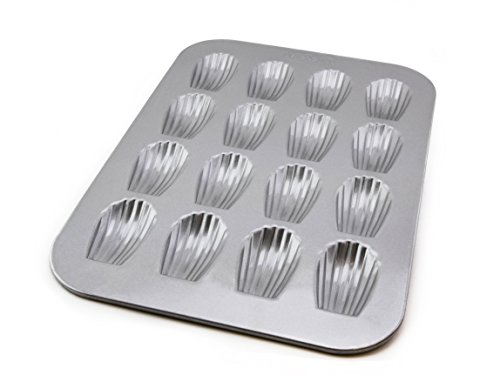
The baker doing bigger batches. USA Pan publishes 1.8 pounds for 16 wells in one aluminized steel sheet, with fields of 11.13 by 15.75 by 0.56 inches and a stated oven limit of 450 degrees Fahrenheit. It is the heaviest of these five and the only one with its own named nonstick coating.
What We Could Not Verify
Everything above comes from the makers’ own listings. These are the things a buyer choosing on weight needs and the published data does not supply.
- Ten of the sixteen listings in this pool publish a weight for a two pack or a four pack, and not one of them states what a single pan weighs.
- Only CHEFMADE states a steel thickness. USA Pan calls its steel heavy gauge and Fox Run calls its steel durable, and neither attaches a figure.
- Not one of the five publishes a cavity size, so the finished madeleine is unstated across the whole page.
- Chicago Metallic is a single pan with no published weight at all, and its dimension fields of 7.8 by 0.5 by 0.5 inches carry the same placeholder figure twice.
- CHEFMADE publishes no temperature limit, only the phrase safety in high temperature, so the best documented construction here has the least documented heat rating.
- No listing states how much batter a cavity holds, so batch size can only be read from the cavity count.