How the Five Compare on the Numbers
Three of these five publish a figure for the jar itself. The 12 oz Brod & Taylor states 3 inches wide and 3.6 inches tall in its own bullet. The 32 oz Brod & Taylor states a 4 inch by 5 inch jar. Howasai’s fields read 5.0 by 5.0 by 5.9 inches. ComSaf and WECK publish nothing for the jar, only a figure for the package the jars arrive in.
Capacity sorts them differently again. The 12 oz Brod & Taylor holds up to 100 g of risen starter, the 32 oz jar up to 300 g. ComSaf states 34 oz, given also as 1 liter, for each of two jars. WECK states 3/4 liter for each of two. Howasai states 50 oz in a single jar, and publishes a 5 inch mouth to reach into it.
What the table cannot settle is how much shelf the parts need once the box is thrown away. A bamboo lid, a cloth cover and a feeding band have to live somewhere, and no maker here publishes a size for any of them. The jar figures are exact where they exist, and everything that sits beside the jar is described in words only.
What Each Jar Takes Out of the Shelf
The Three That Publish a Jar Block
A shelf loses depth and width to a jar as surely as it loses headroom. The 12 oz Brod & Taylor’s own bullet gives 3 inches wide, the 32 oz version gives 4 inches, and Howasai’s width field reads 5.0 inches. Those three figures are the only ones on this page that describe a jar standing on a shelf rather than a carton waiting to be opened.
The dimension fields and the makers’ own sentences do not always agree. The 12 oz Brod & Taylor’s fields read 3.6 by 3.6 by 4.6 inches while its bullet says 3 inches wide and 3.6 inches tall, so the bullet is used here and the field set is set aside. The 32 oz jar is closer: fields of 4.0 by 4.0 by 5.5 inches against a stated 4 inch by 5 inch jar.
The Two That Publish Only a Package
ComSaf and WECK publish no dimension for the jar at all. ComSaf’s only figures are 3.74 by 3.74 by 7.48 inches for the box that holds its two 34 oz jars, and a 3.3 inch mouth opening. WECK’s only figures are 5.0 by 5.0 by 7.0 inches for the box that holds its two jars. Neither number tells a reader how much shelf one jar needs.
That matters more than it sounds, because both of these are sold in pairs and the whole point of a pair is that both jars are in use. A shelf has to hold two of each, and on this page there is no published figure for either one standing alone. A reader who needs an exact fit has to measure a jar in the kitchen rather than trust a listing.
The Gap Above the Shelf
Heights in the Fields, and in the Makers’ Own Words
The published height figures run 4.6 inches for the 12 oz Brod & Taylor, 5.5 inches for the 32 oz version and 5.9 inches for Howasai. Only two of the five put a height in words: the 12 oz jar at 3.6 inches tall and the 32 oz jar at 5 inches. The 12 oz pair of figures disagree by a full inch, and the bullet is the one the maker wrote as a sentence.
None of these figures includes a lid standing proud of the glass, a cloth cover tied over the mouth, or the clamp clips WECK fits to its glass lids. A jar measured to the rim and then covered with cloth for a day of active fermentation is taller than its field says, and no listing here quantifies that difference. Leave headroom for it.
What the Mouth Costs You in Reach
Three of the five publish a mouth figure, and they are the practical half of the shelf question: a jar you cannot get a hand into gets carried to the sink instead of worked on where it stands. The 32 oz Brod & Taylor publishes a 4 inch opening and says plainly that it fits a hand for scrubbing. Howasai publishes 5 inches. ComSaf publishes 3.3 inches.
The other two say nothing with a number behind it. The 12 oz Brod & Taylor states a body width of 3 inches and never gives a separate opening figure, and WECK calls its jars wide mouth without publishing a measurement for the mouth. On a shelf, that is the difference between knowing a spatula will clear the rim and finding out afterward.
What Lands on the Shelf Beside the Jar
Covers, Lids and Bands
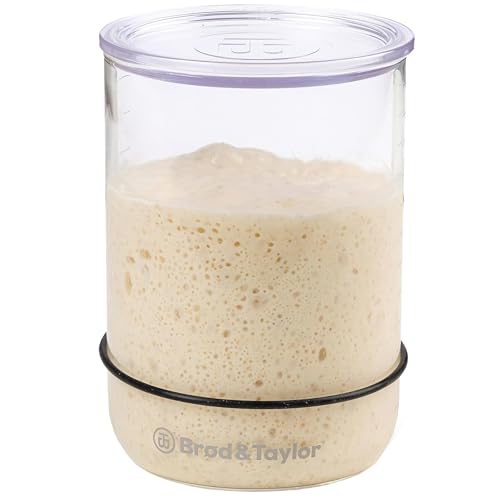
Brod & Taylor keeps the parts count down at both sizes. The 32 oz listing names a plastic lid and a black silicone level marker; the 12 oz listing names a plastic lid and a black silicone ring. Both lids are described as loose fitting so pressure cannot build during fermentation, which is a design choice rather than a figure, and both jars carry markings in inches and centimeters.
The other three ship more. Howasai lists two breathable cotton covers, a bamboo lid for storage, a feeding band and a silicone base. ComSaf lists 304 stainless steel lids, a silicone spatula, a feeding band, a thermometer sticker and a breathable cloth cover. WECK lists glass lids, rubber gaskets and clamp clips, with the lid, gasket and jar as separate pieces.
Washing, and Where the Parts Go Afterward
Four of the five say something about washing. Both Brod & Taylor jars are described as 100 percent dishwasher safe for the glass and the plastic lid, and the 32 oz listing adds that its 4 inch opening fits a hand for scrubbing and has no grooves or ridges. WECK states dishwasher and microwave safe, and notes that separating the lid and gaskets makes pouring and washing easier.
ComSaf is narrower than that. It names hand cleaning through the 3.3 inch mouth and tells the reader to wipe the steel lids dry after washing, but it never clears a dishwasher for either part. Howasai names neither a sink nor a dishwasher. Its bullets say only that cleaning is easier through a 5 inch mouth, which is a claim about access and not a method.
Which One Fits Your Kitchen
A shelf shared with bread tools. The 32 oz Brod & Taylor. It publishes a 4 inch by 5 inch jar, a 4 inch opening and 0.7 lb, and the only things that have to sit beside it are a plastic lid and a silicone level marker.
A low shelf with a fixed gap. The 12 oz Brod & Taylor, which states 3 inches wide and 3.6 inches tall in its own words, and 0.39 lb against 0.7 lb for the 32 oz version. It holds up to 100 g of risen starter.
A week of loaves from one jar. Howasai, at 50 oz with fields of 5.0 by 5.0 by 5.9 inches and a 5 inch mouth. It takes the most shelf of the three that publish a jar figure, and it is the one you can get a whole hand into.
Two starters running at once. ComSaf, two 34 oz jars with 304 stainless steel lids and a 3.3 inch mouth. The published 3.74 by 3.74 by 7.48 inches is the box, not the jar, so measure the shelf gap before committing to it.
A jar that goes in the microwave. WECK, a pair of 3/4 liter jars with glass lids, rubber gaskets and clamp clips. It is the only listing here cleared for a microwave, and the only figure it publishes is 5.0 by 5.0 by 7.0 inches for the pair’s box.
What We Could Not Verify
Everything above comes from the five listings themselves. These are the things they do not say.
- ComSaf and WECK publish no dimension for a single jar, only a figure for the package.
- The 12 oz Brod & Taylor’s 4.6 inch height field is not reconciled with the 3.6 inches its own bullet states.
- No maker here publishes a size for a cloth cover, a bamboo lid or a feeding band.
- The 12 oz Brod & Taylor and WECK publish no mouth figure.
- Howasai names neither a sink nor a dishwasher anywhere in its listing.
- The 12 oz Brod & Taylor and Howasai never state how many jars arrive.