How the Five Compare on the Numbers
Eight listings sit on the fact sheet and three are left off. BINGBING publishes 1.87 lb, Ourokhome 1.7 and ONCE FOR ALL 1.98, which puts all three inside the band two picks here already cover, and none of them adds a different construction. The five below span the whole published range instead, from 0.35 lb up to 2.03, which is the only way to see what the weight is actually buying.
Weight on a mandoline is not a nuisance figure, it is the design. A tool at 0.35 lb is held in one hand and pushed against a bowl. A tool at 2 lb sits on the counter and resists the push instead, which is why one of these listings sells a non slip base and another sells a non slip handle. The gap between those two is nearly six times, across products sold as the same thing.
The table cannot tell you how much of each published weight is blade and how much is plastic housing, which is the part that matters for whether a light tool feels cheap or precise. It also cannot compare thickness ranges across all five, because two of them publish no setting figures at all, and one publishes two different minimums on the same listing.
What the Weight Is Actually Buying
A Third of a Pound, Held in One Hand
OXO publishes 0.35 lb, which is the lightest figure in this pool by a wide margin, and every other choice on the listing follows from it. It adjusts to 1 mm, 2.5 mm or 4 mm, it has a large non slip handle and a stable foot, and it is designed to slice directly onto a plate, on a board, or hooked over the rim of a bowl. There is no catch container because the bowl is the container.
It also publishes a window in the body so the volume sliced can be judged while working, which is a feature only a handheld tool needs. At 0.5 by 3.75 by 11.5 in it is a long flat blade rather than a machine, and the weight is the reason a drawer will take it. The trade is obvious: one blade, three settings, and your hand doing the work of a base.
Two Pounds That Hold Themselves Still
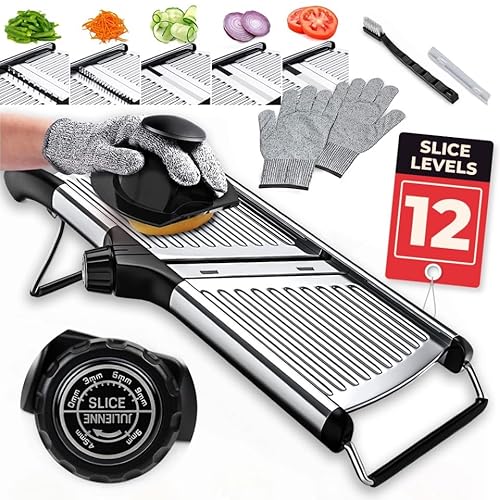
Gramercy publishes 1.9 lb and spends it on stability and on protection. Its base is non slip with anti slip feet, its blade is a rotating cylinder in professional 4CR15 stainless steel, its dial gives 12 slice settings, and the box includes cut resistant gloves, a removable blade guard and a cleaning brush. It is also the only pick here that publishes top rack dishwasher safe.
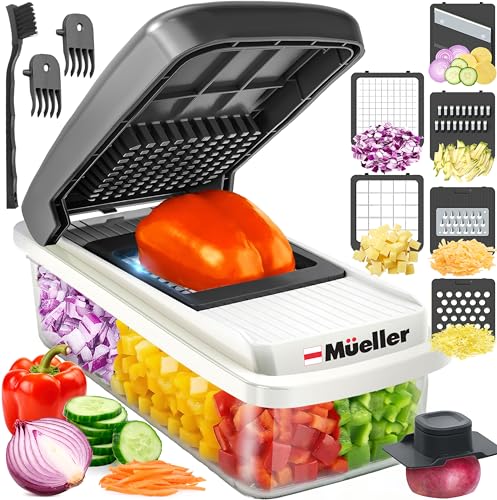
JANSKA publishes 2.03 lb, the heaviest figure in the pool, across six blades described as two chopper blades and four interchangeable ones for slicing, julienne and grating. It publishes a history rather than a specification, dating its own refinement to 2013, and its bullets name a different maker than the brand field does, which is worth noticing before comparing anything it says.
The Middle of the Range
Half a Pound With a Tray Under It
Solucky publishes 0.5 lb, five interchangeable blades covering coarse shred, fine shred, slice, julienne and grate, and a transparent leak proof catch tray that sits under the slicer. That is a machine’s feature list at a handheld tool’s weight, and it is achieved with BPA free food grade plastic around high quality stainless steel.
The catch tray is what the weight cannot include. A tray full of sliced vegetables is heavier than the slicer holding it, so the published 0.5 lb describes the tool empty and the working object is something else. Two of its five bullets are the same text repeated, which is a sign of how much of this listing is written rather than measured.
A Pound and a Half That Folds
SupMaKin publishes 1.5 lb and a foldable, compact design it says takes up little cabinet space, which is an unusual pairing: the weight of a bench tool with the storage of a light one. It publishes built in blades so nothing has to be handled to change the cut, a thickness range, and cleaning either under the tap or in a machine.
Its dimension fields, 6 by 5 by 13 in, describe a tool in use rather than folded, and the listing publishes no folded figure. So the claim about cabinet space is real and unquantified, which is the same shape of gap as OXO’s drawer, except OXO’s 0.5 by 3.75 by 11.5 in answers it by accident.
Where the Published Figures Stop Agreeing
A Slicer Published at Two Inches Across
Solucky’s size field says 4.17 by 5.39 by 6.22 inch. Its dimension fields read 0.98 by 2 by 2 in. Nothing 2 in across holds five interchangeable blades over a catch tray, so the fields are not describing this product, and the maker’s own figure is the one used above. The gap is not a rounding error, it is a different object.
The rest of the page is better behaved. OXO, SupMaKin, Gramercy and JANSKA all publish a single set of dimension fields and no competing sentence, so there is nothing to reconcile, and all four sets are plausible for the tools they describe. Gramercy’s 16.54 in is the longest published figure here and is consistent with a full bench slicer.
One Millimeter or a Tenth of One
SupMaKin’s title publishes an adjustment range of 1 to 8 mm. Its second bullet publishes 0.1 to 8 mm. A tenth of a millimeter is not a setting anyone would cut to and a one millimeter minimum is ordinary, so the title is the believable figure and the bullet is most likely a stray decimal point. Both are recorded in the table above as published.
The only other listing with a real range is Gramercy, which publishes 12 slice settings on a dial without naming the millimeters at either end. OXO publishes the opposite, exactly three settings with all three named. Solucky and JANSKA publish no thickness figures at all, on tools whose selling point is how many different cuts they make.
Which One Fits Your Kitchen
A drawer and no counter to spare. OXO, at 0.35 lb and 0.5 by 3.75 by 11.5 in, adjusting to 1 mm, 2.5 mm or 4 mm, with a large non slip handle, a stable foot and a window to watch the volume build. It slices over a bowl rather than into a tray.
Five cuts at a light weight. Solucky, 0.5 lb with five interchangeable blades and a transparent leak proof catch tray, published by the maker at 4.17 by 5.39 by 6.22 in. Its dimension fields describe something else entirely.
A bench tool that folds away. SupMaKin, 1.5 lb with built in blades so nothing is handled to change the cut, a published range of 1 to 8 mm, and a foldable body cleaned under the tap or in a machine.
Twelve settings and gloves in the box. Gramercy Kitchen Company, 1.9 lb on a non slip base, a rotating 4CR15 stainless blade cylinder, a 12 setting dial, cut resistant gloves, a removable blade guard and a brush, top rack dishwasher safe.
Six blades and a chopper base. JANSKA, 2.03 lb across two chopper blades and four interchangeable ones, at 5.47 by 11.18 by 5.2 in. It publishes no thickness settings, no steel grade and no dishwasher statement.
What We Could Not Verify
Every figure above is from the maker’s own listing. These are the things we went looking for and could not source in any of the eight.
- No listing says how much of its weight is blade and how much is housing, which is what separates a light tool from a flimsy one.
- Solucky publishes 4.17 by 5.39 by 6.22 in in words against dimension fields of 0.98 by 2 by 2 in.
- SupMaKin publishes 1 to 8 mm in its title and 0.1 to 8 mm in a bullet for the same adjustment.
- Solucky and JANSKA publish no thickness settings at all, and Gramercy publishes 12 settings without naming the range they cover.
- SupMaKin claims a foldable design that saves cabinet space and publishes no folded dimension.
- JANSKA’s own bullets name a different maker than its brand field does, and it publishes neither a steel grade nor a cleaning method.