How the Five Compare on the Numbers
Sixteen manual grinders are on this fact sheet and almost all of them list pour over among the brews they suit. Only one tells you where to set the dial for it. That is the difference this page is built on, because a grinder with forty clicks and no guidance is forty guesses, and the same grinder with a starting number is one adjustment away from a good cup.
The five below range from four grind levels to forty eight, and from a 20 g hopper to an 80 g one. Four publish a weight in their own words as well as in the field. Two publish something about the burr beyond its material, and three of them tell you never to let water near the mechanism while a fourth says to rinse it.
The figure that would settle a pour over decision is grind retention, and nobody publishes it. Nor does anyone state a step size in millimeters except one listing elsewhere in the pool, which says each click moves 0.05 mm. Two of these five publish a burr figure at all, and the other three name a material and stop there.
Which Listings Tell You Where to Set It
Thirty Two to Thirty Four Clicks
Agilive publishes the single most useful bullet on this fact sheet. It gives click counts by brew method: about 7 to 20 for an espresso machine, about 20 to 24 for a moka pot, about 32 to 34 for pour over, and about 36 to 40 for a French press. It calls those reference values and asks you to adjust to taste, which is the honest framing.
For a daily routine that turns setup into one step. It also publishes a 38 mm stainless steel burr, a CNC machined 420 stainless grinding core, an aluminum alloy body with an ABS handle, and an instruction to turn the dial clockwise to a stop before first use so the starting point is known.
Six Settings Named After the Brew
VEVOK CHEF takes the opposite approach and removes the counting entirely. Its six external settings are labeled by brew rather than by number, and the listing names espresso, AeroPress, pour over, French press, Chemex and cold brew among them. With six positions there is nothing to dial in, which is a real advantage on a routine and a real limit on a fussy one.
It is also the only pick that publishes how long a grind takes, at about 45 seconds, and the only one with a stated capacity for its glass container at 48 g. It publishes 6 inches tall and 0.99 lb in its own words, and its weight field agrees, which happens less often on this fact sheet than it should.
How Many Settings Is Enough
Forty Eight Clicks, or Four Levels
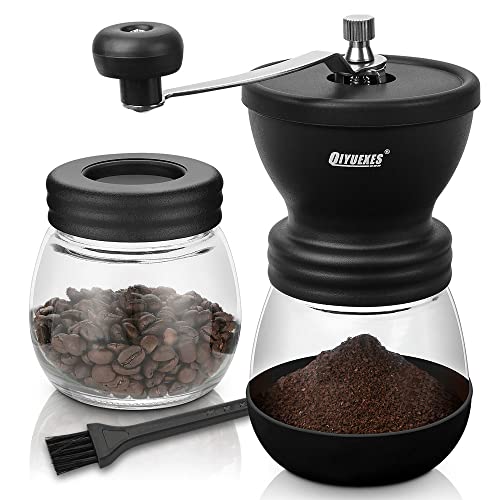
QIYUEXES publishes 48 settings on an external adjustment ring, an 80 g bean capacity and 425 g of grinder, and names pour over among the methods without saying where to set it. Forty eight positions give real resolution for someone who wants to move one click and taste the difference, and they are only useful if you keep a note of where you were.
LHS sits at the other end with four grinding levels on a knob in the middle of the body. For a single brew method that is enough and it cannot be dialed in, because a pour over sits between two of four positions rather than on one of forty eight. The listing does not name pour over at all, which is consistent rather than an omission.
A Hardness Figure and a Burr Diameter
HAMILADUO publishes the only material specification here that goes past a name: a CNC machined stainless steel conical burr at a hardness of 55 to 58 HRC, on a dual bearing central shaft in a full metal aluminum alloy body. It also states that its hexagonal burr is faster for espresso and saves effort when grinding for pour over, which is the closest thing to a reason in this group.
Agilive publishes the other figure, a 38 mm burr. Everyone else names ceramic or stainless steel and leaves it there. Ceramic is claimed by QIYUEXES and LHS to run cooler, and stainless steel is claimed by Agilive and HAMILADUO to cut faster, and no listing on this fact sheet measures either claim.
Cleaning, Where the Listings Contradict Each Other
Three Say Never Use Water
Agilive states it twice in two separate bullets: never wash with water, and disassemble and clean with the brush about once a week if you use it often. HAMILADUO says do not rinse with water and clean it with the included brush. QIYUEXES says use the included brush or a dry cloth. Three grinders, three versions of the same prohibition.
That matters more on a daily routine than on an occasional one, because oils build up. Agilive is the only listing that puts a frequency on the job, at once a week, and it is also the only one that warns not to grind within the 1 to 6 setting range before first use or when changing settings, which is a break in protection for the core.
One Says Just Rinse It
LHS states that its grinder is easy to clean and that you simply rinse it with water. Three other picks on this page say the opposite about their own mechanisms. Both positions can be true of different designs, and a buyer reading one listing would never know the other position exists, which is why they are worth putting side by side.
VEVOK CHEF publishes no cleaning instruction at all, which on a stainless burr in a glass container is the gap. What it does publish is that the glass bottle can be replaced if it breaks, and QIYUEXES supplies two jars so a broken one is not the end of the grinder. Those are the practical answers to the same fragility.
Which One Fits Your Kitchen
Knowing the setting before you start. Agilive, a published 1.2 lb with a 38 mm CNC machined 420 stainless burr in an aluminum alloy body, publishing click counts by brew including about 32 to 34 for pour over, and a weekly brush clean with water never used.
Six positions and no counting. VEVOK CHEF, a published 0.99 lb at a stated 6 inches tall with six external settings labeled by brew including pour over and Chemex, a stainless conical burr, a 48 g glass container and about 45 seconds a grind.
Dialing in one click at a time. QIYUEXES, a published 0.69 lb, stated as 425 g and 2.95 by 2.95 by 7.28 inches, with 48 settings on an external ring, a conical ceramic burr, an 80 g capacity and two jars with a brush.
A metal body and a hard burr. HAMILADUO, a published 1.3 lb, stated 600 g, with a CNC machined stainless conical burr at 55 to 58 HRC on a dual bearing shaft in a full metal aluminum alloy body and a 20 g hopper.
One brew and a quick rinse. LHS, a published 0.81 lb with a ceramic burr and four grinding levels on a central knob, supplied with two containers, and stated easy to clean by rinsing with water. It does not name pour over.
What We Could Not Verify
Every figure above comes from the maker’s own listing text. These are the things we went looking for and could not source in any of them.
- No listing publishes grind retention, so how much coffee stays inside the burr between brews is unstated everywhere.
- Only Agilive publishes a setting for pour over, so on three of these five the starting point is a guess.
- Only two of the five publish any burr figure, a 38 mm diameter and a hardness range, and three name a material only.
- Agilive publishes no capacity, so how many cups one fill grinds is unknown on the best documented pick here.
- VEVOK CHEF publishes no cleaning instruction, and three of the other four forbid water outright while the fifth recommends it.
- No listing publishes a step size in millimeters, though one grinder elsewhere in this pool states 0.05 mm a click.