How the Five Compare on the Numbers
Three listings were left out. One is a plastic nesting set whose fifth piece is a coffee scoop rather than a cup. One publishes four cups, a handle and a ring and nothing else across five bullets. One is a steel set whose published grade is the best in the pool but whose sizes duplicate a set already here. The five below cover the two kinds of measuring cup and every size a recipe is likely to ask for.
Weight is published on all five and each figure counts a different number of pieces. Pyrex is 2.8 pounds, the heaviest here, for two glass jugs. EWFEN is 1.27 pounds for seven cups, seven spoons, five mini spoons and a leveler. Hudson Essentials is 1.06 for six cups, OXO 0.79 for four, and YILIHCIA the lightest of the five at 0.77 for four cups, five spoons and a scraper.
What the table cannot tell you is whether any of these cups actually holds what it says. Not one of the five publishes a tolerance, a calibration standard or a fill volume in milliliters for its dry cups, and a stamped steel cup can be out by a teaspoon without looking wrong. Only the glass jug publishes a second unit at all, and it is the only one of the five that can be checked against a scale without emptying it.
Which Sizes Are Actually in the Box
The Missing Two Thirds
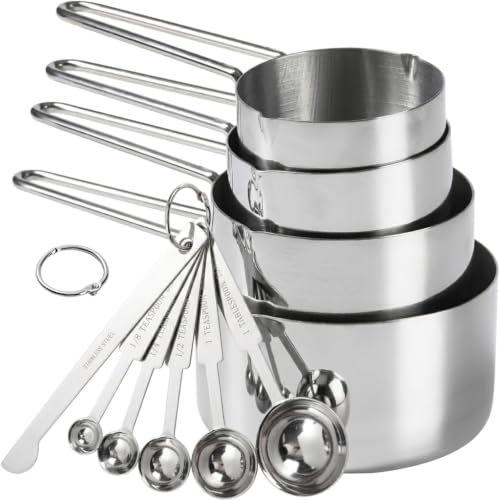
The standard nesting set is four cups: a quarter, a third, a half and one. Recipes do not restrict themselves to those. Two thirds of a cup and three quarters of a cup appear constantly in baking, and with a four piece set you get them by combining two cups and hoping you leveled both. OXO and YILIHCIA are both four piece sets and both leave those two out.
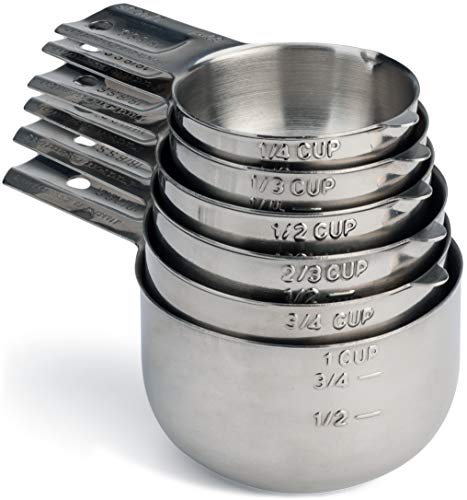
Hudson Essentials publishes six: a quarter, a third, a half, two thirds, three quarters and one. EWFEN publishes seven, adding an eighth of a cup below the quarter. Those two are the only sets in this pool that measure two thirds or three quarters in a single scoop, and if you bake rather than cook, that is the specification that decides this page.
Seven Cups, Seven Spoons and Five More Spoons
EWFEN is the largest set here by a wide margin: seven cups from an eighth to a full cup, seven spoons from a sixteenth of a teaspoon to a tablespoon, five additional mini spoons and a leveler. A sixteenth of a teaspoon is a genuinely unusual size and it exists for spice work rather than baking.
It also publishes a detail no other listing here mentions: each cup carries markings on the outside for a smaller measurement that is visible on the inside, so one cup reads two volumes. On a set that already covers seven sizes that is close to redundant, but it is the kind of design note that only turns up when someone has thought about the object.
Dry Cups and a Glass Jug Are Not the Same Tool
Why Pyrex Is Here
Four of these five are dry measuring cups: you fill them past the rim and level off. Pyrex is the other kind, a graduated glass jug you fill to a line and read at eye level, in a 1 cup and a 2 cup. Using one for the other’s job is the most common measuring error in a home kitchen, and no listing in this pool explains the difference.
Pyrex is also the only pick that publishes two units, bold measurements in both ounces and milliliters, and the only one that goes in a microwave, a freezer or a preheated oven as well as a dishwasher. Its 2.8 pounds for two jugs is glass rather than steel, which is why it is the heaviest set here and the only one that can break.
What Each Does Better
For flour, sugar and anything you scoop, the nesting steel sets are correct: you cannot level a liquid jug and you cannot read a jug accurately below about a quarter of its volume. For milk, oil, stock and melted butter the jug is correct, because a dry cup filled to the brim will spill before it reaches the counter.
That means a serious kitchen owns one of each, and it also means the choice on this page is not really between five products. It is between four versions of one tool and one example of a different one. Nothing in any of these five listings acknowledges that, which is why the sizes and the units are the only honest comparison available.
Steel, Markings and the One Published Gauge
0.7 Millimeters, and Nobody Else Says
YILIHCIA is the only listing in this pool to publish a metal thickness: cups crafted from 0.7 mm stainless steel, with spoons formed in one piece. On a measuring cup that number matters because a thin stamped cup flexes when you press flour into it, which changes the volume you just measured.
EWFEN says its cup body was thickened and gives no figure. Hudson Essentials, OXO and Pyrex publish nothing about thickness at all. EWFEN does publish its alloy, 18/0 stainless steel, which is the nickel free grade, and it is the only alloy named here: Hudson Essentials says food grade stainless, OXO and YILIHCIA say stainless steel, and none of the three goes further.
Etched, Engraved or Printed
Markings are the part of a measuring cup that fails, and three of the five address it. OXO publishes permanent, etched measurement markings. EWFEN publishes engraved size marks on the inside and the outside. Pyrex publishes bold, large measurements in ounces and milliliters, which on glass are fired on rather than cut in.
Hudson Essentials and YILIHCIA publish nothing about how their sizes are marked, which on a dishwasher item is a real omission: a printed figure on steel will eventually go, and an unmarked measuring cup is a small bowl. Hudson Essentials does state that its cups are dishwasher safe and will never rust or corrode, which is a claim about the body rather than the numbers on it.
Which One Fits Your Kitchen
Baking from real recipes. EWFEN publishes seven cups from an eighth to a full cup including both two thirds and three quarters, seven spoons down to a sixteenth of a teaspoon, five mini spoons and a leveler, in one piece 18/0 stainless with engraved marks inside and out on a removable ring.
Six sizes and nothing you will not use. Hudson Essentials publishes a quarter, a third, a half, two thirds, three quarters and one cup in food grade stainless, nesting inside one another with a stainless pour spout, stated rust proof and dishwasher safe, at 1.06 pounds.
Cups that do not scatter in the drawer. OXO uses magnetic handles that hold the four cups together and let you take one off at a time, with permanently etched markings, soft non slip handles and a shape designed for leveling. Its four sizes leave out two thirds and three quarters.
Honey, oil and sticky ingredients. YILIHCIA publishes dual pour spouts for thin and thick liquids, welded non slip handles for messy hands, a 0.7 mm cup body which is the only gauge on this page, and a leveling scraper, with four cups and five spoons at 0.77 pounds.
Liquids rather than dry ingredients. Pyrex is the only graduated glass jug here, a 1 cup and a 2 cup marked in both ounces and milliliters, with a curved spout, safe in the microwave, freezer, preheated oven and dishwasher. At 2.8 pounds for two it is glass, and it can break.
What We Could Not Verify
These six things decide whether a measuring cup measures, and the listings settle none of them.
- Accuracy. Not one of the five publishes a tolerance or a calibration standard, so a set that reads a teaspoon light would look exactly like one that does not.
- Volume in a second unit on the four dry sets. Only the glass jug publishes milliliters, so the steel cups cannot be checked against a scale without emptying them.
- Metal thickness on four of the five. One listing publishes 0.7 mm, one says its body was thickened without a figure, and three say nothing.
- How the sizes are marked on two of the five. Neither Hudson Essentials nor YILIHCIA says whether its marks are etched, engraved or printed.
- Dishwasher safety on one of the five. EWFEN publishes a removable ring and stackability and never states whether the set can be washed in a machine.
- Dimensions on four of the five. Only EWFEN publishes fields, so how much drawer any of the others occupies is unstated.