How the Five Compare on the Numbers
Four of these five arrive as more than one thermometer. Escali puts four mini steak dials in a set, Copkim puts three digital probes in a box with three tip protectors, and both AWLKIM listings put two in a box, one analog and one digital. The fifth, Vuwwey, is a single body with two probes, which is a different way of solving the same problem.
The counts are not the whole story. What each listing adds beside the units is where they separate: pot clips on one, tip protectors on another, batteries and a fold-out guide on a third, and a wired leave-in probe on the fourth. Escali adds nothing but four differently colored dial faces, which is the only extra it needs.
What the table cannot tell you is whether a second identical tool is worth more than one better tool. No listing here publishes a per-unit price break, a warranty that covers both units, or what happens if one of a pair fails. Two of the five publish no weight at all, and one publishes a weight that belongs to a single unit rather than to the pair it ships.
What Is Actually in Each Box
Four Dials, Three Probes, Two Pairs
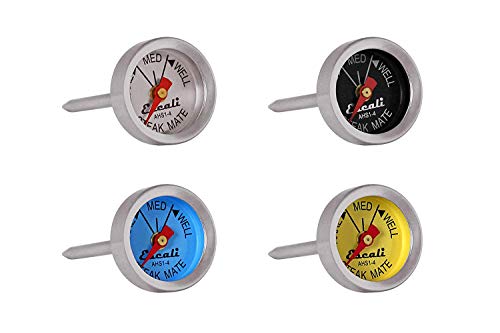
Escali packs the most units: four mini steak thermometers with a 2.25 inch probe and a 1 inch dial each, labeled rare, medium and well done rather than numbered. The reason for four is stated plainly in the listing: everyone likes their food cooked differently, so four differently colored dial faces let the cook track four steaks at once on one grill.
Copkim ships three digital units of about 9.2 inches each with a 5 inch stainless probe, and its own bullet gives the reason as ample quantity for daily use and replacement. Both AWLKIM listings ship two and both give the same reason in almost the same words: one for the kitchen, one for the grill, or one to give away.
The Extras Are Where They Separate
The analog AWLKIM adds two pot clips, and the bullet explains what they are for: a spring clip holds the probe off the bottom of a pan so you read the jam rather than the pot. That makes the pair useful for yogurt, cheese making and a water bath as well as a roast, which no other listing here claims.
The digital AWLKIM adds CR2032 batteries and a fold-out meat temperature guide in the box, on top of a doneness chart printed on the handle, a magnet and a hang loop. Copkim adds three probe tip protectors, which is the only listing here that addresses what happens to a sharp probe loose in a drawer.
One Body With Two Probes Is Also a Set
An Instant Read and a Leave-In in One Handle
Vuwwey ships one thermometer and two probes. The fold-out probe gives a spot reading in a stated three seconds, and a second wired probe is meant to stay in the food with the unit outside the heat, with an alarm you set and walk away from. That covers two jobs the other four cannot cover with a single tool.
Both AWLKIM listings make the same split across two bodies instead. The analog pair stays in the meat to 500 F and reads through the oven door. The digital pair states the opposite in its own bullet: designed for spot checks, not for leave-in oven use. Buy the wrong one of those two and the pair does half of what you wanted.
Why a Second Identical Tool Is Not Always the Answer
Two of the same thermometer is only useful if you need two readings at once, or a spare. Escali’s four make sense because four steaks finish at four different moments. Copkim’s three make sense as replacements for a tool with a button cell and no stated waterproof rating beyond a washable body. Two identical digital units make sense mostly as a spare.
Vuwwey’s arrangement is the one that adds a capability rather than a copy, and it is also the one publishing the least. It gives no probe length, no weight and no washing instruction, on a body its fields give as 1.77 by 6.5 by 0.63 inches. A hands-free alarm you cannot rinse is a real limitation for a raw meat tool.
What a Multi-Pack Does Not Tell You
One Published Weight Belongs to One Unit
The analog AWLKIM publishes 0.09 lb while its own bullet says 1.4 oz each. Those two figures agree with each other and disagree with the box, because 1.4 oz each means the pair weighs twice that. The published field is a single thermometer, so it cannot be compared with the 0.25 lb Copkim publishes for three units or the 0.16 lb the digital pair publishes for two.
The same listing states 5.1 inches long and a 4.5 inch probe, which is consistent, and its dimension fields were set aside as a carton at 2.5 by 5.0 by 2.5 inches. Escali and Vuwwey publish no weight at all, so on a page ranking by what arrives in a box, two of five give no way to judge how much of it there is.
Three Listings Publish No Reading Time
Speed is not the axis here, but its absence tells you something about these listings. Escali, Copkim and the analog AWLKIM publish no reading time at all, which for two analog dials is expected and for a digital three-pack is not. The digital AWLKIM publishes 2 to 3 seconds and Vuwwey publishes 3 seconds.
Accuracy is patchier still. Copkim publishes plus or minus 1.8 degrees Fahrenheit, the digital AWLKIM and Vuwwey both publish plus or minus 2, and the two analog listings publish none. For comparison, the fastest models elsewhere in this pool publish half a second and much tighter tolerances, and none of those arrives as a set.
Which One Fits Your Kitchen
The cook grilling steaks for four. Escali is the only pick with four units, each a 2.25 inch probe under a 1 inch dial labeled rare, medium and well, in four colors so nobody’s steak gets mixed up. It publishes no weight and no accuracy.
The cook who keeps losing thermometers. Copkim ships three digital units of about 9.2 inches with 5 inch probes, three tip protectors and AG13 button cells, publishing minus 58 to 572 F and plus or minus 1.8 degrees Fahrenheit.
The cook who roasts and makes jam. The analog AWLKIM pair needs no battery ever, reads 120 to 220 F on a 2.5 inch dial through the oven door, is rated to 500 F and adds two pot clips to hold a probe off a pan bottom.
The cook who wants one by the grill and one indoors. The digital AWLKIM pair includes batteries, a fold-out guide, a magnet and a hang loop, publishing 2 to 3 seconds and plus or minus 2 F. Its own bullet rules out leave-in oven use.
The cook who wants an alarm rather than a spare. Vuwwey is one body with two probes, a fold-out for spot checks in a stated three seconds and a wired probe that stays in the food with an alarm. It publishes nothing about washing.
What We Could Not Verify
Everything above is taken from the makers’ own published text, and on what actually arrives in a box that text has real holes.
- No listing publishes a warranty that covers both or all of the units it ships, or what happens if one fails.
- Escali publishes no weight, no accuracy figure and no temperature range for its set of four.
- Vuwwey publishes no probe length, no weight and no washing instruction for a raw meat tool.
- The analog AWLKIM field weight is a single unit rather than the pair the listing sells, and nothing says so.
- Copkim publishes no waterproof rating, only that the entire body is washable.
- No listing says whether the units in a multi-pack are calibrated to each other, or how far two of them may disagree.