How the Five Compare on the Numbers
Start with the honest answer to the qualifier. Nothing in this pool takes a socket. Across all sixteen listings there is no cord, no plug, no wattage and no voltage, so a kitchen short of outlets can buy any of them. What separates them is the level below that: eleven run on a cell and five run on nothing at all. Those five are bimetal dials, and they are what this page ranks.
Once the power question is settled the order is decided by two published figures: the temperature range the dial covers and whether the maker permits it to stay inside a hot oven. AWLKIM publishes both, a 120 F to 220 F dial and oven, grill and smoker use to 500 F. The others publish one or the other, and the Escali steak set publishes neither in degrees.
The row this table cannot fill is accuracy. Every digital model in this pool publishes one, from plus or minus 0.5 F to plus or minus 2 F, and not one of these five dials publishes any figure at all. AWLKIM gets closest by printing a 212 F boiling-point mark so the dial can be checked against water, which is a verification method rather than a specification.
What No Battery Actually Buys
The Two Listings That Say It Outright
AWLKIM is the most explicit listing in the pool. Its first bullet reads: stays in the meat while it cooks, no battery ever, and it names the mechanism, bimetal mechanics, nothing to charge, nothing to replace, nothing to set up. A later bullet repeats the point for the gift case, offering the second unit to the cook who is tired of gadgets that need charging. Two thermometers, two pot clips, and nothing to buy again.
Rubbermaid is the other one to say it in so many words: battery free, mechanical thermometer reads instantly and without the need for battery power. It is an instant-read pocket tool rather than a leave-in, published at 5 by 1.4 by 1.25 inches with a sheath and a pocket clip, NSF certified, and 0.06 pounds, the lightest of these five.
The Three That Simply Do Not Have One
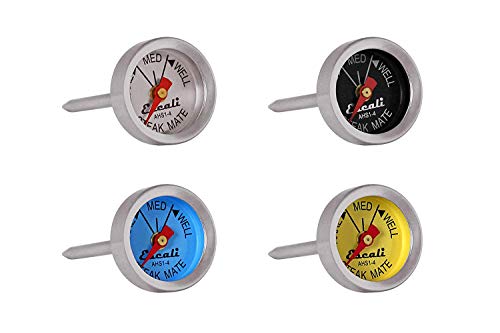
The two Escali dials and the SPOROLWE never use the word battery, because a bimetal dial has nowhere to put one. Escali’s AH1 publishes a 140 F to 190 F range in both units with a 4.75 inch probe and a 2.375 inch dial. The AHS1-4 steak set publishes four colored dials with a 2.25 inch probe and a 1 inch face. SPOROLWE publishes a 40 F to 220 F range behind a 2 inch dial.
What none of the three publishes is what happens when the dial drifts. A bimetal spring is a mechanical part and it moves over years, and the only listing here that gives you a reference point is AWLKIM’s 212 F boiling mark. The digital models offer ice-bath recalibration with a button. That is the trade for needing no power, and no listing in this pool states it plainly.
Ranges, Ovens and What Each Dial Is For
Narrow on Purpose
Escali publishes 140 F to 190 F, which is roasting and nothing else. AWLKIM publishes 120 F to 220 F, the meat range plus boiling. SPOROLWE publishes 40 F to 220 F and argues for the low end explicitly: starting 80 degrees lower than a standard analog dial means resting meat can be tracked as it climbs. Rubbermaid publishes 0 F to 200 F, which is the only range here that goes below freezing.
Against those, the digital half of this pool publishes -58 F to 572 F almost uniformly: TempPro, Copkim, AWLKIM’s digital pair, Antonki and Vuwwey all give that span, and Taylor gives -40 F to 396 F. If you fry, make candy or check frozen food, a mechanical dial will not do it and this page is the wrong shortlist. If you roast meat, the wide range is buying nothing and costing a battery.
Only One Oven Ceiling in the Whole Pool
AWLKIM publishes 500 F for the oven, grill and smoker, and backs it with a 304 stainless casing and a tempered-glass lens it says will not melt or warp. That is the only maximum oven temperature published by any thermometer on this fact sheet. Escali’s AH1 and its steak set both say the thermometer may be left in meat cooking in an oven or grill, and neither gives a limit.
SPOROLWE is sold as a leave-in and describes oven roasting, grilling and slow cooking without a figure either. Rubbermaid is the one pick here that rules it out, publishing that it is to be used to test food temperature outside of the oven or grill. That is not a flaw so much as a different tool: it is an instant read you carry in a pocket, and it is on this page because it needs no cell.
The Eleven Listings With a Cell in Them
Every Battery Type Named
The digital half of this pool is unusually forthcoming about power. TempPro publishes 1 AAA battery for up to 3,000 hours of use and argues that a AAA lasts twice as long as a button cell and is easier to replace. Taylor publishes one LR44 included with an insulation tab to pull. Copkim publishes a button cell AG13. AWLKIM’s digital pair and Antonki both publish a CR2032. Grille Perfect publishes two AAA cells.
Those are honest, useful disclosures and they are also the reason those eleven are not on this page. A kitchen that is short of sockets is often short of the small supplies drawer too, and a thermometer that stops working on Christmas morning because a CR2032 died is worse than one with a narrower range that never stops at all.
What the Digital Models Do Better
They are faster and they say by how much. ThermoMaven publishes 0.5 seconds at plus or minus 0.5 F. TempPro publishes 1 second at plus or minus 0.9 F. AWLKIM’s digital pair publishes 2 to 3 seconds at plus or minus 2 F. Copkim publishes 0.1 F increments at plus or minus 1.8 F. Not one of the five mechanical dials on this page publishes a response time or an accuracy figure.
They also do things a dial cannot. Vuwwey publishes a wired probe for monitoring an air fryer, oven, grill, BBQ or smoker with an alarm you set. Alpha Grillers publishes a recalibrating feature and an IP67 rating. If the kitchen has a drawer of batteries and wants an alarm, those are better tools, and they are covered by other pages on this site rather than this one.
Which One Fits Your Kitchen
A Sunday roast and no interest in gadgets. AWLKIM publishes no battery ever, oven, grill and smoker use to 500 F, a 120 F to 220 F dial with target temperatures printed on the face, and two units with two pot clips for jam or a water bath.
You want to set a target and leave the room. SPOROLWE publishes a 40 F to 220 F dial with a red indicator clip you slide to your finish temperature, plus a 4.3 inch stainless probe read through the oven door. It publishes no weight and no oven ceiling.
Failing eyesight and a hot oven. Escali’s AH1 publishes a 2.375 inch dial, the largest dial figure here, over a 4.75 inch probe, with a 140 F to 190 F range in both units and NSF certification. Its 0.1 pounds is the heaviest of these five.
Spot checks rather than roasts. Rubbermaid publishes battery free, 0 F to 200 F, 0.06 pounds and a sheath with a pocket clip. It is the one pick here the maker says to use outside the oven, so it never leaves your hand.
Four people who all want their steak differently. The Escali steak set publishes four colored dials reading rare, medium and well done, a 2.25 inch probe and a 1 inch face, all oven and grill safe. It publishes no degrees at all, which is the point and also the limitation.
What We Could Not Verify
Every figure above is a manufacturer’s own published number or sentence. These are the things we went looking for across all sixteen listings and did not find.
- An oven ceiling for four of the five. Only AWLKIM publishes one, at 500 F, and three other leave-in dials say oven safe with no figure.
- A temperature range for the Escali steak set, which publishes three doneness words and no degrees.
- A stated accuracy for any of these five dials. Every digital model in the pool publishes one and no mechanical one does.
- A response time for any of the five. Rubbermaid says it reads instantly and puts no number on it.
- A weight for SPOROLWE or the Escali steak set, and a probe length for Rubbermaid.
- Any statement about bimetal drift over time, or how often a mechanical dial should be checked, from any of the five makers.