How the Five Compare on the Numbers
A pasta rack is used at the exact moment a kitchen is busiest: the dough is cut, the water is on, and the pasta is drying while both hands are needed elsewhere. That makes two published figures more useful than any dimension. How long the maker says the rack takes to go up, and what it supplies to move the pasta.
Two of the sixteen listings publish a setup time. KITCHENDAO states within 15 seconds for its plastic tree and Hourise states less than a minute. Four publish a transfer wand, and one of those publishes where the wand lives afterwards. Three publish rods or bars that come out loaded, which moves a whole batch rather than a strand. The rest publish tool free and leave it there.
What the table cannot show is the part of the job that takes the time. Every listing publishes what the rack does while the pasta hangs and none publishes how long that is. So the setup figure and the transfer method are the only two columns that describe the minutes a cook actually spends, and on two of these five the setup row is empty.
The Handoff at Both Ends
Wands, and Where They Go Afterwards
Four listings in the pool publish a transfer wand: KITCHENDAO’s bamboo rack, MUMSUNG, OWOWO and MARCATO. The wand is a rod you lift cut pasta onto so it travels from the machine to the arms without being touched. MUMSUNG counts its wand as one of 11 stainless steel arms, which is honest bookkeeping and also means the arm count reads higher than the drying count.
MARCATO publishes the follow-up question nobody else answers: the multipurpose wand stores neatly in the central column. A loose rod in a drawer is a rod you hunt for, and MARCATO is the only listing in these sixteen that gives the wand an address. The rest supply it in the box and say nothing about where it goes when the pasta is cooking.
Bars That Come Off Loaded
The second half of the trip is worse than the first, because the pasta is now dry and brittle and there is boiling water waiting. OWOWO publishes a solution: lift the bars from the rack and carry them directly to the pot. That is one trip per bar rather than one per handful, and with 12 bars it moves a whole row at a time.
Two more listings publish the same idea without the phrasing. KOUISYY publishes 16 rods that can be easily removed so pasta goes from the maker to the drying bar or from the bar to the pot. Purewood publishes 16 removable drying arms and a 10 pound load. Neither is picked here, because neither publishes a setup time or a wand, and this page ranks on both.
What Setup Actually Costs
Seconds, a Minute, and Ready in Minutes
KITCHENDAO publishes the only hard figure in the pool: this pasta hanger could be set up within 15 seconds due to the innovative design. Hourise publishes the next best thing, a method and a bound: insert the removable arms and start drying pasta in less than a minute, no tools, no screws. Those two sentences are the whole published evidence on setup speed across sixteen listings.
Everything else is adjectival. Weston publishes ready in minutes and, to its credit, the steps: place the stand in the base, tighten by hand, slide five 14 inch rods in to form 10 arms. Purewood publishes screw the center rod into the base and slide in the arms. Cambom publishes no screw and tools needed, just hand adjust, even a child can fit it. Useful, unmeasured.
The Rack That Wants a Drill
Ferrochef is the outlier and worth naming, because it is the one rack here that costs real time once and then none. It is wall mounted, and the package contains mounting screws, wall plugs and an L shaped wrench; you pre-drill the holes yourself. It publishes 10 rods and arms of 13.8 inches, and it folds against the wall afterwards.
For a kitchen where counter space is the constraint rather than patience, that trade is the right one, and this page leaves it out only because the topic is the weeknight, not the install. STWWO sits between the two: no tools required, simply screw it on, onto a marble base at 3.31 pounds that the maker says resists tipping. Assembly is a screw thread rather than a drill.
Figures That Do Not Hold Up
Five Weights the Tooling Flags
KITCHENDAO’s bamboo rack publishes 1.26 pounds against 11.0 by 11.8 by 12.8 inches. MUMSUNG publishes 1.9 pounds at 12.0 by 12.0 by 23.6. OWOWO publishes 1.0 pound at 12 by 12 by 16. KITCHENDAO’s plastic rack publishes 0.59 pounds at 11.97 by 17.28 by 11.77. Ayfasnk publishes 2.0 pounds. Each of those is flagged as too light for an object of that size.
On this category the flag is usually wrong and it is worth saying so. A pasta tree is a thin column, a small base and a dozen rods; the box it occupies is mostly air, so a pound of bamboo filling a cubic foot is exactly right. STWWO is the one pick here that carries no flag, and it is the one with stone in the base.
Three Racks, Three Different Sizes
MARCATO publishes 18.5 by 2.75 inches in its own sentence, repeats the pair in its size field, and then publishes dimension fields of 10.0 by 18.13 by 3.0 inches. STWWO publishes 18.5 inches tall on a 12 inch round base in the bullet and fields of 17.72 by 11.81 by 16.93. In both cases this page uses the maker’s sentence and records that the fields were discarded.
Hourise is the hardest case, because there is nothing to fall back on. Its fields read 2.0 by 15.0 by 2.0 inches, which is a bundle of arms and a column in a sleeve rather than a rack standing up, and the listing publishes no size in words at all. OWOWO is the opposite: 16 by 12 by 12 inches in the bullet and 12 by 12 by 16 in the fields, the same object twice.
Which One Fits Your Kitchen
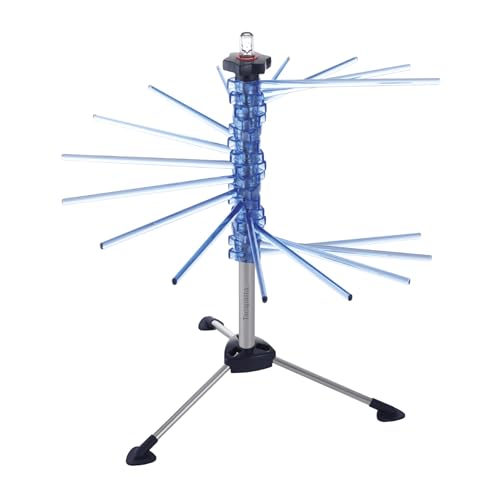
You make pasta on a weeknight, not a weekend. KITCHENDAO’s plastic tree publishes a setup within 15 seconds, 8 rotatable rods, a load of up to 5 pounds and dishwasher permission. It is the only pick here with both a stated setup figure and a stated washing method.
You want the batch moved in one go. OWOWO publishes a transfer wand and bars that lift off the rack loaded, 12 of them, with up to 13 pounds of capacity and a 5 degree upward tilt on every rod to stop strands sliding.
You lose small parts. MARCATO stores its wand inside the central column and nothing else detaches: 16 rods of 8 inches fan out and close up. It publishes 18.5 by 2.75 inches and wipes clean with a dry brush or cloth.
Your counter is uneven or the rack keeps tipping. STWWO screws on without tools onto a marble base the maker says resists tipping, 18.5 inches tall on a 12 inch round base, with 10 arms of 21.5 inches. At 3.31 pounds it stays where it is put.
You want it gone the moment the pasta is dry. Hourise publishes 8 arms that push in, drying begun in less than a minute, and the reverse afterwards: take the rack apart and tuck every piece into a drawer. It publishes no capacity at all.
What We Could Not Verify
Every figure above is a manufacturer’s own published number or sentence. These are the things we went looking for across all sixteen listings and did not find.
- A drying time from any of the sixteen listings, so how long the rack is occupied is unstated.
- A setup time from fourteen of the sixteen. Only KITCHENDAO’s plastic rack and Hourise publish one.
- A capacity for STWWO and Hourise, which publish arm counts and no load.
- Any statement of how OWOWO’s bars lock into the rack, which is what a loaded bar hangs on.
- An in-use size for Hourise, whose only published dimensions describe it packed.
- A washing statement for OWOWO, STWWO and Hourise, three of the five picks.