How the Five Compare on the Numbers
A pastry mat is a rectangle competing with a counter, so the working area is the specification and every one of these five publishes one. They read 23.6 by 15.7, 24 by 16, 28 by 20, 31 by 24 and 36 by 24 inches, which means the largest covers close to double the area of the smallest.
The second half of the question is what the mat becomes when the baking stops. One listing publishes a figure for that, 75 percent less space when rolled, and supplies the strap that does it. Two publish a method rather than a figure, and two say nothing about storing the mat at all.
What the table cannot settle is how thick a rolled mat is. Three of these five describe rolling the mat up and none publishes the diameter of the roll, which is the figure a drawer actually cares about. A 0.7 mm mat 36 inches wide rolls into something considerably fatter than the same mat at 24 inches.
The Size Ladder, End to End
Twenty Three Inches, With a Pin On Top
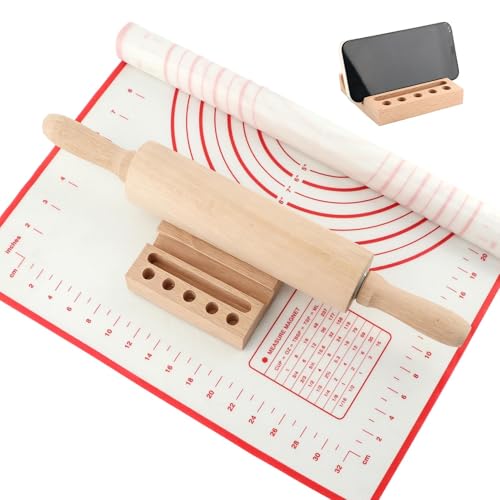
Meirivrn publishes the smallest working area here, approximately 23.6 by 15.7 inches, and it is not really selling the mat. The listing is about a 15 inch hand polished beech rolling pin on 304 stainless steel bearings, with a wooden stand that stores the pin and, the listing notes, doubles as a phone stand.
It publishes a maintenance schedule most listings skip: wipe with a damp cloth, air dry, and apply mineral oil or olive oil once or twice a month to preserve the grain. That is a wooden pin’s real cost. The mat gets a size and nothing else: no thickness, no temperature, no storage claim.
Thirty Six Inches, and the One Storage Figure
Folksy sits at the other end with 36 by 24 inches, and it does the comparison itself: 50 percent more working space than a regular 28 by 20 inch mat. On a page about small kitchens that is the pick to think hardest about, because the area you gain on the counter has to go somewhere afterwards.
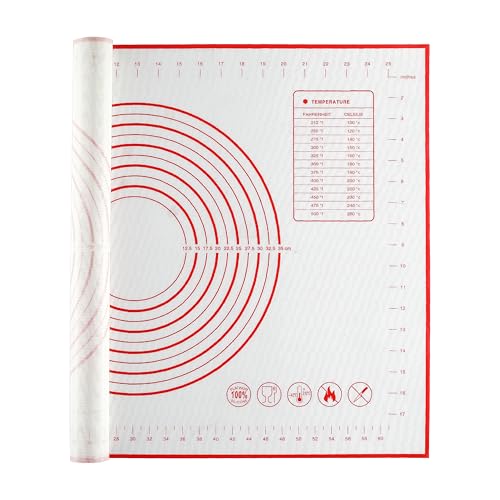
Which is why its second figure matters. An elastic strap is supplied, the mat rolls up in seconds, and the listing states storage space is reduced by 75 percent. No other listing in this pool quantifies the rolled state at all. It publishes 0.7 mm thickness, a dishwasher rating, and 1.3 lb.
Thickness, and the Edge That Replaces It
QUELLANCE Publishes What 0.7 Millimeters Is For
QUELLANCE publishes 0.7 mm and then explains it: twice as thick as a standard 0.3 mm mat, so it withstands daily kneading, rolling and shaping without warping, and lays flat rather than rolling up at the edges. That is the clearest statement of why thickness matters on any listing in this pool.
At 28 by 20 inches, given again as 50 by 70 cm, it is the middle size here and the lowest weight at 0.68 lb. Cleaning is warm soapy water or air drying, with a note that burnt sugar and fat fall off on their own. It folds or rolls for storage, with no strap and no hanging hole published.
LCOCWMY Publishes an Edge Instead
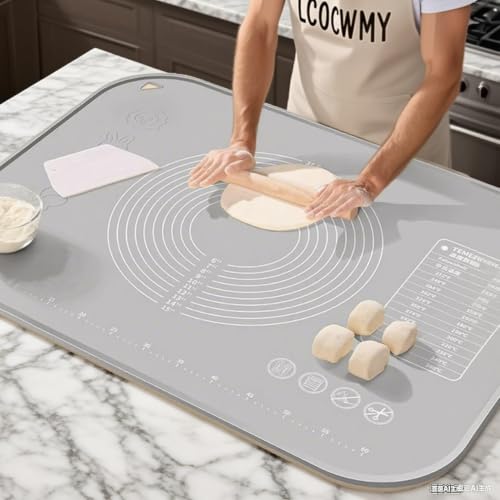
LCOCWMY publishes no overall thickness and instead publishes a 6 mm raised edge, stated to stop spills while kneading and rolling. That is a different answer to the same mess: rather than resisting wrinkles, the mat contains what escapes. It also publishes hanging holes for rolling or folding it away.
Its temperature range is the only one in this pool, and its two halves disagree: minus 40 C to 230 C, given as minus 100 F to 450 F. The upper pair converts correctly and the lower pair does not, since minus 40 degrees C is minus 40 degrees F. It publishes a dual scale, a central circle template for pie crusts and 1.1 lb.
When the Mat Is the Accessory
MIKULA Sells the Rings
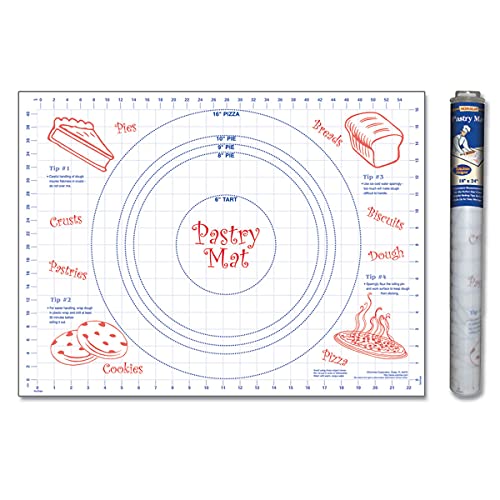
MIKULA publishes a 24 by 16 inch measuring mat in silicone and glass fiber, stated not to wrinkle or fade, and then spends the rest of the listing on the pin: 304 stainless steel with four detachable rings at 1/16, 1/8, 1/4 and 3/8 inch for rolling to a set thickness, plus a two in one dough scraper and pizza cutter.
Those ring figures are worth more to a baker than most mat specifications, because dough thickness is what decides whether a pie crust bakes evenly. The mat is documented by size alone, and at 1.5 lb the set is the heaviest thing on this page, most of which is the pin.
What Both Sets Leave Out
Neither pin set publishes a mat thickness, a temperature range, a storage claim for the mat, or a washing instruction for it. On both, the mat is described as measuring or non stick and sized, and the rest of the listing belongs to the pin. If the mat is the reason for the purchase, a mat sold alone is better documented.
If the pin is the reason, the sets are the better buy on published detail: a 15 inch beech pin on steel bearings with a stand and an oiling schedule, or a steel pin with four ring sizes and a scraper. Both publish a mat size that puts them at the small end of this page, which for a cramped counter is not a drawback.
Which One Fits Your Kitchen
A counter with no room to spare. Meirivrn, a mat published at approximately 23.6 by 15.7 inches with a 15 inch beech pin on steel bearings and a wooden stand that keeps the pin off the surface, at 1.14 lb, with oil recommended monthly.
Pastry at a set thickness. MIKULA, a 24 by 16 inch measuring mat in silicone and glass fiber with a 304 steel pin carrying rings at 1/16, 1/8, 1/4 and 3/8 inch, plus a scraper and pizza cutter, at 1.5 lb.
The lightest thing to lift and store. QUELLANCE, a 28 by 20 inch mat published at 0.7 mm and stated twice as thick as a 0.3 mm mat, washed in warm soapy water, folded or rolled away, at 0.68 lb.
A wet dough and a clean counter. LCOCWMY, a 31 by 24 inch mat with a 6 mm raised edge, hanging holes, a dual scale and a circle template, published from minus 40 to 230 degrees C, dishwasher safe, at 1.1 lb.
Room to roll a full batch. Folksy, a 36 by 24 inch mat at 0.7 mm stated to give 50 percent more space than a 28 by 20 inch mat, with an elastic strap and a stated 75 percent storage saving, at 1.3 lb.
What We Could Not Verify
Every figure above comes from the maker’s own listing text. These are the things we went looking for and could not source in any of them.
- No listing publishes the diameter of the mat once it is rolled up.
- Two of the five publish no mat thickness at all.
- LCOCWMY’s Fahrenheit conversion does not match its own Celsius figure.
- Neither rolling pin set publishes a thickness, a temperature or a washing rule for its mat.
- Two publish nothing about how the mat is stored.
- No listing publishes how much the silicone weighs separately from the pin it arrives with.