How the Five Compare on the Numbers
Surface and thickness are the two figures that matter, and they do not move together. The Folksy mat is published at 28 by 20 inches, the JJOO at 27 by 19, the EuChoiz at 24 by 16 and the mat in the Vinoil set at about 23.6 by 15.7 inches. The AMUZHI set publishes a mat but no mat size at all, only the 16.7 inch rolling pin that comes with it.
On thickness, the EuChoiz states 1.3 millimeters, the Folksy 0.7 millimeters, and the JJOO, AMUZHI and Vinoil publish no figure, with JJOO saying only that it is thicker than most standard mats. Weights run from 0.42 pounds for the JJOO mat alone to 1.1 pounds for the Vinoil set, which includes a stainless steel pin, so the weights are not measuring the same object.
The table cannot tell you how a printed ruler survives. Every mat here carries markings and not one maker says whether they are printed on the surface, printed under a layer or molded in, which is the difference between a guide that lasts and one that fades in a year of dishwater. Nor does any maker publish the accuracy of those rulers, which is worth a thought before you trim a pie crust to a printed circle.
Thickness, and the Baselines Makers Invent
0.7 Millimeters Against Two Different Standards
The Folksy mat states 0.7 millimeters and says that is almost twice as thick as others, which it puts at 0.4 millimeters. A second 28 by 20 inch mat left off this page makes the same 0.7 millimeter claim but calls the standard 0.3 millimeters. Same thickness, same size, two different definitions of ordinary. The lesson is that the multiplier in these listings is marketing and the millimeter figure is the only part worth reading.
Thickness earns its keep in one specific way, which both makers name: a thin mat wrinkles and creeps when you lean into a roll. Folksy says the 0.7 millimeter mat will stay put on the table and not wrinkle. That is a claim about stiffness rather than protection, and it is the reason a mat you will knead on is not the same purchase as a mat you will only bake on.
The Thick Mat and the Mats With No Figure
The EuChoiz is published at 1.3 millimeters, nearly double the two mats that state 0.7, and it is the only one with a raised edge, stated at 0.16 inches, meant to keep liquid from running off while you work wet dough. At 1.08 pounds it is heavier than the flat mats of similar area, which is consistent with the extra material rather than a surprise.
The JJOO, the AMUZHI mat and the Vinoil mat publish no thickness at all. JJOO says it is thicker than most standard silicone mats and that it lays flat without sliding, wrinkling or bunching, which is the same argument the others make with a number attached. The JJOO does name fiberglass reinforcement, and a reinforced mat can be stiff at a lower thickness, so the missing figure is not proof of a thin mat.
What Is Actually Printed on the Mat
Rulers, Circles and Conversion Charts
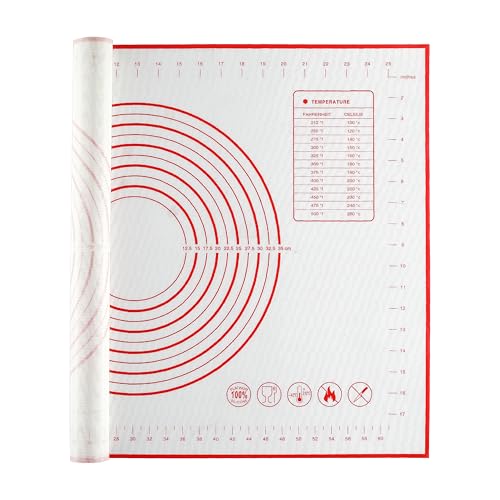
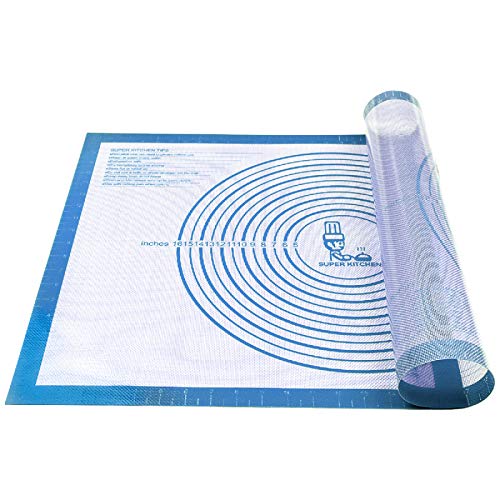
The JJOO publishes the most complete set of markings on this page: rulers along the edges reading 0 to 25 inches and 0 to 42 centimeters, circular guides from 5 to 14 inches for pie crusts, plus conversion charts and baking guides. For anyone who rolls to a tin size rather than by eye, the circles are the feature, because they remove the tape measure from the middle of a sticky job.
The AMUZHI mat is close behind and adds something none of the others print, a temperature reference and volume conversion charts alongside inch and centimeter rulers and circle guides. Folksy, EuChoiz and Vinoil all say their mats carry measurements without describing them, so you are buying a marked mat without knowing the ranges or whether it has circles at all.
Reinforcement and the Surface Itself
Only the JJOO and the AMUZHI state fiberglass reinforcement in the silicone. That matters more than it sounds: a reinforced sheet resists stretching, and a mat that stretches drags its printed ruler out of true as you roll. Folksy, QUELLANCE and EuChoiz describe food grade silicone with a nonslip back and no internal reinforcement, and Vinoil describes its mat only as a measuring pastry mat.
Nonstick performance is claimed by all five and specified by none. QUELLANCE goes furthest, saying the surface needs no flour to stop dough sticking and that burnt sugar and fat fall off on their own. Those are usable claims for a pastry mat, but they are claims, and the only care limit anyone publishes is the Folksy temperature range of minus 30 F to 470 F.
Mats Sold With a Rolling Pin
A Pin That Sets the Thickness
The Vinoil set is a 17 inch 304 stainless steel pin with four detachable rings at 1 sixteenth, 1 eighth, 1 quarter and 3 eighths of an inch, and a mat of about 23.6 by 15.7 inches. The rings are the reason to buy the set, because they hold a pastry at one thickness across the whole sheet, which is the thing a bare pin cannot do and a printed circle on a mat cannot fix.
Read the ring conversions with care. Vinoil gives the four rings as 2, 4, 6 and 10 millimeters, and another listing for the same fraction set gives 2, 3, 6 and 10 millimeters. One eighth of an inch is nearer 3 millimeters than 4, so the metric column in one of those listings is rounded loosely. If you work in millimeters, trust the fractions rather than the conversions.
The Seamless Pin and the Dishwasher
The AMUZHI set pairs a fiberglass reinforced mat with a 16.7 inch one piece steel tube, and its selling point is the absence of seams for flour to lodge in. It is also the only pick where the listing puts both the mat and the pin in the dishwasher, and it is the only set that describes storage for both pieces, the pin lying flat and the mat rolled tight.
What AMUZHI does not publish is the size of its mat, which is a strange omission on a set whose mat is half the product. Vinoil publishes its mat size in a sentence while its structured dimension fields describe the pin instead, at 17 inches long, so this page reads the maker’s description for the mat and the fields for the pin. Two more pin and mat sets were left out for publishing even less.
Which One Fits Your Kitchen
The baker who rolls to a tin size. The JJOO prints rulers reading 0 to 25 inches and 0 to 42 centimeters with circle guides from 5 to 14 inches, is fiberglass reinforced, and at 0.42 pounds is the lightest of the five to roll up and put away.
The baker who needs the biggest surface. The Folksy is published at 28 by 20 inches with a 0.7 millimeter thickness and a nonslip back, and it is the only pick that states a temperature range, from minus 30 F to 470 F. It arrives with instructions and a gift box.
The baker working wet or sticky dough. The EuChoiz is the thick one at 1.3 millimeters with a 0.16 inch raised edge to keep liquid on the mat, plus side holes so it hangs to dry. Its 24 by 16 inch surface is the smallest of the four mats with a published size.
The baker who wants one clean kit. The AMUZHI brings a fiberglass reinforced mat with rulers, circles, a temperature reference and volume charts, plus a seamless 16.7 inch steel pin, and both pieces go in the dishwasher. It never publishes the mat size.
The baker rolling pastry to an exact thickness. The Vinoil set puts four rings at 1 sixteenth, 1 eighth, 1 quarter and 3 eighths of an inch on a 17 inch 304 stainless pin, with a mat of about 23.6 by 15.7 inches. Trust the fractions, not the millimeter conversions.
What We Could Not Verify
Every mat here is sold on its markings and its thickness, and much of both is missing:
- How the rulers and circles are applied. No maker says printed, sublimated or molded, so nobody says whether they fade.
- Thickness for three of the five. JJOO, AMUZHI and Vinoil publish no millimeter figure at all.
- The mat size in the AMUZHI set, which publishes only the 16.7 inch pin.
- Any accuracy claim for the printed rulers, which are the reason to buy a marked mat.
- Temperature limits for four of the five. Only the Folksy publishes a range.
- Whether a mat is safe under a hot tray. Only one temperature range exists here and no maker states oven use for the mat itself.