How the Five Compare on the Numbers
There are almost no numbers to compare, and that is the single most useful thing to know before buying piping tips. Of the seven listings looked at, exactly one publishes a tip dimension and exactly one publishes a weight. No maker publishes a tip diameter, a wall thickness, a coupler thread size or an opening width. What they publish instead is a piece count, and sometimes the tip numbers themselves.
Those tip numbers are the figures that actually matter. A 1M, a 2D or a 195 is a standard code that tells you what the tip does, lets you follow a tutorial, and lets you replace one tip rather than a set. PJERASR and ABEJFIC list every code in their sets. Suuker hides its codes in the size field. COKUMA and Kaverme describe shapes in words and never give a code at all.
What no cell in that table can tell you is the one measurement every buyer needs: the diameter of the tip base, which decides whether it fits a standard coupler or must be dropped straight into a bag. Three of these five are sold as large tips, which by convention means too wide for a coupler, but not one maker publishes the base diameter that would confirm it. RFAQK publishes a height range instead.
Why the Tip Number Is the Real Specification
A Code Is a Shape You Can Reorder
Piping tip codes are an old industry convention, not branding. A 1M is a large open star, a 2D is a large drop flower, a 195 is a French star. Every tutorial, every book and every video refers to them by number, which means a set that prints its codes lets you follow instructions written by someone who has never seen your set. PJERASR prints nine codes and ABEJFIC prints eight.
The second reason is replacement. Tips get dropped, crushed underfoot, or lost down a drain, and a code lets you buy that one shape back for a fraction of a new set. A set described only as containing a round plain tip, an open star, a closed star, a drop flower and a French star tells you the shapes but leaves you guessing which of several sizes of each you were sent.
Where Each Set Sits on That Scale
RFAQK takes the opposite approach and is arguably the strongest of the five on this point: it states that all 48 tips are numbered on the metal itself and ships a pattern chart, a booklet, an e-book in PDF and a video course to read them by. It does not print the list of 48 codes in the listing, so you cannot check for a specific shape before buying, but every tip identifies itself once it arrives.
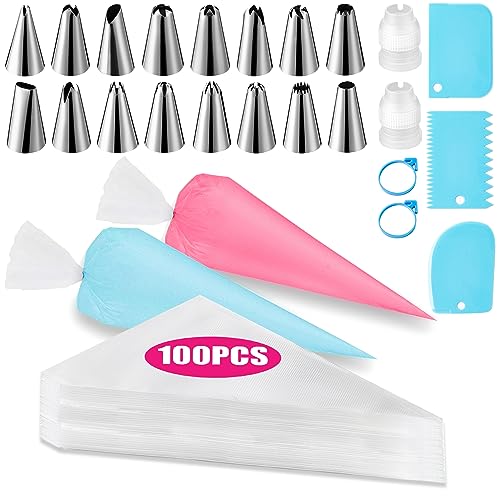
BOOMIBOO sits at the bottom of this scale. It states 16 stainless tips and names the categories, star tips for rosettes, round for writing and dots, petal for flowers, leaf for leaves and multi-hole for grass, but publishes no codes and no numbering claim. For a kit whose main content is 100 disposable bags, the tips are effectively unidentified accessories rather than a chosen collection.
Sets, Kits, and What You Are Really Buying
Five Tips, or Seventy Four Pieces
These five listings are not the same kind of purchase. COKUMA sells 5 large tips and nothing else, ABEJFIC sells 8, PJERASR sells 9. RFAQK sells a 74 piece kit built around 48 tips in 14 styles with bags and teaching material. BOOMIBOO sells 100 disposable 12 inch bags with 16 tips, two couplers, two bag ties and three plastic scrapers thrown in around them.
If you already own bags, a coupler and a scraper, the large tip sets are the efficient purchase, and the only question is how many shapes you want. If you own nothing, the two kits solve the whole problem in one order. What makes them hard to compare is that a piece count of 74 or 100 mixes disposable bags in with tools, so the counts are not measuring the same thing.
Disposable Bags Against Reusable Ones
BOOMIBOO is explicit that its bags are disposable and go straight in the trash, which for buttercream and melted chocolate is a genuine convenience argument: a piping bag is the single most annoying thing in the kitchen to wash. It states the bags are anti burst, hold stiff buttercream without splitting, and have an anti-slip textured surface. It also states a wide open mouth for filling.
RFAQK also states 12 inch anti burst pastry bags but does not say whether they are disposable or reusable, and does not give a count, so how many bags sit inside the 74 pieces is unanswerable from the listing. Neither maker publishes a bag thickness in microns or mils, which is the figure that actually predicts whether a bag splits under a stiff frosting.
Steel, Seams, and the Two Sets That Look Identical
Grade Stated, and Grade Assumed
ABEJFIC names 304 stainless steel, and PJERASR names food grade stainless without a grade number. RFAQK, BOOMIBOO and COKUMA say only stainless steel. Two of the listings left off this page, Suuker and Kaverme, also name 304 and stainless respectively. Grade matters here for one narrow reason: a tip lives in acidic frosting and goes through a dishwasher, and lower grades pit over time.
Three of the five make a claim about the seam. COKUMA states a smooth, seamless construction, and PJERASR states a smooth seamless structure for precise work. A seam inside a star tip is where frosting catches and where a cleaned tip stays dirty, so this is a more useful claim than it sounds. Only ABEJFIC and COKUMA state dishwasher safe in plain words.
The Same Five Tips Under Three Brands
Three listings in this pool describe what appears to be the same five-tip large set. COKUMA, Kaverme and Suuker all sell five large stainless tips. Kaverme lists them as round plain, open star, closed star, drop flower and French star. COKUMA’s bullet begins the identical list before the text is cut off. Suuker puts codes in its size field rather than its bullets: 1A, 1E, 348, 347 and 356.
COKUMA was kept here because it is the only listing in the whole pool that publishes a weight, 0.07 lb, and because it states dishwasher safe. Kaverme and Suuker were left out as near duplicates of it rather than as bad products. If the five-tip large set is what you want, treat those three listings as one product and buy whichever names its codes, which is Suuker.
Which One Fits Your Kitchen
The complete beginner. RFAQK, for the 48 numbered tips in 14 styles plus a pattern chart, booklet, e-book and video course. It publishes the only tip dimensions on this page, a height range of 0.8 to 1.73 inches, so you know the range of sizes before ordering.
The occasional decorator who hates washing bags. BOOMIBOO, for 100 disposable 12 inch bags with 16 tips, two couplers, two ties and three scrapers. The tips are unidentified and uncoded, so treat them as a starting collection rather than shapes you can reorder.
The cook who follows tutorials. PJERASR, because it prints all nine codes: 1A, 1E, 1M, 1C, 6B, 195, 356, 853 and 9FT. That is the longest code list published by any large set here, and it includes a 9FT that the other sets do not carry.
The buyer who wants steel grade in writing. ABEJFIC, the only set here that names 304 stainless and states dishwasher safe, with eight codes printed: 1M, 2F, 4B, 195, 853, 2D, 1A and 6B. Two large drop flower and petal shapes the smaller sets skip.
The cook who already owns bags and a coupler. COKUMA, five large tips at 0.07 lb, stated dishwasher safe with a seamless construction. It is the smallest and simplest purchase here, and the only one on this page whose weight is published at all.
What We Could Not Verify
These listings publish very little that can be measured. The following were looked for on all seven and not found.
- No maker publishes the base diameter of a tip, which is what decides whether it fits a standard coupler.
- No maker publishes a wall thickness, so how easily a tip crushes cannot be compared.
- Only RFAQK publishes any tip dimension, a height range of 0.8 to 1.73 inches across its 48 tips.
- Only COKUMA publishes a weight, 0.07 lb, so there is nothing to weigh the other four against.
- Neither kit publishes a bag thickness or a bag count, so bag durability and quantity are unknown.
- RFAQK states that all 48 tips are numbered but does not print the list, so a specific shape cannot be confirmed before buying.