How the Five Compare on the Numbers
A pizza steel is the heaviest flat thing most kitchens own, and it lives somewhere for years between bakes. So the figures that matter for a cabinet are the weight you have to lift out and the area that has to lie flat. Across these five, published weight runs from 13.6 pounds to 27 pounds and every one of them is at least 16 inches on its long side.
Thickness explains most of that spread. Loftern, Primica, Chef Pomodoro and Artisan Steel all publish a height field of 0.24 or 0.25 inch, and their weights sit between 13.6 and 16 pounds. ThermiChef publishes 0.38 inch and 27 pounds, which is most of a stone slab more than the others for the same 16 inch reach.
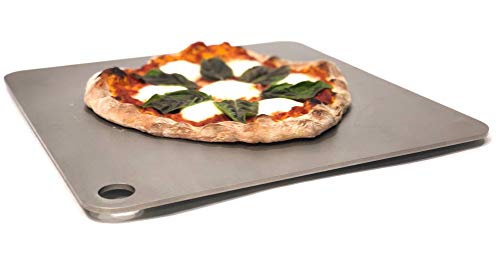
The one figure this page will not use is any published grip. Not a single one of these five states a handle, a hole or a cutout, because a pizza steel is a plain rectangle. Two other listings in this category do publish one, a thumb hole and a pair of lifting holes, and neither of those two products is well enough documented elsewhere to earn a place here. For these five, plan on two oven mitts and both hands.
Weight Is the Storage Specification
Under sixteen pounds
Loftern publishes 13.6 pounds across a 14 by 16 inch plate, the least weight of the five, and its listing is the only one that addresses fit at all by saying the plate fits most standard ovens and outdoor cookers. Primica publishes 14.44 pounds across 16 by 13.4 inches, and Chef Pomodoro publishes 14.64 pounds with field figures of 13.39 by 16.14 inches.
Those three are within a pound of each other and differ mainly in shape: two are close to 14 by 16 and one is narrower at 13.4 inches. For a low cabinet or a shelf above shoulder height, that pound matters less than the fact that all three are lifted the same way, flat, with no grip, from whatever they are stacked against.
Sixteen pounds and twenty seven
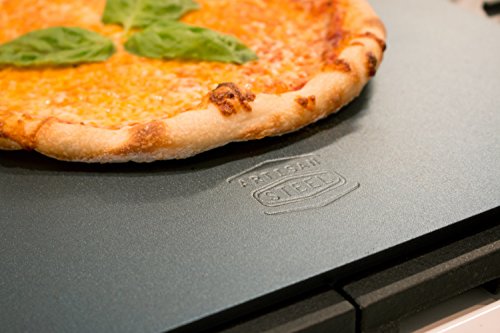
Artisan Steel publishes 16 pounds in both its field and its own text, at 16 by 14.25 by 0.25 inches, which makes it the only plate here whose two weight figures agree exactly. That consistency is worth noting in a category where the fields and the copy routinely disagree, and it is also the largest quarter inch plate of the five.
ThermiChef publishes 27 pounds in its field and 27.5 pounds in its title, for a 16 by 16 inch plate at 0.38 inch. Its listing explains the purpose plainly: the thicker plate stores more heat than thinner steels and recovers faster between pizzas, which it recommends for hosting, batch cooking and bread. It is also the one plate here that two people might reasonably move together.
What Each Plate Asks of You Before the First Bake
Ready to cook
Loftern and Chef Pomodoro both state that the plate arrives pre-seasoned and ready to use. Loftern describes a low maintenance surface that needs a quick wipe rather than soaking, and says the steel resists warping and cracking unlike ceramic stones. Chef Pomodoro says the plate arrives seasoned so the seasoning step can be skipped entirely.
Neither publishes what the seasoning is or how to renew it, which is the gap that matters over years rather than weeks. A seasoned surface is a consumable layer, and a listing that mentions it only as a convenience on day one gives you nothing for the day the layer wears through.
Season it yourself
ThermiChef publishes the full routine and is the only one of the five to do so: the plate ships shot blasted rather than pre-seasoned, and the instruction is to wash it, apply a thin coat of oil and bake it at 375 F for one hour. Artisan Steel takes the middle road, saying the plate is easy to wash and care for and should be re-seasoned only as needed.
Primica publishes nothing about seasoning in either direction. For a plate that will be stored for weeks between uses, that is a real omission, because a bare or lightly seasoned steel left in a humid cabinet is the one in this group most likely to come out with a bloom of rust on it.
Reading the Heat Claims
Twenty times what
Primica states almost 20 times the conductivity of ceramic and starts a heat capacity claim that its published text cuts off mid sentence. ThermiChef states up to 20 times more efficient heat conduction than a ceramic pizza stone. Artisan Steel says only that its surface is more conductive than ceramic or stone baking sheets, with no multiple attached.
None of the three names the ceramic stone being compared, its thickness or its conductivity, so the multiples cannot be lined up against each other or against anything else. What they do agree on is the direction, and the useful figure behind all of them is the thickness, which every one of these five publishes in its dimension fields.
The claim that is about storage
ThermiChef is the only listing here whose heat claim is framed as a reason to accept the weight: a thicker plate holds more heat and recovers faster between bakes, which it says suits back to back cooking. That is the honest version of the trade, and it means the 27 pound figure buys something specific rather than just being more metal.
Loftern makes the opposite argument without the numbers, describing high heat retention on a quarter inch plate and calling out versatility for sourdough, cookies, pastries and roasting. For a cabinet, that is the plate that comes out more often because it is easier to move, and a plate that gets used is worth more than a plate that performs better on paper.
Which One Fits Your Kitchen
The cook lifting from a low shelf. Loftern publishes 13.6 pounds, the least of the five, across a 14 by 16 inch plate that arrives pre-seasoned. It is also the only listing here that says anything about fitting an oven, claiming most standard ovens and outdoor cookers.
The cook with a narrow oven. Primica publishes 16 by 13.4 inches at 14.44 pounds, the least area of the five on its published fields, and states almost 20 times the conductivity of ceramic. It publishes nothing about seasoning, so plan to oil it yourself.
The cook who wants it seasoned on arrival. Chef Pomodoro publishes 14.64 pounds with fields of 13.39 by 16.14 by 0.24 inches and states the plate is pre-seasoned and ready to use. It publishes no seasoning routine for later, which is the figure you will want in a year.
The cook who wants figures that agree. Artisan Steel publishes 16 pounds in both its weight field and its own text, at 16 by 14.25 by 0.25 inches, made in the United States, with re-seasoning only as needed. It is the largest quarter inch plate here.
The cook baking several pizzas in a row. ThermiChef publishes 0.38 inch and 27 pounds, with a full seasoning routine at 375 F for one hour and advice to measure the oven before ordering. Read the weight twice before deciding where it will live.
What We Could Not Verify
All the figures above come from these makers’ published text. Here is what is missing.
- No handle, hole or grip published on any of the five plates.
- No seasoning routine from three of the five, including both plates sold as pre-seasoned.
- No storage or humidity guidance from any listing, for a bare steel plate.
- No explanation of the half pound gap between one plate’s stated and published weight.
- No named baseline behind any conductivity multiple.
- No steel grade from four of the five, only the words carbon steel.