How the Five Compare on the Numbers
Six listings came back and one is not here. GGIU sells a 2 pack of stackable wire baskets at 11.89 by 10.2 by 8.6 inches, publishes a lid 0.3 inches thick and a 10 second assembly, and duplicates what Snpwne does with two baskets and a cutting board lid. It is a good listing; it is the second wire basket set in a pool of six, which is why it is the one left out.
The five that remain are not really the same product. Three are sets of bins for a worktop, one is a pair of stainless baskets and one is a cabinet on wheels 38 inches tall. Across all five, the figure a buyer wants most, how much produce goes in, is published twice and in two different units.
What the table cannot tell you is how deep the produce sits. No listing publishes an interior measurement, so on every pick the useful depth has to be guessed from an exterior figure and a wall thickness nobody states. Nor does any listing mention light, which is the other half of stopping potatoes from sprouting, and four of the five are open or mesh-sided.
Capacity, Published Twice in Five Listings
Pounds Against Kilograms
ZICOTO is the only pick that translates its box into the thing you buy: about 9 to 10 pounds in the potato bin and about 6 to 7 in the onion bin. Both are approximate and both are useful, because a 5 pound bag of potatoes and a 10 pound sack are the two units a shop sells, and this is the one listing that lets you match them.
Dekosilave answers the same question in kilograms, stating its 13 by 7.1 by 5.9 inch potato container holds about 3 kilograms. Nothing else in the pool publishes a load at all. Because the two makers chose different units and neither publishes the other, this page leaves both as written rather than converting one and presenting the result as a maker’s figure.
Three Listings That Publish Boxes Instead
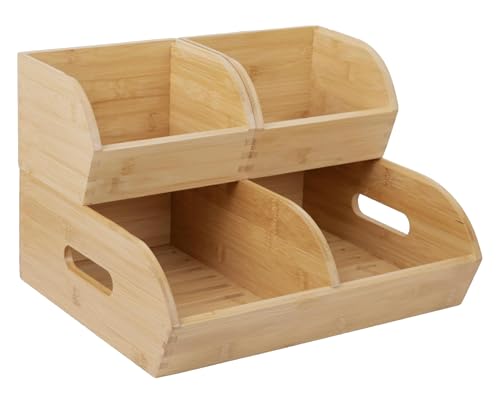
Homeware Express publishes the most thorough dimensions here, a large bin at 15 by 12 by 5 inches and two small bins at 7 by 6 by 5, and never says what fits inside. Snpwne does the same for its two baskets, 11.18 by 6.69 by 6.69 inches and 10.55 by 6.3 by 5.91. Both let you calculate a volume and neither will tell you a weight.
ARTETHYS is the least forthcoming in this respect. It publishes one overall figure, 15.7 by 13.4 by 38 inches, and nothing about how the interior divides: no shelf count, no per-layer height, no capacity. For a cabinet that is mostly interior, that is the omission that matters, and it is the only pick that needs assembling before you can measure it yourself.
Ventilation, and the One That Vents Underneath
Slits in the Base
Homeware Express is the only pick that puts the openings under the produce. Its first bullet makes the reasoning explicit: ventilated slits in the bases give natural air circulation and prevent the trapped moisture and stagnant air that spoil potatoes and onions. Anyone who has found a soft potato at the bottom of a pile knows exactly which surface that happens on.
The trade is the material. Bamboo with a lacquered finish and interlocking finger joints is handsome and it is also wood sitting under damp produce, where Dekosilave’s argument for coated iron lands: iron containers are less prone to damage than glass, ceramic or clay, and a matte powder coating resists flaking and rust.
Holes, Perforations and Open Mesh
ZICOTO and Dekosilave both drill vent holes in the walls of otherwise solid containers, which moves air past the produce rather than through the pile. Snpwne perforates its baskets more heavily and adds a large hollow opening so you can see what is inside without lifting a lid, which is also a lot of airflow.
ARTETHYS goes furthest with wire mesh on every side, and then does the one thing no other pick attempts: it seals the door. Its listing states the sealed door provides extra security for bread and vegetables and protects food from pests, which in a garage or a utility room is a different problem from moisture and a real reason to pick it.
Lids, Labels and Where It Lives
Three Lids With Three Jobs
Snpwne’s lid does the most work: it doubles as a cutting board, so the surface covering the onions is the surface you chop them on. Dekosilave publishes the thickest lid on the page, bamboo at 1.5 centimeters, which is the one most likely to keep light off a potato. ZICOTO fits a metal lid with a wooden handle and counts its 10.1 inch height with the lid in place.
Homeware Express publishes no lid at all, which fits a bamboo bin designed for airflow and leaves the produce in daylight. Dekosilave is also the only pick that labels its containers, printing Potatoes, ONIONS and GARLIC on the bodies, which sorts the store cupboard permanently and fixes what each box is for.
Stacking, Wheels and Two Sets of Figures That Argue
Homeware Express and Dekosilave both stack, with Dekosilave nesting as well when empty. Snpwne stacks and adds a slot that stops the baskets sliding when carried, which is a small detail that matters on a loaded pair. ZICOTO publishes no stacking claim, and ARTETHYS solves the whole question by rolling on 4 wheels.
Two listings disagree with themselves. ARTETHYS states 38 inches of height in its bullet where its dimension field reads 36, a 2 inch gap on a cabinet that has to fit under a shelf. Homeware Express states bins 5 inches high while its field reads 10, which most likely describes them stacked. ZICOTO is the only pick whose fields and bullet carry the same three numbers.
Which One Fits Your Kitchen
Anyone who buys potatoes by the sack. ZICOTO publishes about 9 to 10 pounds for its potato bin at 10.1 by 7.5 by 7.2 inches with the lid on, and about 6 to 7 pounds for the onion bin, in powder-coated metal with vent holes and a wooden lid handle.
A cupboard where everything gets mixed up. Dekosilave prints Potatoes, ONIONS and GARLIC on three iron containers, publishes about 3 kilograms for the 13 inch potato box, fits bamboo lids 1.5 centimeters thick, and stacks or nests with side handles.
A worktop where produce spoils from underneath. Homeware Express vents through the bases rather than the walls, in lacquered bamboo with finger joints, across one bin at 15 by 12 by 5 inches and two at 7 by 6 by 5, stackable with built-in handles at 6.0 pounds for the set.
A small kitchen with no spare surface. Snpwne’s lid doubles as a cutting board across two stainless baskets, 11.18 by 6.69 by 6.69 inches and 10.55 by 6.3 by 5.91, with a perforated body, a hollow opening and a slot that stops the stack sliding.
A garage, a utility room or a pantry with pests. ARTETHYS is 15.7 by 13.4 by 38 inches on 4 wheels, with mesh sides, a baffle on each layer and a sealed door stated to keep pests out. It weighs 27.72 pounds empty and you assemble it yourself.
What We Could Not Verify
Every figure above comes from the makers’ own listings. These are the things we went looking for and could not source.
- Three of the five publish no capacity at all, in any unit, only exterior dimensions.
- No listing publishes an interior depth or a wall thickness, so usable volume cannot be calculated.
- ARTETHYS publishes a 38 inch height in its bullet and a 36 inch dimension field, unreconciled.
- Homeware Express publishes a 10 inch field against bins it states are 5 inches high.
- No listing mentions light or darkness, which is the other half of stopping potatoes sprouting.
- ARTETHYS publishes no shelf count and no per-layer height, so how the cabinet divides inside is unknown.