How the Five Compare on the Numbers
A shallow cabinet is settled by one number, and the number has to be one you can hold a tape measure against. Three of these five write a size into their own text. iDesign gives 14.5 by 6.25 by 3 inches, Newness gives 13.1 by 8.5 by 2.16 inches, and Dial gives 4.5 by 15 by 3 inches in a bullet. The other two do not.
All five publish three dimension fields, so there is always a fallback. What no listing here does is say which direction each field measures. iDesign writes 14.5 inches in its bullet while its depth field reads 14.75 inches, and the same bullet restates the size in centimeters as 36.8 by 15.9 by 7.6, which follows the bullet rather than the field.
What the table cannot settle is which of a listing’s own figures faces the front of the shelf. The fields are labeled width, depth and height, and the order of the three numbers moves from listing to listing: iDesign’s bullet reads 14.5 by 6.25 by 3 inches while its fields read 3, 14.75 and 6.25 inches in that order. Two further listings were left out, and both for reasons this page is about: Koja’s fields carry a warning that its published weight cannot belong to an object that size, and theaoo publishes no size for a single unit, because its fields describe a carton.
Where the Size Figure Comes From
Three Listings That Write It Into Their Own Text
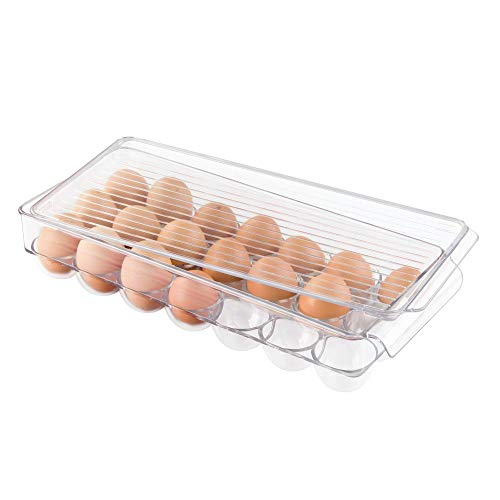
iDesign is the most thoroughly stated listing on this page. Its last bullet reads 14.5 inches by 6.25 inches by 3 inches high, and then repeats the same measurement in centimeters as 36.8 by 15.9 by 7.6. Two statements of one size, in two unit systems, is more than anything else here offers, and the two agree with each other.
Newness states 13.1 by 8.5 by 2.16 inches in the same bullet that gives its capacity, and its three dimension fields hold the same three numbers. It is the only one of these five where the words and the fields do not argue. Dial states 4.5 by 15 by 3 inches in its fourth bullet, and that is where its trouble starts.
Two Listings Where the Fields Are All There Is
mDesign carries no feature bullets at all on this fact sheet. Everything the listing offers sits in its title, which names a stackable plastic covered egg tray with a lid and a handle holding 12 eggs, and in its fields, which read 4.25 by 12.25 by 3 inches with a published weight of 0.75 pounds. There is no second source for any of it.
PBELIFCRTLR publishes a size line, and it holds one number: 5.59 inches, which is also its height field. The other two figures, 3.35 and 11.93 inches, appear only in the dimension fields. Its text is otherwise detailed, naming a 10 degree slope, two layers and a capacity of up to 14 eggs, so the single figure looks like a choice rather than an oversight.
Where a Listing Disagrees With Itself
One Tray and Two Published Sizes
Dial publishes two sizes for one tray. Its size line reads 4.4 inches by 15 inches by 4.5 inches. Its fourth bullet reads 4.5 inches by 15 inches by 3 inches. The 15 holds still and the other two numbers move, so a reader measuring a cabinet has to decide for themselves whether 4.5 inches or 3 inches is the figure to work from.
The dimension fields side with the bullet: they read 15, 4.5 and 3 inches. That leaves the 4.4 inch figure on the size line with no support anywhere else on the listing, and it leaves the 4.5 inch figure doing two jobs, standing as one dimension in the bullet and as a different one on the size line. Neither statement is marked as the correct one.
A Size Line That Holds a Single Number
The 5.59 inches PBELIFCRTLR publishes is the clearest case on this page of a stated size that does not describe an object. A size is three numbers, and one of them tells a reader very little about whether the thing will go in. The listing is not withholding the rest: its fields give 3.35 and 11.93 inches, and nothing on the listing contradicts them.
iDesign has a milder version of the same problem. Its bullet says 14.5 inches and its depth field says 14.75 inches. The centimeter restatement in that same bullet, 36.8 by 15.9 by 7.6, converts from the bullet’s inches rather than from the field, so two of iDesign’s three published statements agree and the field stands on its own.
What the Listings Say Beyond the Size
Eggs, Layers and What One Purchase Holds
The egg counts run 12, 14, 14, 21 and 24. mDesign’s title claims 12 and calls them dozen sections. Dial’s title claims 14. PBELIFCRTLR claims up to 14 across two layers and adds that the real number varies with egg size, which no other listing here says. iDesign claims 21 in individual slots. Newness claims up to 24 in each container, 48 in total.
Four of the five are a single unit. Newness is a set of two, and its stated 13.1 by 8.5 by 2.16 inches is one container rather than the pair, which its own bullet makes clear by giving the size in the same sentence as the per-container count. A reader buying it gets two objects to place in the cold, not one.
Covers, Handles and Washing
All five state a cover. iDesign names a clear lid, Dial a strong cover, and PBELIFCRTLR a detachable top cover with a groove on its upper face for stacking. mDesign and Newness name a lid in their titles. Four of the five state a handle: iDesign a built-in one for sliding in and out, Dial one for handling, Newness one with an extended buckle, and mDesign one in its title.
Washing is where these five separate most plainly. Newness states that it is dishwasher safe. iDesign asks for mild soap and water and tells you not to place it in the dishwasher. PBELIFCRTLR suggests hand washing in cold or warm water, says to avoid hot water, and rules the dishwasher out as well. Dial says only that it is easy to clean, and mDesign publishes no washing text.
Which One Fits Your Kitchen
The reader who wants a figure in the maker’s own words. iDesign. Its bullet gives 14.5 by 6.25 by 3 inches and restates the same size in centimeters as 36.8 by 15.9 by 7.6. It holds 21 eggs in individual slots under a clear lid, and it publishes no weight.
The reader buying two trays at once. Newness. Two containers, each stated at 13.1 by 8.5 by 2.16 inches and each holding up to 24 eggs, with troughs shaped for deviled eggs, a handle with an extended buckle, and the only dishwasher safe statement on this page.
The reader who wants eggs to roll forward. PBELIFCRTLR. Two layers on a stated 10 degree slope for up to 14 eggs, with a detachable cover in PP and PET, and the only listing of these five that names a cabinet among the places it is meant to sit.
The reader who wants a plain covered dozen. mDesign. Fields of 4.25 by 12.25 by 3 inches and a published weight of 0.75 pounds, with a lid, a handle and 12 sections named in the title. There is no feature text behind any of it.
The reader who will measure before buying. Dial. A 14 egg tray with a cover and a handle, published once as 4.4 by 15 by 4.5 inches and once as 4.5 by 15 by 3 inches, and 3.3 pounds, one of only two weights on this page.
What We Could Not Verify
Six things this page went looking for and could not source.
- A weight for iDesign, PBELIFCRTLR or Newness. Three of these five publish none, so a loaded tray cannot be weighed before it arrives.
- A size in mDesign’s own words. Its listing carries no feature text on this fact sheet, so its fields of 4.25 by 12.25 by 3 inches have no second source.
- Which of Dial’s two published sizes governs: 4.4 by 15 by 4.5 inches on its size line, or 4.5 by 15 by 3 inches in its fourth bullet.
- Two of PBELIFCRTLR’s three figures in its own words. It publishes 5.59 inches as its size and leaves 3.35 and 11.93 inches to the fields.
- Which direction any of these fifteen dimension figures measures. No listing here says which of its three numbers faces the front of a shelf.
- A washing method from Dial beyond easy to clean, and any washing text at all from mDesign.