How the Five Compare on the Numbers
One of these five puts a measurement of the tray in its size row. Two put a bare adjective there, one puts a capacity and a pack count, and one puts the words one size. Four of the five are multipacks whose dimension fields describe the carton, so on four listings out of five the only figure that describes the thing you freeze with sits in a sentence rather than a field.
The good news is that the sentence usually exists. Both listings that give a bare adjective publish a cube measurement elsewhere, and once you find it the two words order correctly. All five publish a weight, all five state a dishwasher is fine, and two publish a temperature range. Nobody publishes a measurement of a single tray except the one that puts it in the row.
The table cannot tell you which number to measure a freezer drawer with, because on four of the five the answer is a carton figure that stops being true the moment the box is opened. It also cannot flag the GGOW arithmetic: a compartment published at 4.13 inches across, in a package published at 4 by 6 by 2 inches, with two trays in it. One of those figures is wrong.
What Each Size Row Was Asked to Carry
The One Row That Holds a Measurement
CiCixixi writes 11.61 by 4.72 by 4.72 inches into its size row, and its three dimension fields hold the same three numbers with the first two swapped between slots. That is the only tray measurement on this page. It is also a figure with a question inside it, because 4.72 inches appears twice and the listing never says which of the two axes it belongs to, or whether the figure covers one tray or both on their stand.
The set is two stainless trays, a stand, an easy release lever on each tray, tongs and an ice pick, with eighteen cubes per tray. Those are generous details and none of them resolve the measurement. Note also that the figures are converted rather than native: 4.72 inches is 12 centimeters and 11.61 inches is 29.5 centimeters, so a round metric set was turned into inches before it reached the listing.
A Capacity, a Count, a Color and a Refusal
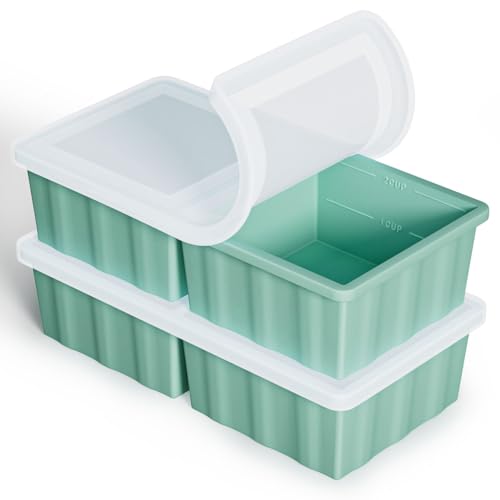
Xomoo uses the row for a capacity and a pack count rather than a size, which is a reasonable choice for a portion tray: the thing a buyer wants is the portion. Its own bullet backs the row up with fill marks at 125 ml and 4 oz and at 250 ml and 8 oz, so the 1 cup in the row is the top mark on a scaled compartment and not a nominal claim.
Aopigavi uses the row to say nothing at all. The words one size are not a measurement, a capacity or a count, and the listing carries no linear figure for the tray or the cube either. What it does publish is a volume scale from 1 Tbsp and 15 ml up to 2 Tbsp and 30 ml and 1 oz, plus ten cubes per tray across two trays. The portion is specified; the object is not.
Where the Adjective Is Calibrated After All
Extra Large Means a Cube of Four Inches
GGOW puts the words Extra Large in the size row and then, in its first bullet, publishes exactly what that means: a compartment of 2.16 by 4.13 by 4.13 inches, fill lines at 1 cup and 250 ml and at 2 cups and 500 ml, two compartments per tray, and a stated capacity of up to 8 cups across the two trays. The adjective is calibrated, just not where a buyer looks for it.
That is the useful pattern on this page. A bare adjective in the size row is not automatically empty; it is a pointer to a figure in a bullet. On GGOW the pointer resolves to the largest compartment here by a wide margin, and the 2 cups per compartment is a stronger claim for a soup tray than any linear measurement would have been.
Small Means a Cube of One and Seven Tenths
NFK does the same thing in the opposite direction. Its size row is the single word Small, and its first bullet publishes a cube of 1.7 by 1.1 by 0.8 inches, twelve cubes per tray and four trays for forty eight cubes in all. So two listings on this page use a bare adjective and both of them calibrate it, and the ordering the words imply survives the check.
That is worth more than it sounds. The common failure on size words is that nothing anywhere resolves them, and a buyer is left ranking adjectives from different sellers against each other. Here the two words come out in the right order on real figures, which means the adjective was descriptive rather than promotional. It is still the wrong slot for it.
What Happens When the Fields Are a Carton
Four Cartons and One Tray
Four of these five are multipacks, so their dimension fields were describing the box rather than the tray and have been moved aside and labeled as the package. Xomoo ships in 5.51 by 11.81 by 3.4 inches, NFK in 4.52 by 7.9 by 3.38 inches, Aopigavi in 4.53 by 10.43 by 1.57 inches and GGOW in 4 by 6 by 2 inches. Every one of those is a real published figure about a real object.
None of them is the tray. A carton figure is useful for one purpose, which is knowing what arrives on the doorstep, and useless for the purpose a buyer has, which is knowing what fits in a drawer. CiCixixi is the exception only because its own words repeat its field figures, which is what kept them in place as a measurement of the product.
The Box That Cannot Hold the Cube
GGOW is where the carton figures stop being merely unhelpful. Its package triple is 4 by 6 by 2 inches, and its own first bullet publishes a single compartment at 2.16 by 4.13 by 4.13 inches. One compartment measures 4.13 inches across two of its three axes, and two of the box’s three sides are 4 inches and 2 inches. The box is smaller than one compartment of one of the two trays inside it.
So one of those two published figures is wrong, and the listing offers nothing to break the tie. The compartment figure is the one to use, because it is stated in a sentence with a purpose and it agrees with the 2 cup fill line published beside it. The package triple is the one to discard, and this page does not rest any comparison on it.
Which One Fits Your Kitchen
The buyer who needs a figure to measure the freezer with. CiCixixi is the only option. It publishes 11.61 by 4.72 by 4.72 inches in its size row and in all three dimension fields, which no other listing here matches. It is 304 stainless, weighs 3.11 lb, makes eighteen cubes per tray, and arrives with a stand, tongs and an ice pick.
The buyer freezing soup in large portions. GGOW publishes a compartment of 2.16 by 4.13 by 4.13 inches with fill lines at 1 cup and at 2 cups and a stated 8 cups across both trays, which is the biggest portion on this page. It has steel reinforced edges, a tight lid and a push release, and the listing permits dishwasher, oven and refrigerator use.
The buyer who wants a temperature number. Xomoo publishes a range from minus 8 to 428 degrees Fahrenheit and Aopigavi publishes minus 40 to 446 degrees Fahrenheit, and nobody else publishes one at all. Xomoo adds a stainless steel ring top, platinum grade silicone, four 1 cup cavities per tray and fill marks at 125 ml and 250 ml.
The buyer filling a drinks tray, not a soup tray. NFK gives you a cube of 1.7 by 1.1 by 0.8 inches, twelve per tray and four trays, with a storage bin included and a silicone bottom that both presses and twists to release. At 0.88 lb it is the lightest purchase here, and it is the only one of the five that ships four trays.
The buyer measuring herbs and stock, not drinks. Aopigavi marks every cavity from 1 Tbsp and 15 ml up to 2 Tbsp and 30 ml and 1 oz, which is the smallest portion on the page and the right one for freezing a spoonful of paste. Ten cubes per tray, two trays, a stainless rim on a silicone base, and a range from minus 40 to 446 degrees Fahrenheit.
What We Could Not Verify
Six questions went looking for a figure on these listings and came back without one.
- The size of one Xomoo, GGOW, NFK or Aopigavi tray, where all four publish a carton triple and none publishes a measurement of the tray itself.
- Which of the two CiCixixi axes the repeated 4.72 inch figure belongs to, and whether the triple covers one tray or both on the stand.
- How a GGOW compartment published at 4.13 inches across fits a package published at 4 by 6 by 2 inches with two trays in it.
- A cube measurement for CiCixixi, Xomoo or Aopigavi, where the first publishes eighteen cubes, the second four cavities and the third ten, and none gives a figure for one of them.
- A temperature range for CiCixixi, GGOW or NFK, where one is steel, one permits an oven without a number and one says nothing about heat at all.
- A capacity for CiCixixi or NFK, where both publish a cube count per tray and neither publishes a volume in any unit.