How the Five Compare on the Numbers
A rice dispenser holds twenty pounds or more, which means the hard parts are not the dispensing at all: they are getting the rice in and getting the bin out of the way. Three of these five publish something about moving the container, and all five publish something about how it is refilled, which is more than most categories manage.
AROMA publishes hidden wheels so the bin rolls across a counter. Mairuker publishes a foldable hidden handle for lifting. Xilei publishes wall mounting as its recommended installation. RTUSUML and Marsyyds publish nothing about moving, and answer the refill question instead with a one-button lid and a wide opening.
Two of these five publish no weight at all, which on a container that will hold 22 pounds of rice is an odd omission: the empty figure is what tells you whether you can lift it to a shelf before filling it. Nobody publishes a filled weight, and nobody publishes the height of the dispensing drawer above a counter.
Getting the Rice In
One button, one click, one lift
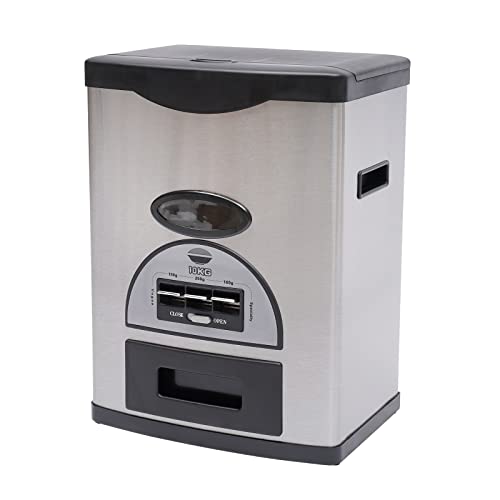
RTUSUML publishes the most deliberate refill design: a wide opening that lets rice be loaded without spilling, and a lid that opens and closes by pressing a button rather than by prising it off. On a bin at the back of a counter, a button beats a rim you have to grip with both hands.
Marsyyds publishes a lid that opens with one click and a large opening for quick refilling, and adds the detail that its conical funnel promotes a stable flow so the rice put in first is consumed first. AROMA publishes the traditional answer, a removable lid you lift to pour, alongside a clear view window and capacity lines so you know when to do it.
Clamps and flip lids
Mairuker publishes four locking clamps and an internal silicone gasket on a semi-transparent flip lid, which is a stronger seal than any other listing here describes and correspondingly more work to open. It offsets that with a flip lid you can see through, so the bin does not have to be opened to check the level.
Xilei is the outlier: five separate grids in one wall-mounted unit, each holding a different grain, filled from a lid that seals against water vapor and dust. Refilling a wall-mounted bin means reaching up with a bag, which suits some kitchens and rules out others entirely.
Getting the Bin Out of the Way
Wheels, a handle and a wall
AROMA publishes hidden wheels and says plainly what they are for: rolling the dispenser across a countertop. For 27 pounds of rice, that is the difference between shifting the bin to wipe underneath and living with it where it landed. It publishes 4.0 pounds empty and 7.25 by 16.5 by 16.5 inches.
Mairuker publishes a foldable hidden handle for lifting and moving, on a container of 15.1 by 10.6 by 7.4 inches at 4.01 pounds, with a flat top and flat bottom for stacking. That is a different shape of solution: not a tall bin that rolls, but a low box that stacks and carries.
Off the counter entirely
Xilei publishes the most radical answer, a unit that lays flat, hangs on a wall or sits on a table, with the listing recommending wall installation. Five grids in one body means one object instead of five, and a wall mount means no counter space at all, which in a small kitchen is worth more than any dispensing figure.
RTUSUML at 6.5 pounds empty and Marsyyds publish nothing about moving at all. Both are stainless steel bins with fully sealed lids, and both are objects you place once and leave. For a kitchen where reaching and lifting are the constraints, that is worth knowing before ordering rather than after.
What Comes Out, and How Much
Two listings publish a portion
AROMA publishes 180 ml funneled into the dispensing drawer with a single touch of the lever, which is the only volumetric figure here and close to a standard rice cooker cup. RTUSUML publishes three buttons releasing 0.22, 0.33 and 0.55 pounds, which is the only weight-based portioning on this page.
Those two approaches suit different cooks. A fixed 180 ml push means counting pushes; three buttons mean choosing one. Either beats what the other three publish, which is a press, a funnel and no figure, and leaves you measuring in a cup afterwards anyway.
The measuring cups and what they add
Mairuker includes a measuring cup and a spoon, and publishes a date dial on the lid to record when the bin was filled. Xilei includes a measuring cup with its five grids. RTUSUML includes a grain tray and a removable container at the bottom, so what is dispensed can be carried to the pan.
That removable container is the accessible detail on the RTUSUML: rice lands in a vessel you lift out rather than in a fixed drawer you scoop from. AROMA’s drawer is sealed, which keeps the dispensed rice fresh but means a scoop or a tilt to get it out.
Which One Fits Your Kitchen
The bin that has to move. AROMA publishes hidden wheels for rolling along a counter, 27 pounds of capacity, 180 ml per push into a sealed drawer, a clear view window with capacity lines, and 7.25 by 16.5 by 16.5 inches at 4.0 pounds empty.
The one you can carry and stack. Mairuker publishes a foldable hidden handle, four locking clamps with a silicone gasket, a date dial, a measuring cup and spoon, and a flat top and bottom for stacking, at 15.1 by 10.6 by 7.4 inches.
The kitchen with no counter to spare. Xilei publishes a five grid unit that lays flat, hangs on a wall or stands on a table, holding 25 pounds across five grains, with a measuring cup and a press-the-funnel dispenser.
The most controllable portion. RTUSUML publishes three buttons releasing 0.22, 0.33 and 0.55 pounds into a removable container, on a 430 stainless bin of 22.05 pounds capacity with a button-operated lid and a wide refill opening.
The simplest refill. Marsyyds publishes a one-click lid with a large opening on a stainless steel and ABS bin of 22 pounds, with a conical funnel that keeps older rice moving first and an anti-fingerprint finish.
What We Could Not Verify
All the figures above come from these makers’ own listings. Here is what they leave out.
- No weight from two of the five, on containers built to hold 22 pounds.
- No filled weight from any of the five.
- No portion figure from three of the five.
- No size in the text from one of the five.
- No height for the dispensing drawer or outlet from any of them.
- No agreement between the stated size and the dimension fields on one of them.