How the Five Compare on the Numbers
A small household gives up little counter, so the two horizontal figures decide the pick before capacity does. The Xilei publishes 5.67 by 14.96 inches and the maker states it can be hung on a wall. The Lenwi publishes 6.6 by 12.6 inches, the smallest depth figure among the five. The Proarea publishes 6.7 by 13.3 inches, the UFORU publishes 7.09 by 13.39 inches, and the Peaoop publishes 11.0 by 11.0 inches, the largest width figure here.
Weight separates the five by less than a pound. The UFORU is the lightest at 2.56 pounds, the Lenwi publishes 2.89 pounds, the Peaoop is the heaviest at 3.31 pounds, and the AROMA publishes 4.0 pounds. The Proarea and Xilei makers publish no weight. Capacity figures run from 13 pounds on the UFORU to 25 pounds on the Proarea, with the Lenwi at 22 to 25 pounds and the Peaoop at 22 pounds.
The table does not say which of the three published figures is the depth and which is the height of the object. A listing publishes a length, a width and a height, and the maker does not state which one is measured across the handles or the lid. The table also cannot say how much rice comes out per press, because only the AROMA publishes that figure.
Footprint and Mounting in a Small Kitchen
What the width and depth figures mean at the counter
The Xilei publishes a width of 5.67 inches, the smallest width figure among the five, and its maker states it can be laid flat or hung on the wall. That is the only wall option here, and it removes the unit from the counter rather than shrinking it. The Lenwi publishes 6.6 by 12.6 inches, the smallest depth figure among the five, so it sits further back on a shelf than the others.
The Peaoop publishes 11.0 by 11.0 inches, a square footprint. It is the largest width figure here and the smallest depth figure here at the same time, which means it fits a corner differently from the long, shallow bodies of the Lenwi and Proarea. The UFORU publishes 7.09 by 13.39 inches, close to the Lenwi in width and close to the Proarea in depth.
Weight and refilling
The UFORU is the lightest of the five at 2.56 pounds, and the Peaoop is the heaviest at 3.31 pounds, a difference of 0.75 pounds. The Lenwi publishes 2.89 pounds and the AROMA publishes 4.0 pounds. The Proarea and Xilei makers publish no weight, so a reader cannot place those two on the same scale as the other three.
Capacity sets how often the body has to be lifted and refilled. The Proarea publishes 25 pounds, the largest capacity figure among the five. The Lenwi publishes 22 to 25 pounds, the Peaoop publishes 22 pounds and the AROMA publishes 27 pounds. The UFORU publishes 13 pounds, the smallest stated capacity here, which suits a household cooking rice a few times a week.
Dispensing and Grain Handling
How rice leaves the container
The AROMA maker states that a single touch funnels 180 milliliters into the dispensing drawer. That is the only published dispensing volume among the five. The Lenwi lists a one-touch button, the Proarea and Peaoop list push buttons, and the UFORU lists a sloped slide that the maker says releases rice without clumps. The Xilei uses a press funnel with a first in, first out flow.
Only the Xilei divides its body into five compartments, so five grains can be stored in one unit. The other four publish a single undivided body. The Lenwi adds a built-in fresh box for spices, and the UFORU adds a top insect box for garlic or star anise. Those two features address storage alongside dispensing rather than the dispensing itself.
Seals and covers
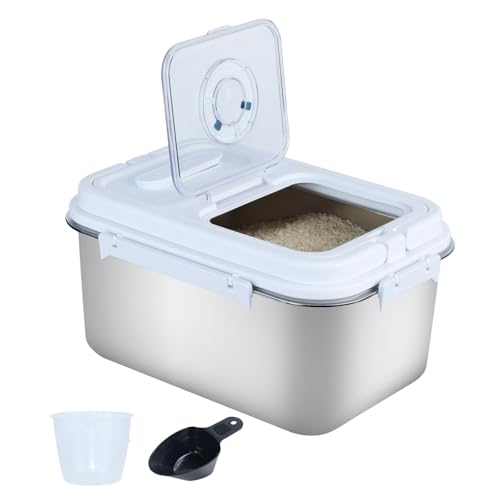
The Peaoop lists a removable top cover with a sealing ring inside. The UFORU lists a moisture-proof seal. The Lenwi lists an extra sealing ring for dust. The AROMA lists a sealed lid and a sealed dispenser drawer. The Xilei lists a sealed environment that isolates water vapor and dust. All five makers describe a seal, and none publishes a seal rating or a tested duration.
The AROMA also lists hidden wheels, which the maker states let it roll across a countertop. That is the only rolling option among the five. The Xilei is the only one the maker states can be hung on a wall. The other three are placed and left in position, so their published weight matters when they are full and have to be moved for cleaning.
Which One Fits Your Kitchen
Renter with no counter to spare. The Xilei publishes a width of 5.67 inches and the maker states it can be hung on a wall. That takes the unit off the counter entirely, and the five compartments hold five grains in one body.
Cook who lifts the container to refill. The UFORU is the lightest of the five at 2.56 pounds, and its published 7.09 by 13.39 inch footprint is close to the smallest depth here. Its 13 pound capacity is the smallest stated capacity among the five.
Household that buys rice in bulk. The Proarea publishes 25 pounds, the largest capacity figure among the five, at 6.7 by 13.3 inches. The maker does not publish a weight, so the full container weight is not documented.
Kitchen with a corner to fill. The Peaoop publishes 11.0 by 11.0 inches, a square footprint, and holds 22 pounds. It is the heaviest of the five at 3.31 pounds, and its 11.0 inch width is the largest width figure here.
Cook who wants a measured portion. The AROMA maker states that one touch funnels 180 milliliters into the drawer, the only published dispensing volume among the five. It publishes 4.0 pounds and a 7.09 by 16.54 inch footprint.
What We Could Not Verify
Several figures a buyer would want are not on the listings, and we did not fill them in.
- The Proarea and Xilei makers publish no weight for their dispensers.
- No maker states which of the three published figures is the depth and which is the height of the object.
- No maker publishes an interior volume in quarts or liters, only a rice weight in pounds.
- No maker states how much rice comes out per press except the AROMA at 180 milliliters.
- No maker publishes a seal rating or a stated freshness duration for the lid or drawer.
- No maker states the height of the unit with the lid removed or the drawer open.