How the Five Compare on the Numbers
Only one of these five puts a measurement in its size entry and only two put one in the title or a bullet, so on four of the five the dimension fields are doing most of the work. Convert those fields back into centimeters and three of them land on whole numbers, which means nobody measured them in inches. The fourth is a set of round inches instead.
Three of the five publish a weight in a field and two publish one in their own words, where one of those two gives grams with ounces beside it. Two publish a capacity. Two name the country of manufacture. Nobody publishes a figure for the drain holes, which on this category is the part doing the work.
What the table cannot tell you is how little of this was written in inches to begin with. The Yulatik row, the HERCHR fields, the Yoshikawa fields and the KRYTJACZ fields are all exact centimeter figures wearing inch units, and on Yoshikawa the maker prints the centimeters itself. Inomata is the only listing here whose figures look native, and they describe a carton.
Inches That Are Really Centimeters
A Row Whose Three Figures Are All Round Centimeters
Yulatik writes 7.48*4.72*6.3in, the only size entry on this page with a measurement in it. Convert each figure and the pattern is unmistakable: 7.48 inches is 19.0 centimeters, 4.72 inches is 12.0 centimeters and 6.3 inches is 16.0 centimeters. Three round metric numbers do not arrive by accident from measurements taken in inches.
Its dimension fields then read 4.7, 6.3 and 7.5 inches, which is the same measurement rounded to one decimal and reordered, and the rounding destroys the metric tidiness that identified the source. So the row is the figure to use and the fields are a derived copy. A scale is printed on the outside, an auxiliary handle is named, and 0.44 lb is published with no capacity figure at all.
Three Fields, No Row, and Twenty Centimeters
HERCHR publishes no size entry and no measurement in its title or any of its seven bullets. Its three dimension fields read 6.3, 7.87 and 4.72 inches, and those are 16.0, 20.0 and 12.0 centimeters exactly. Every figure describing the size of this bowl is a conversion, and the original is not printed anywhere on the page.
Where it does publish its own figures, it publishes both systems. The capacity is given as 400ml and restated as 14oz, and the weight as 214g restated as 7.5oz, neither of which reaches the weight field, which is empty. Food safe ABS plastic, external volume scales, a fine mesh strainer, an auxiliary handle, and a matching lid that turns the strainer into a storage bowl.
When the Maker Publishes Both Systems
An Outer Diameter in the Fields and an Inner One in the Title
Yoshikawa is the only listing here that prints its measurement in both systems, and it is unusually careful: its first bullet gives an outer diameter of 8.9 inches, an inner diameter of 8.3 inches and a height of 4.5 inches, then restates all three as 22.5 by 21 by 11.3 centimeters. Those pairs convert exactly, in both directions.
Which makes the next part worth noticing. The title headlines 8.3 inches with 21 cm, and that is the inner diameter. The dimension fields read 8.86 inches twice, which is 22.5 centimeters, the outer one. So the two most prominent figures on the listing describe different edges of the same rim, both correctly, and neither says which it is. Stainless steel of Japanese manufacture, 0.86 lb against a bullet stating 13.8 oz.
Two Metric Measurements of One Bowl
KRYTJACZ puts a size word in its entry and a measurement in its fifth bullet, which gives approximately 9.45 inches by 5.12 inches. Those are 24.0 and 13.0 centimeters. Its dimension fields read 10.24, 14.17 and 3.54 inches, which are 26.0, 36.0 and 9.0 centimeters. Both sets are exact metric figures and neither set contains the other.
So this bowl has two published metric measurements and no way to tell which is the bowl and which is something else, a box or a handle span or an earlier model. Nothing on the listing reconciles them. Its bullets are also visibly damaged, with words missing mid sentence in four of the five, which is worth knowing before trusting any figure on it. High grade PET, side drain holes, a sturdy side handle, no weight and no capacity.
The One Listing Written in Inches
Round Inches, and a Carton Rather Than a Bowl
Inomata is the only one of these five whose figures do not convert to round centimeters. Its triple reads 9.0, 10.0 and 5.0 inches, which are round in inches and not in anything else, so somebody measured this in inches. The catch is what was measured: two bowls arrive, so those three figures sit in the package row rather than the dimension fields.
Neither bowl is measured anywhere. What is published instead is the division of labor: a 2 quart Rice Washing Bowl for soaking and a 2.5 quart Rice Speed Washing Bowl, with a bullet telling you to use the solid bottomed one for soaking. BPA free food grade plastic of Japanese manufacture, both bowls top rack dishwasher safe, 0.64 lb for the pair.
What the Unit Tells You and What It Does Not
A figure that converts to a whole centimeter was written in centimeters, and that is worth knowing for two reasons. It tells you the maker is working from a metric drawing, so the inch figure carries a rounding error the listing never admits. And it tells you which of two conflicting figures is closer to the source, because the rounder one in metric is the earlier one.
What it does not tell you is whether the figure describes the right object. Yoshikawa’s fields are exact metric and they are the outer diameter rather than the inner one its title leads with. KRYTJACZ has two exact metric sets and only one can be the bowl. Inomata’s figures are native inches and describe a carton. The unit identifies the source, not the subject.
Which One Fits Your Kitchen
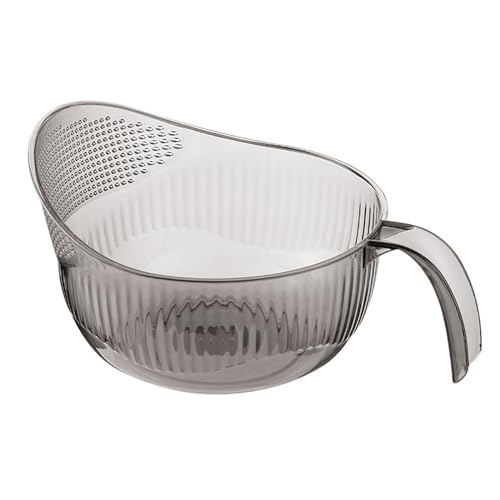
A scale printed on the outside. Yulatik. The only size entry here with a measurement in it, at 7.48 by 4.72 by 6.3 inches, which are 19, 12 and 16 centimeters. A fine strainer, a top drainer, an auxiliary handle to cut the lifting effort, and 0.44 lb. No material and no capacity is named.
A lid that turns it into storage. HERCHR. 400ml restated as 14oz, with external volume scales, a matching lid for the fridge, an auxiliary handle and a fine mesh strainer in food safe ABS. Its weight is published as 214g and 7.5oz in a bullet, and its only dimensions are three fields.
Stainless steel made in Japan. Yoshikawa. The only listing publishing both unit systems: an 8.9 inch outer diameter, an 8.3 inch inner diameter and a 4.5 inch height, restated as 22.5 by 21 by 11.3 centimeters. 0.86 lb with a bullet stating 13.8 oz, for 2 to 4 servings.
Side drain holes and a clear body. KRYTJACZ. High grade PET described as shatter resistant and food safe, with side drain holes and a sturdy side handle for tilting. Published at 9.45 by 5.12 inches in a bullet, with fields giving 10.24 by 14.17 by 3.54 instead. No weight and no capacity.
Soaking in one bowl and washing in another. Inomata. Two bowls of Japanese manufacture, a 2 quart for soaking with a solid bottom and a 2.5 quart Speed Washing Bowl, in BPA free food grade plastic, both top rack dishwasher safe, 0.64 lb for the pair. Neither bowl is measured.
What We Could Not Verify
Everything above is read off each maker’s own listing text. These are the things those listings leave open, and this page does not fill them in.
- Any dimension for either Inomata bowl, where the only triple published describes the package the two arrive in.
- Whether the KRYTJACZ bowl is 9.45 by 5.12 inches or 10.24 by 14.17 by 3.54, since its bullet gives one and its fields give the other.
- What the original centimeter figures were on Yulatik, HERCHR and KRYTJACZ, none of which prints a metric number anywhere.
- A capacity for Yulatik, Yoshikawa or KRYTJACZ, none of which publishes one in any unit.
- A weight for HERCHR or KRYTJACZ in the weight field, where one publishes it only in a bullet and the other not at all.
- The size or the count of the drain holes on any of these five, which every listing describes in words only.