How the Five Compare on the Numbers
Saucepans are bought by the quart, and these five cover the range a home kitchen uses. Herogo publishes 1 quart, Farberware 2 quarts, SENSARTE and EWFEN both publish 3 quarts, and MICHELANGELO publishes a set of 1, 2 and 3 quart pans together. One quart boils two eggs or warms a cup of milk. Three quarts holds pasta for two.
Weight separates them more than capacity does. Herogo publishes 1.8 pounds for its 1 quart pan and Farberware 1.94 pounds for a 2 quart, both light enough to pour one handed. EWFEN publishes 3.44 pounds and SENSARTE 4.1 pounds at 3 quarts. The MICHELANGELO figure of 6.79 pounds is three pans together, not one.
The published length figures are not comparable across these listings, because some include the handle and some do not. SENSARTE publishes 15.2 inches and EWFEN 16.14 inches for 3 quart pans, which is the handle, while Herogo publishes 6.0 by 6.0 inches for a 1 quart, which is the body. Capacity and weight are the two figures every maker here states the same way.
Coated or Bare Changes Everything About Ownership
What the three coated pans commit to
SENSARTE publishes a Swiss ILAG granite coating and states it is free of intentionally added PFOA and PFOS. MICHELANGELO publishes a ceramic coating with the same two exclusions. Farberware publishes DiamondMax nonstick without naming what it excludes. All three release food and wipe clean, which is the whole reason to buy coated.
None of the three publishes a maximum temperature for the coating, and none states how long it lasts. A coating is the part of a saucepan that wears out first, so the figure that would predict its life is the one figure no listing here provides. Buying coated means accepting that the pan has a service life nobody has quantified.
What the two bare pans give up and gain
Herogo publishes 18/10 stainless steel and states plainly that there is no toxic chemical coating. EWFEN publishes a 304 stainless interior over an aluminum core. Those are the same family of steel described two ways, and both mean a surface that will not wear out, will not peel, and will stick if the pan goes on dry.
The trade is real and it goes both ways. A bare steel saucepan takes a metal whisk, a scouring pad and a hot oven without damage, and it browns the base of a sauce in a way a coated pan does not. It also needs fat or liquid in it before the heat goes on, and oatmeal will weld to it if left.
One Pan or a Set
The case for buying three at once
MICHELANGELO publishes 1, 2 and 3 quart pans as one purchase, each with a lid. For a kitchen starting from nothing that covers reheating, a sauce and a small batch of pasta without a second decision. The published 6.79 pounds is the three of them together, so no single pan in that set is heavy.
The cost of a set is that every pan shares one coating and one build. If the ceramic wears on the 2 quart, the other two are the same surface on the same base, aging the same way. Buying separately means a worn pan is replaced alone, which is why the single pans here are not simply worse value.
Which single size to start with
Three quarts is the size that does the most. SENSARTE and EWFEN both publish it, and it holds pasta for two, a batch of rice, or soup for a family. It is also large enough that warming a small amount leaves a wide base of bare metal, which is where nonstick earns its place over steel.
One quart is the second pan, not the first. Herogo publishes 1.8 pounds and a 6.0 inch body, which suits a cup of milk, a single egg or a sauce for one. Farberware sits between at 2 quarts and 1.94 pounds, and it is the only pan here whose maker describes moving it from cooktop to oven.
The Details That Decide Daily Use
Lids, spouts and pouring
SENSARTE is the only pan here with two pour spouts, one on each side of the rim, which the maker states suits left and right handed use. That is a small thing until you pour hot stock from a pan with no spout and watch it run down the outside. None of the other four publishes a spout.
The lids differ more than they look. Farberware publishes a tempered glass lid with a vent in the knob, which lets steam escape without lifting it. EWFEN publishes a glass lid it describes as sealing to hold moisture in. Those are opposite intentions, and which one suits depends on whether you simmer uncovered or reduce under a lid.
Handles and heat
Three makers describe the handle. Farberware publishes double riveted stay cool handles and says they carry the pan to the oven. EWFEN publishes a cool touch grip. Herogo publishes a long bakelite handle riveted to the pan. Bakelite stays cool on the hob and does not belong under a grill, which is a limit the listing does not spell out.
SENSARTE and MICHELANGELO publish nothing about their handles at all. On a saucepan that matters more than on a skillet, because a saucepan is lifted full and poured at head height. Where the handle is not described, its material and its oven tolerance are both unknown from the listing.
Which One Fits Your Kitchen
The cook who pours from the pan. SENSARTE 3 Quarts. Two pour spouts, a granite nonstick surface stated free of PFOA and PFOS, and a magnetic base the maker confirms works on every cooktop including induction.
The cook who wants nothing coated. EWFEN 3 Quarts. A 304 stainless interior over an aluminum core with a sealing glass lid, at 3.44 pounds. Nothing to wear off, and it takes a metal whisk without a second thought.
The one who finishes sauces in the oven. Farberware 2 Quarts. The only pan here whose maker describes moving it from cooktop to oven, with double riveted stay cool handles and a vented lid knob, at 1.94 pounds.
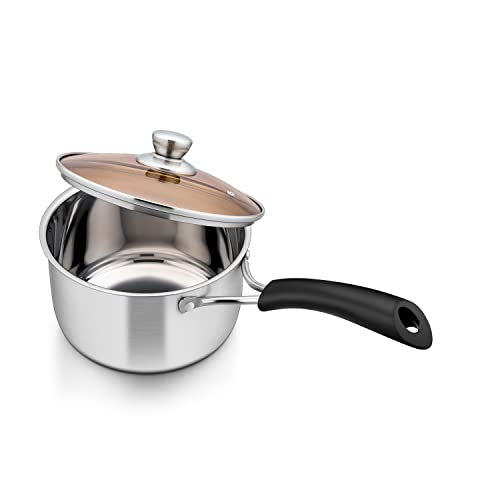
The one pan for milk, eggs and one portion. Herogo 1 Quart. Published at 1.8 pounds with a 6.0 inch body, 18/10 steel and no coating, with a tinted glass lid. A second pan rather than a first.
The kitchen being set up from scratch. MICHELANGELO Set. Three pans at 1, 2 and 3 quarts with lids, 6.79 pounds for all three, ceramic coated and stated free of PFOA and PFOS.
What We Could Not Verify
Everything above comes from the maker’s own listing. These are the questions those listings leave open.
- Maximum coating temperature for the three nonstick pans, which is what predicts how long a coating lasts.
- Oven ratings for four of the five. Only Farberware describes oven use, and it gives no figure.
- Handle material for the SENSARTE and the MICHELANGELO set.
- Base thickness on all five, which is what decides whether a sauce scorches in the middle.
- Induction compatibility for four of the five. Only SENSARTE states it.
- Whether the lids are interchangeable across the three pans in the MICHELANGELO set.