How the Five Compare on the Numbers
Exactly one of these is a smart microwave in the sense most people mean. GE connects over Wi-Fi to the SmartHQ app, works with Alexa and Google Assistant, and will scan a frozen food barcode and set the time and power itself. The other four use the word differently: LG means inverter power control, Toshiba and Farberware mean a humidity sensor, and BLACK+DECKER does not claim it at all.
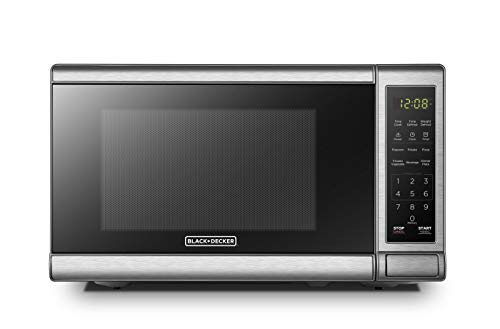
On raw figures the connected one is the weakest. GE publishes 900 W into 0.9 cubic feet, while LG publishes 1000 W into the same 0.9, and Toshiba and Farberware both publish 1000 W into 1.2 cubic feet. BLACK+DECKER is the small one at 700 W and 0.7 cubic feet. The connectivity costs a hundred watts here rather than buying them.
Three of those rows carry figures that should not be trusted. Farberware publishes a weight of 1 lb for a 1.2 cubic foot microwave, which is not a weight. LG publishes 10 inches for all three of its dimensions, a placeholder rather than a measurement, while its own title and bullet give 18.75 by 14 by 10.69 inches. Toshiba’s fields and its own sentence disagree, and the sentence was used.
Four Different Things Called Smart
The One With Wi-Fi in It
GE is the only microwave here with a network connection, and the feature it enables is genuinely specific: Scan-to-Cook, where you scan a frozen food barcode with the SmartHQ app and the microwave sets the time and power level for that product. That is not something a sensor can do, because it relies on a database of packaged foods rather than on measuring steam.
It also adds Alexa and Google Assistant, which for a microwave means starting, stopping and setting time by voice. Whether that is useful depends on your kitchen, because a microwave is an appliance you are standing in front of anyway. The honest case for GE is the barcode feature and remote monitoring, not hands-free operation.
Sensors and Inverters Are Not Connectivity
Toshiba and Farberware both use the phrase smart sensor, and Toshiba explains it properly: the microwave adjusts time and power based on food humidity. That is a real mechanism and it addresses the most common microwave failure, guessing a time and getting it wrong. It requires no app, no account and no network, which for many buyers is a feature rather than a limitation.
LG means something different again. Smart Inverter refers to power delivery: instead of cycling a magnetron fully on and off to average out a lower power level, an inverter supplies continuous reduced power. That is the most substantive engineering claim on this page and it has nothing to do with software. BLACK+DECKER claims none of the three and sells 10 power levels and six preset buttons.
Power, Capacity, and the Figures Only Two Publish
Output Against Input
Every listing here states an output wattage and only two state an input. Toshiba publishes 1000 W output against 1600 W input, and BLACK+DECKER publishes 700 W output against 1050 W input at 110 volts. Those are the figures that tell you what the appliance draws from the wall, which matters on a shared circuit in an apartment or a dorm.
GE, LG and Farberware publish output only. On the pattern the other two set, a 1000 W microwave draws somewhere above 1500 W, so the LG and Farberware are not appliances to run beside a kettle on the same breaker. Nothing in their listings says so, and the two makers that do publish input power are doing the more useful thing.
Capacity Against Turntable
Capacity in cubic feet is a volume that includes space above your plate you cannot use. The turntable diameter is the figure that decides whether a dinner plate fits and rotates, and three of the five publish it. Toshiba states 12.4 inches, LG 12 inches and BLACK+DECKER a 10 inch removable glass plate. GE and Farberware publish no turntable figure at all.
That matters because BLACK+DECKER at 0.7 cubic feet and a 10 inch turntable will refuse a large dinner plate, while Toshiba at 1.2 cubic feet and 12.4 inches will take most of them. GE’s 0.9 cubic feet sits between, and without a turntable figure you cannot tell which side of the line it falls on, which is a real gap for the most expensive-sounding feature set here.
Dimensions, Doubles, and Two Listings That Are One
Where the Published Numbers Fail
This category has the worst dimension data on the site so far. LG’s fields read 10 inches for width, depth and height, which is a placeholder, while its own title states 18.75 by 14 by 10.69 inches. Toshiba’s fields read 20.51 by 17.14 by 12.83 inches while its own bullet states external dimensions of 20.6 by 14.6 by 11.8, so the depth and height disagree by more than two inches and one inch.
GE and BLACK+DECKER are the two listings whose fields match their own sentences, 19 by 14.5 by 11.5 and 17.3 by 13 by 10.2 inches respectively. Farberware publishes fields of 20.5 by 17.3 by 12.8 inches and no dimensions in its text, so there is nothing to check them against, and given its published weight of 1 lb its data deserves caution.
The Twins, and the Duplicates
Toshiba and Farberware are almost certainly the same machine. Both state 1.2 cubic feet, 1000 W output, 10 power levels, six one-touch settings, defrost by weight or by time, a child safety lock and an LED display, and their published fields are within two tenths of an inch of each other. Toshiba publishes more: an input wattage and a 12.4 inch turntable.
Two further listings were left out entirely because they are the same listing twice. Both were titled as app remote control touch screen lightwave ovens, both published 0.39 inches for all three dimensions, and both carried the same five bullets word for word, including one describing mechanical dial controls on a product sold as app controlled and another describing air frying, dehydrating and fermenting.
Which One Fits Your Kitchen
The cook who buys frozen food. GE, the only microwave here with Wi-Fi, an app, and barcode Scan-to-Cook that sets time and power from the packet. It also answers Alexa and Google Assistant. It is the lower powered of the 0.9 cubic foot pair at 900 W, and publishes no turntable size.
The cook who wants real low power. LG NeoChef, whose Smart Inverter delivers continuous reduced power rather than cycling the magnetron, at 1000 W into 0.9 cubic feet, with seven named auto cook types and a 12 inch turntable. Its published dimension fields are placeholders, so use its own 18.75 by 14 by 10.69 inches.
The household reheating dinner plates. Toshiba, with a 12.4 inch glass turntable in 1.2 cubic feet, 1000 W output against a stated 1600 W input, a humidity sensor, six preset menus and quick start from 1 to 6 minutes. At 34.8 lb it is the heaviest here.
The buyer who finds the same machine cheaper. Farberware, which matches the Toshiba on capacity, output, power levels, preset count and defrost modes, and adds a child safety lock. It publishes no turntable size, no input power and a weight of 1 lb that cannot be right.
The dorm room or office. BLACK+DECKER at 0.7 cubic feet and 700 W, with a stated 1050 W input at 110 volts, a 10 inch removable glass turntable, a child lock, a push-button door release and 30 second express cooking. Its published size matches its own text exactly.
What We Could Not Verify
These are the makers’ own published figures. These are the gaps and errors that mattered.
- Farberware publishes a weight of 1 lb for a 1.2 cubic foot microwave, so no weight comparison includes it.
- LG publishes 10 inches for all three dimensions, a placeholder, and its real size comes from its own title.
- Toshiba’s published fields contradict its own stated exterior dimensions by more than two inches on depth.
- Three of the five publish no input wattage, so their draw on a household circuit is unknown.
- GE and Farberware publish no turntable diameter, which is the figure that decides whether a dinner plate fits.
- GE publishes no count of power levels, the one specification every rival here states.