How the Five Compare on the Numbers
Six ovens were in this pool and one is not here. Emeril’s 26 quart French door model publishes four bullets, no wattage, no temperature range, no fan speed and no capacity beyond the figure in its title. Its French doors and dual-speed fan are real differences, and there is nothing else on the listing to set against the other five.
Among the five that remain, the word smart is carrying very different loads. Two connect to a phone and one of those has a temperature probe inside the cavity. One runs algorithms over five quartz elements with no connectivity at all. One offers 142 presets. One offers a dial, a toast shade selector and a 60 minute timer, and publishes more hard figures than either connected oven.
What the table cannot tell you is how long any of these take to get hot. Not one listing publishes a preheat time, which on a countertop oven is the figure that decides whether it replaces the range for a weeknight. Nor does any of them publish a decibel figure, despite two publishing fan speeds above 2000 RPM in a box that sits at head height on a worktop.
What Smart Means Here
Two Ovens That Actually Connect
Typhur is the only oven in this pool with a wireless probe built into it. The probe tracks the core temperature of the food and stops the cook when the target is reached, with a separate auto-shutoff if the probe is removed. Its app handles multi-stage cooking and alerts, and a recent feature generates a recipe from a photo of your ingredients or a dish name.
CHEF iQ connects differently, over WiFi rather than Bluetooth, which it describes as unlimited range: you can check the oven from the sofa or from elsewhere entirely. It pairs that with a touchscreen carrying haptic feedback and audio alerts, so the app is an addition rather than the only interface.
Three Ovens That Mean Something Else
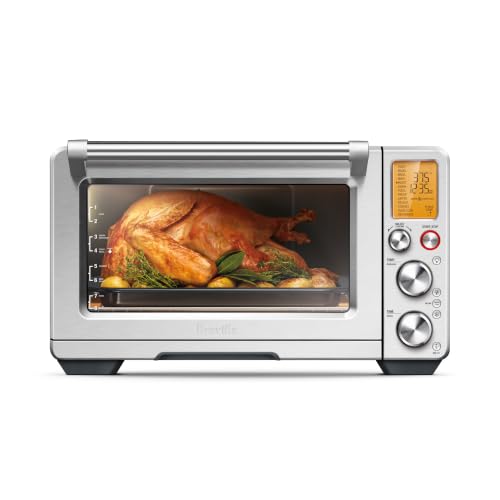
Breville’s Element iQ is intelligence with no network attached. Five independent quartz elements are steered by an algorithm, with sensing and digital PID temperature control stated to eliminate cold spots. That is a real engineering claim about heat distribution, and it is the reason the oven carries the word smart in its name while publishing no app.
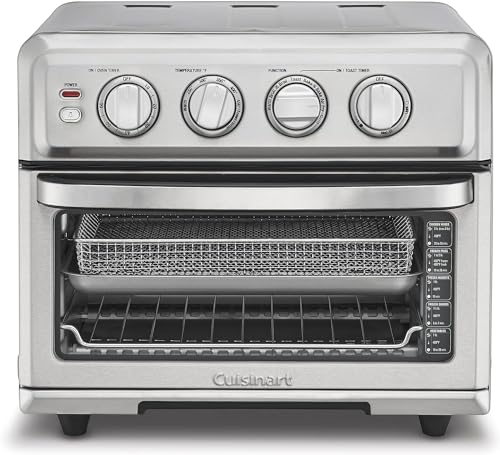
Nuwave’s version is a library: 142 easy-cook presets in total, made up of 12 cooking functions, 100 one-touch presets and 30 memory slots you fill yourself. Cuisinart does not use the word at all, offering an adjustable dial, a toast shade selector and a 60 minute timer with auto-shutoff, and publishing more hard numbers than Typhur does.
Capacity in Four Different Currencies
Quarts, Cubic Feet and Actual Inches
Breville is the only listing that publishes the inside of the box: 16 by 13.5 by 7 inches. That is the figure that answers whether your own roasting tin fits, and it is backed with specifics, a 9 by 13 inch pan, a 12 cup muffin tray, a 5 quart Dutch oven. No other listing in this pool tells you the interior in any unit.
Everyone else publishes a headline volume instead. Nuwave states 30 QT, CHEF iQ 25 quarts and Cuisinart 0.6 cubic feet, which are three units for the same idea and cannot be lined up without converting figures no maker published. Typhur publishes no capacity figure whatsoever, which for a countertop oven is an odd thing to leave out.
What They Say Will Fit
The food claims are the most comparable part of this table because everyone uses the same objects. Breville states 9 slices of bread and a 14 pound turkey. Nuwave states two 13 inch pizzas, a 10 pound chicken, a 6 pound roast and 2 pounds of fries. CHEF iQ states a 13 inch pizza or 6 slices of toast. Cuisinart states 6 slices, 3 pounds of wings, a 12 inch pizza and a 4 pound chicken.
Read together, those put Breville and Nuwave at the larger end and Cuisinart at the smaller, which is consistent with Cuisinart’s 0.6 cubic feet. The outlier is the exterior: Nuwave publishes the largest stated capacity and the lightest weight here, 17.8 pounds, against Breville’s 30.2.
Heat, Fans and the Claims Behind Them
Ranges, Wattages and Two Listings That Skip Both
Nuwave publishes the widest range, 50 to 500 degrees Fahrenheit, with 1800 watts behind it. CHEF iQ publishes 70 to 500 degrees and 1750 watts. Cuisinart publishes 1800 watts and a range running from warm to 450, a ceiling 50 degrees below the other two, which matters for pizza more than for anything else.
Typhur and Breville publish neither a wattage nor a temperature range. On Breville that is strange for a listing that publishes interior dimensions to the half inch and names 5 quartz elements. On Typhur it sits alongside two bullets of press quotation, so the listing spends its space on reputation rather than specification.
Who Decides Where the Heat Goes
Nuwave hands the decision to you, and it is the only one that does: the ratio of top to bottom heaters is adjustable from 0 to 100 percent, the fan speed is adjustable separately, and the timer runs to 100 hours. For anyone who has burned the top of a bake, that is a more useful control than another preset.
Breville takes the decision away, steering 5 independent quartz elements automatically and offering only a 2 speed convection fan, super and regular. CHEF iQ sits between the two, varying its 3200 RPM DC motor by function without user input. Typhur publishes a 2400 RPM fan with dual elements and no adjustment at all.
Where the Claims Do Not Hold Together
Three Times Faster, or Twice
Nuwave’s third bullet is headed 3 times faster and 35 percent crispier, and the sentence underneath states that the newly designed fan and housing deliver 100 percent faster speeds. One hundred percent faster is twice, not three times. The listing also references both a 2025 upgraded convection system and a 2026 new system in the same product page.
The speed claims elsewhere are vaguer rather than contradictory. Breville states super convection reduces cooking time by up to 30 percent and CHEF iQ states roasting up to 30 percent faster than conventional air fryers. Neither names the oven the comparison was made against, so neither figure can be checked.
What Comes in the Box
Typhur itemizes the most: an air fryer basket, a roasting pan, a wire rack, a crumb tray and the wireless probe, with select parts stated dishwasher safe and replacement parts available. It does not say which parts are dishwasher safe, which is the one detail that would make the sentence useful.
Cuisinart lists a rack, a baking pan and drip tray, an air fry basket and a ceramic nonstick reversible grill and griddle. Nuwave includes a reversible grill and griddle with dual drip spouts for char marks. Breville and CHEF iQ publish no accessory list at all, though Breville does state it dehydrates up to 4 trays at once.
Which One Fits Your Kitchen
A cook who roasts meat to temperature. Typhur is the only oven with a wireless probe inside it, stopping the cook at your target, with app control of multi-stage cooking, recipe generation from a photo, dual elements and a 2400 RPM fan. It publishes no wattage, range or capacity.
A household that checks the oven from elsewhere. CHEF iQ pairs unlimited WiFi range with a haptic touchscreen, 1750 watts, 70 to 500 degrees Fahrenheit, 11 functions, a 3200 RPM DC motor and 25 quarts holding a 13 inch pizza, at 26.15 pounds.
Anyone who measures before buying. Breville publishes an interior of 16 by 13.5 by 7 inches, 9 slices of bread, a 14 pound turkey, a 5 quart Dutch oven, 5 quartz elements under PID control and 13 functions. It has no app, and at 30.2 pounds it is the heaviest here.
A cook who wants the controls. Nuwave sets the top and bottom heater ratio from 0 to 100 percent, the fan speed separately, a timer up to 100 hours and a 50 to 500 degree range, over 142 presets and 1800 watts, at 17.8 pounds. Read its speed claims carefully.
Someone who never wants to open an app. Cuisinart is a dial, a toast shade selector and a 60 minute timer with auto-shutoff, over 1800 watts, 0.6 cubic feet and 8 functions, with a rack, pan, basket and reversible grill and griddle included.
What We Could Not Verify
Every figure above comes from the makers’ own listings. These are the things we went looking for and could not source.
- Typhur publishes no wattage, no temperature range and no capacity figure of any kind.
- Breville publishes no wattage and no temperature range, despite publishing interior dimensions.
- Nuwave’s own bullet is headed 3 times faster and states 100 percent faster in the sentence beneath it.
- No listing publishes a preheat time, and none publishes a noise figure.
- Only Breville publishes interior dimensions, so usable space is unknown on the other four.
- Typhur states that select parts are dishwasher safe without saying which parts.