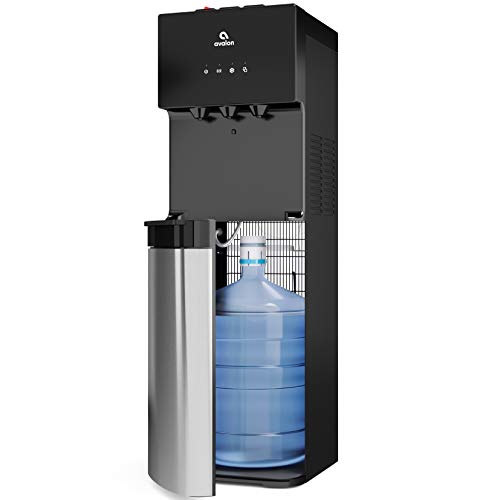
How the Five Compare on the Numbers
One listing was set aside, and the reason is worth stating before anything else. Tehanld’s second bullet asks you to customize your drinking experience with the Brio Essential water dispenser, which is a rival brand’s product name left inside its own copy. Its other four bullets track Brio’s almost sentence for sentence, and its dimension fields are identical to Manastin’s, another listing in the same pool.
Among the five that remain, the figure that separates them is the water temperature. NEWBULIG, EUHOMY and Manastin publish actual degrees. Brio and Avalon, the two established names here, publish three temperature settings and no temperatures. Avalon publishes wattages instead, 420 W heating and 100 W cooling, which nobody else gives, so the two groups are measuring different things entirely.
The row nobody can fill is throughput. Not one of these five publishes how many cups of hot water it can pour before the tank needs to reheat, or how long that reheat takes. A hot tank is a small tank, and on a busy morning the recovery time is the only specification that matters. Manastin says its tanks are large capacity and gives no volume for either.
What Smart Means on a Water Cooler
It Means a Light That Says the Bottle Is Empty
Brio’s fourth bullet is headed smart technology, and the technology is this: the dispenser tells you when the bottle needs replacing. That is the whole feature. Avalon publishes the same thing without the word, calling it an empty bottle indicator that lights up. Manastin adds three beeps before the light comes on, which is arguably the most sophisticated version of this feature in the pool.
None of these five has an app, a network connection, a usage log or a voice command. There is nothing wrong with that and it is worth saying plainly on a page with smart in the title, because the word is doing marketing work here rather than describing a capability. What you are choosing between is temperatures, wattage, noise and whether it makes ice.
The Child Lock Is the Feature Worth Comparing
Four of the five publish a child lock and they are not the same design. Brio describes a two step dispenser on the hot spout: release the lock above the button, then press. NEWBULIG and EUHOMY both state a lock on the hot outlet without describing the action. Manastin binds its lock to the top and hot water buttons together, which is double protection.
Avalon publishes no child lock at all. On a dispenser that Avalon itself says produces piping hot output from a 420 W heater, and that is sold with a nightlight for use in the dark, that is the single most surprising omission across all six listings looked at. It publishes UL approval, an antimicrobial coating and no lock.
The Temperatures, Read Carefully
Ninety Eight Degrees Is Not Room Temperature
NEWBULIG publishes the most complete set of figures here and one of them does not make sense. It states hot water up to 200 degrees F, cold water as low as 58 degrees F, and room temperature water at 98 degrees F. Ninety eight degrees is close to body temperature, not to any room, and 58 degrees is warm for what most people call cold.
The likeliest reading is that the room temperature spout is unheated and uncooled water that has been sitting next to a heating tank, and that 98 degrees is a measurement of that rather than a target. Either way it is published, it is specific, and it tells you more about how this machine behaves than Brio’s three temperature settings tell you about anything.
Where the Hot and Cold Figures Actually Land
EUHOMY and Manastin publish the same hot range, 185 to 203 degrees F, and nearly the same cold ceiling: 47 degrees F or below against 48.2. Those hot figures straddle the temperature you want for tea, and 203 degrees is close enough to boiling for most purposes. NEWBULIG’s single figure of up to 200 degrees F sits in the same band.
Brio and Avalon publish nothing here, which for the two most recognizable brands on this page is a real weakness. Avalon does publish the mechanism, 420 W of heating and 100 W of cooling, and that is genuinely useful: wattage predicts recovery speed after you draw a cup. But it does not tell you how hot the water gets, and a heater with no stated target is a heater you cannot plan around.
Ice, Size, and What Is Built From What
Only One of These Makes Ice
EUHOMY is a different appliance wearing the same shape. It publishes 33 pounds of ice per day, nine bullet shaped cubes in seven minutes, and a cold water figure of 47 degrees F or below, all from a cabinet 35.6 inches tall rather than the 41 inches the others run to. It also publishes the catch: there is no built in freezer.
That last sentence is the most honest line in this pool. EUHOMY states that you must move the ice to a fridge when the basket is full, because the machine makes ice and does not keep it. A buyer who reads that understands what they are getting. Nobody else here has an ice maker at all, so the comparison is EUHOMY against its own honesty.
Materials and the One Missing Weight
Two listings say what the water actually touches. Manastin states two 304 food grade stainless steel inner tanks and names high temperature and corrosion resistance. NEWBULIG states ABS and PP plastic components with iron side panels, which is a plastic tank in a metal cabinet. Brio and Avalon both describe stainless steel as an accent or a cabinet, which is the outside.
Manastin also publishes no weight, and it is the only pick here that does not. That is the figure that would tell you whether those two stainless tanks are real, because steel is heavy and a stainless tank should show up on a scale. Brio is the heaviest of the five at 40.5 pounds and NEWBULIG is the lightest at 23.15 pounds.
Which One Fits Your Kitchen
A kitchen that wants the full set of figures. NEWBULIG publishes hot up to 200 degrees F, cold as low as 58 degrees F, room water at 98 degrees F, under 50 dB of noise and its own size as 12.2 by 12.3 by 41.3 inches. It is the lightest of the five at 23.15 pounds, which is worth knowing before you carry it.
Iced coffee at home. EUHOMY makes 33 pounds of ice a day, nine cubes in seven minutes, alongside water at 47 degrees F or below and hot at 185 to 203 degrees F, in a 35.6 inch cabinet with a one year warranty. It states plainly that the ice will melt because there is no freezer.
Stainless steel where the water goes. Manastin states two 304 food grade stainless tanks, hot at 185 to 203 degrees F, cold at 48.2 degrees F or below, and a child lock bound to both the top and hot buttons. It publishes no weight at all, so the tank claim cannot be checked.
A machine with a hygiene story. Avalon publishes UL approval, Energy Star, a BioGuard antimicrobial coating on high contact areas, a built in nightlight and the only wattages here, 420 W heating and 100 W cooling. It publishes no water temperatures and no child lock.
A familiar name with a clear display. Brio publishes an LED display with an empty bottle alert, a two step child lock on the hot spout and three spouts for hot, room and cold, at 40.5 pounds. Its size field reads 41.4 while its height field reads 42.52, so treat the height as approximate.
What We Could Not Verify
These are the figures that decide how a dispenser behaves on a busy morning, and almost none of them is published.
- No listing publishes a hot tank volume or a reheat recovery time, which is what limits how many cups you can pour in a row.
- Brio and Avalon publish no water temperatures at all, hot, cold or room.
- Only Avalon publishes a wattage, so the recovery speed of the other four cannot be estimated.
- Manastin publishes no weight, which is the figure that would support its two stainless steel tank claim.
- Brio’s size field reads 41.4 while its height field reads 42.52, and nothing in the listing reconciles them.
- Only one listing publishes a warranty, and only two publish any noise information at all.