How the Five Compare on the Numbers
Four of these listings publish a temperature and the four figures measure four different things. Feenmai states an oven limit of 450 F. Certified International states an oven limit of 350 F. HOTEC states a heat resistance of 212 F, which is boiling point and rules an oven out entirely. Quatish states 2336 F, which is the kiln temperature its clay was fired at, not a temperature you may use.
Capacity is the other axis and it splits them cleanly: 26 oz for Feenmai and HOTEC, 24 oz for Certified International and Quatish, and 16 oz for Vumdua, which is also the only listing that separates a rated capacity from a full-fill capacity of 18 oz. Only one of the five publishes a weight, 4 lb for a set of four, so nothing here is ranked by weight.
What none of them publishes is wall thickness, which is what actually determines whether a bowl survives a temperature change and how long it keeps soup hot. Feenmai and HOTEC both describe substantial walls without a figure, Feenmai claiming thermal-shock resistance from high-density firing. Those are the right claims to make and there is no number behind any of them.
Four Temperatures, Four Different Meanings
An Oven Limit Is Not a Firing Temperature
The Quatish listing states its bone china clay is fired at 2336 F, and that figure is doing no work for a buyer. Kiln temperature describes how the clay was made, not what the finished bowl will tolerate, and Quatish never states an oven limit at all. Its only use claim is microwave safe, which means reheating from the fridge rather than baking a casserole.
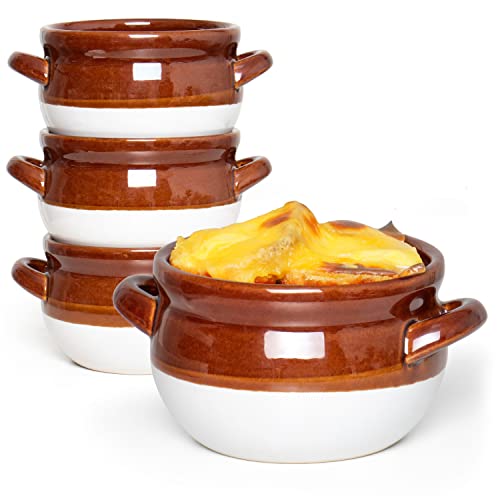
Read next to the two real oven ratings, the gap matters. Feenmai states 450 F, given also as 232 C, and specifically names broiling, which is how you brown cheese on French onion soup. Certified International states 350 F, which is a baking temperature rather than a browning one. A hundred degrees decides whether the crock does the one job crocks exist for.
The Bowl That Must Not Go Near Heat
HOTEC is the clearest listing here and the most limited. It states heat resistance rated up to 212 F, or 100 C, and explicitly warns against prolonged heating and temperatures above that limit. That is boiling point, so the bowl takes hot soup and nothing more: no oven, no broiler, and care with a long microwave cycle.
In exchange it is the only non-ceramic option, made from wheat-straw fiber and BPA-free plastics, with eight bowls in eight colors, a reinforced rim and a stated 5.9 inches wide by 3 inches high. For a household with children, a camper or an RV, a bowl that cannot shatter is worth more than an oven rating nobody uses.
Crocks, Cereal Bowls, and What the Handles Are For
Why a Crock Has Two Handles
Three of these five have handles and they exist because the bowl comes out of an oven with cheese bubbling on top. Vumdua describes two sturdy arc handles that are smooth but non-slip, for passing a hot bowl to someone else. Certified International describes ergonomic dual handles for transporting hot dishes. Feenmai describes sturdy handles and an embossed non-slip exterior for grip.
Quatish and HOTEC have none, and neither pretends otherwise: Quatish is sold as a cereal bowl set that is also good for soup, ramen, salads and rice, and HOTEC is sold as a cereal bowl too. If you want to bake in the bowl and serve from it, handles are not decoration, and that narrows the five to three immediately.
The Only Listing That Admits Two Capacities
Vumdua publishes 16 oz as its rated capacity and then states a full-fill capacity of up to 18 ounces, along with an inner size of 4.6 by 4.6 by 2.8 inches. That is the most honest capacity statement in this pool, because every other listing quotes one number without saying whether it is filled to the brim or to a sensible level.
It matters most on this page precisely because the bowls with handles are meant to go in an oven with bread and cheese on top. A 26 oz crock filled to 26 oz has no room for the topping, which Feenmai addresses directly by saying its bowls are sized for French onion soup with room for cheese and bread. Certified International and Quatish state a number and stop.
Ceramic, Stoneware, Bone China, and Wheat Straw
Four Materials, and One Listing That Says Two
Certified International states stoneware. Quatish states bone china clay. HOTEC states wheat-straw fiber with BPA-free plastics. Vumdua states high-quality ceramic. Feenmai states both: its second bullet calls the bowls premium high-density ceramic and its fourth calls the construction thick stoneware, which are related but not the same material claim.
That inconsistency is worth noting because it is the listing making the highest heat claim, 450 F with broiling. Stoneware and porcelain-type ceramics behave differently under thermal shock, and a listing that uses both words interchangeably is not being precise about the thing its own oven rating depends on. The rating may well be correct; the material description is not internally consistent.
What Each Material Buys You
The practical ranking is simple enough from the published claims. Stoneware and dense ceramic take oven heat, hold it, and break if dropped. Bone china is the thinnest and lightest of the ceramics and Quatish leans on chip resistance rather than heat, claiming resistance to chipping, cracking and fading. Wheat straw and plastic will not break at all and will not go in an oven.
All five state both microwave safe and dishwasher safe, which is the one row of the table where every listing agrees. Only Vumdua adds a freezer claim, stating its crocks are safe for ovens, microwaves, freezer and dishwashers, which is the widest set of permissions here even though it publishes no oven temperature to go with it.
Which One Fits Your Kitchen
The cook who actually makes French onion soup. Feenmai, the only listing here rated to 450 F and the only one naming broiling, in 26 oz crocks stated to leave room for cheese and bread, with handles, an embossed non-slip exterior and a stackable shape.
The host serving stew at a table. Certified International, 24 oz stoneware crocks with ergonomic dual handles and a reactive glaze that makes each one slightly different. Its oven limit is 350 F, so baking is fine and browning cheese under a broiler is not.
The household that eats cereal more than soup. Quatish, six 24 oz bone china bowls at 6 inches that nest to save space, stated resistant to chipping, cracking and fading. It publishes no oven limit, only that the clay was fired at 2336 F, which is not a use temperature.
The cook who wants to know the real capacity. Vumdua, 16 oz rated with a stated full-fill of 18 oz and an inner size of 4.6 by 4.6 by 2.8 inches, on two non-slip arc handles, and the only bowls here also stated freezer safe.
The family with children, a camper or an RV. HOTEC, eight 26 oz wheat-straw and BPA-free plastic bowls in eight colors at 5.9 inches wide and 3 inches high, with a reinforced rim. Heat resistance is rated to 212 F, so no oven and no long microwave cycles.
What We Could Not Verify
These are the makers’ own published figures. These are the gaps that mattered.
- Quatish publishes a kiln firing temperature but no oven limit, so whether it can be baked in is unstated.
- Vumdua states its crocks are oven safe without ever publishing a temperature.
- No maker publishes a wall thickness, which is what determines heat retention and thermal shock resistance.
- Only one of the five publishes a weight, so the bowls cannot be compared by mass.
- Four of the five publish one capacity figure without saying whether it is filled to the brim.
- The Feenmai listing calls its material high-density ceramic in one bullet and thick stoneware in another.