How the Five Compare on the Numbers
Sixteen spiralizers and spiral cutters are on the fact sheet and only seven of them say anything at all about washing. That is the whole problem with shopping for easy cleanup: it is a claim nearly every listing makes in a headline and very few of them turn into a rule you can follow. So the five below were chosen for saying something checkable, not for saying it loudest.
They are also five different machines. Two are full countertop units with a suction pad and a blade box, one is a pocket cutter that comes apart under a tap, one is a lid that screws onto a wide mouth mason jar, and one is an attachment that runs off a stand mixer sold separately. The cleanup job is not the same job on any two of them.
What the table will not tell you is how long any of this takes at the sink. Nobody publishes the number of parts you end up holding, which is the figure that decides the job, and nobody says whether a blade can be cleared without taking it out of its holder. Two listings name a rack and a heat limit and then stop, and the rest leave the method to a headline phrase.
What the Listings Actually Say About Washing
Two Rules You Can Follow Without Guessing
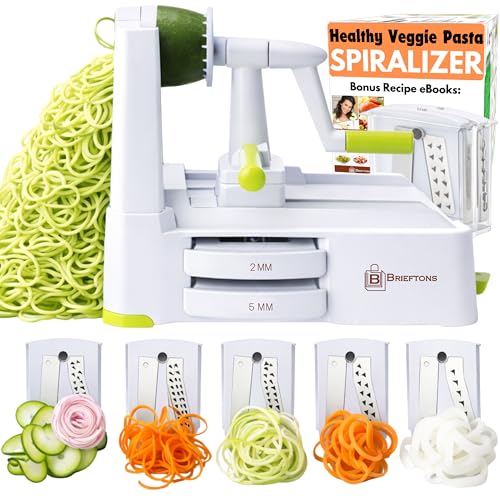
Brieftons is the clearest of the five. The listing states that the body is BPA free white ABS plastic, that the blades are Japanese 420 grade stainless steel, and that all of it is dishwasher safe on the top rack only, with high heat cycles to be avoided. No part is carved out as an exception. On a machine published at 2.1 lb with five labeled blades, that is a complete instruction.
Jarware is the other one, and it gets there by being almost nothing. The listing says all pieces are top rack dishwasher safe and adds that they should be dried immediately, which is the only drying instruction anywhere in this group. Published at 1.04 lb across 3.25 by 3.25 by 0.75 inches, the whole product is three stainless blades and a safeguard cap, so there is very little to be wrong about.
One Listing Splits the Machine in Two
SUSTEAS is the most specific and the most demanding. Its cleanup bullet states that the blades, the handle bar and the blade holder are safe on the top rack, that the main body is hand wash only, and that high heat cycles should be avoided at a maximum of 158 F. That is the only temperature figure published by any listing in this group of five.
It is worth reading that as a warning rather than a weakness. A machine published at 2.54 lb, the heaviest of these five, carries a large suction base and internal blade compartments, and the maker is telling you which half of it can be loaded and which half cannot. The listings that say nothing about their body are not necessarily safer. They are just quieter.
Parts Are the Real Cleanup Cost
A Blade Box Is a Cleanup Feature
Every countertop unit here stores its blades inside itself, and that matters after cooking as much as before. Brieftons states that all five blades store in a safety locking rack that prevents accidental ejection, with a platform slide stop that halts before the rack. SUSTEAS states one blade preinstalled on the holder and two more in built in compartments, with the whole set stowing as one compact piece for a drawer.
KitchenAid handles it differently again: the attachment and its accessories fit inside their own storage case. What none of the three publishes is how a blade is cleared of vegetable threads, which is the part of the job that actually takes time. A locking rack keeps a wet blade away from your fingers. It does not get the zucchini out of the slots.
A Lid That Turns the Jar Into the Bowl
The Jarware lid is the only pick that answers cleanup by removing a container from the job. Its blades sit on a wide mouth canning jar and screw down with the ring you already own, so the noodles land in the jar and stay there, and the listing recommends a 16 oz jar while allowing other wide mouth sizes. Nothing in this group has fewer pieces to wash.
The catch is that it publishes 1.04 lb for three blades and a cap, which is more than twice the 0.48 lb SUREWIN publishes for a whole three mode cutter. Steel is heavy and a lid is small, so the figure is believable. It is also a reminder that a published weight on a spiralizer listing is not a proxy for how much of it you will be scrubbing.
Where a Cleanup Claim Runs Out
Rinsing Is Not the Same as a Dishwasher
SUREWIN publishes 0.48 lb, the lightest of these five, across 3.74 by 3.35 by 3.35 inches, and its cleanup claim is that the cutter can be fully disassembled and rinsed clean under running water. That is a real method and a good one for a tool this size. It is not a dishwasher statement, and the listing never makes one, so a buyer who loads everything cannot assume it belongs there.
KitchenAid is explicit in the other direction. The blades are top rack dishwasher safe and the attachment body is to be wiped clean with a warm damp cloth. That is a metal housing with a motor coupling on one end and it is not going anywhere near a wash cycle. On a cleanup page, a listing that names the exception is more useful than one that names nothing.
The Listings That Say Nothing
OXO publishes a three blade tabletop spiralizer at 1.5 lb with a removable blade box and StrongHold suction, and across six bullets it never mentions washing. Veggetti publishes 0.23 lb and two blades and says nothing either. Neither is a bad tool and neither belongs on a page about cleanup, because the question the page asks is one their own listings decline to answer.
The same rule kept a julienne peeler out of the five. Kuhn Rikon publishes 0.1 lb and says its stainless surfaces rinse clean quickly, which is the easiest cleanup in the whole pool, but a peeler is not a spiralizer and putting it against a countertop machine would flatter it for being a different tool. Two handheld spiral cutters were left out for publishing no weight at all.
Which One Fits Your Kitchen
A dishwasher and no patience for exceptions. Brieftons, 2.1 lb at 4.9 by 10.6 by 7.9 inches, five labeled Japanese 420 grade stainless blades from 2 mm to 5.5 mm, a BPA free ABS body, and every part stated top rack safe if you avoid high heat cycles.
Dense produce and a careful wash. SUSTEAS, 2.54 lb at 8.27 by 5.31 by 11.02 inches, five blades with the holder and handle bar top rack safe to a stated maximum of 158 F, and a main body the maker says must be washed by hand.
A drawer, a tap and one carrot. SUREWIN, 0.48 lb at 3.74 by 3.35 by 3.35 inches, three cut sizes selected on a knob, a non slip blade cover, and a body the listing says comes fully apart to rinse under running water.
Meal prep straight into the fridge. Jarware, 1.04 lb at 3.25 by 3.25 by 0.75 inches, three stainless blades and a cap that fit a wide mouth jar you already own, all pieces top rack safe and to be dried immediately.
A stand mixer already on the counter. KitchenAid, 2.2 lb at 12.4 by 5.8 by 2.9 inches, five quick change blades that are top rack safe, a metal body wiped with a damp cloth, and a storage case. The mixer itself is sold separately.
What We Could Not Verify
Every figure above comes from the maker’s own listing text. These are the things we went looking for and could not source in any of them.
- No listing publishes how many separate pieces you are left holding after use, which is the figure that decides how long the job takes.
- Only SUSTEAS publishes a dishwasher temperature, at 158 F, so the two listings that say avoid high heat give no number to judge it by.
- No listing says whether a blade can be cleared of threads while it stays in its holder, so blade handling after use is unstated everywhere.
- Only Jarware gives a drying instruction, so whether the stainless parts on the other four should be dried immediately is not stated.
- SUREWIN and SUSTEAS name no body material, so what is being washed on two of these five is unknown.
- Nine of the sixteen listings in this pool say nothing at all about cleaning, which is why the shortlist is built from the seven that do.