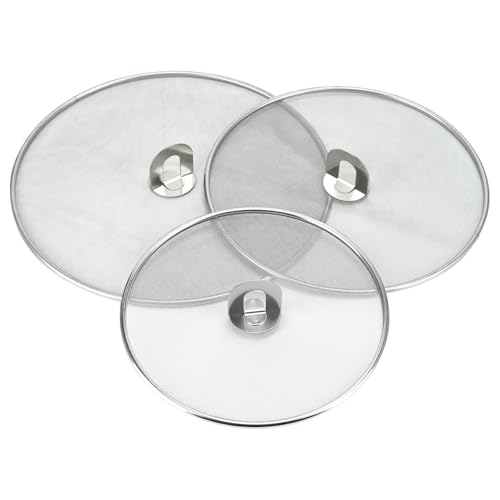
How the Five Compare on the Numbers
Four of these five purchases contain three screens and one contains four. U.S. Kitchen Supply publishes 13, 11.5, 10 and 8 inches, which is the only set here that reaches an 8 inch pan. Handook publishes 10, 11.5 and 13 inches. Hevtsde and Apidgrowth publish exactly the same three, 9.8, 11.4 and 13 inches. Zalaxt publishes 25, 29 and 33 centimeters.
The second half of the question is where three or four flat discs live between uses, and only two listings answer it. U.S. Kitchen Supply states that the handle loop supports hanging or stacking and that the flat design stores compactly. Hevtsde states that folding the handle lets the screen lie flat. The other three publish nothing a drawer can be planned around.
What the table cannot tell you is how any of these sets nests. Every published weight here covers the whole set, no listing publishes a stacked thickness, and the two package figures that exist are both wrong for the screens they describe. So a reader planning a drawer has the storage sentences and nothing measurable.
What a Set Covers That a Single Screen Does Not
Four Sizes, and the Pan Nobody Else Reaches
U.S. Kitchen Supply is the only purchase here with an 8 inch screen. That matters in batch prep because the small pan is usually the one doing eggs, onions or a spice bloom while something larger is frying, and a 13 inch screen over an 8 inch pan sits on the burner grate rather than on the rim.
Its other three sizes, 13, 11.5 and 10 inches, overlap with everything else in this group. Handook starts at 10 inches, Hevtsde and Apidgrowth at 9.8 inches and Zalaxt at 25 centimeters. So the practical difference between a four piece set and a three piece one is entirely at the small end.
The Two Sets That Publish the Same Three Figures
Hevtsde and Apidgrowth both publish 9.8, 11.4 and 13 inches, which is an unusually exact match. The difference is everything else. Hevtsde is stainless steel with a fine mesh, a foldable handle and five named secondary uses. Apidgrowth is food grade silicone with a porous surface, no handle named and no weight published.
That makes them a clean choice rather than a close one. A stainless screen with a folding handle is a lid and a sieve. A silicone screen is lighter on a non stick pan and can be rolled or folded in a way metal cannot, and the listing says it is non stick and will not affect the taste of the food.
Handles, Storage and Three Discs in a Drawer
A Knob, a Grip or Nothing
Handook publishes a heat resistant knob handle, which lifts a hot screen from directly above the pan and takes no extra width. U.S. Kitchen Supply publishes comfortable grip handles that keep hands away from heat, and adds that the handle attachment keeps the screen stable when it is set down. Hevtsde publishes a foldable handle.
Apidgrowth and Zalaxt publish no handle at all. On a silicone screen that may be deliberate, since the edge itself can be lifted. On the stainless Zalaxt set it is simply unaddressed, alongside no storage statement and no secondary use, which makes it the least described purchase in this group despite publishing a clean set of three sizes.
Where They Go Afterwards
U.S. Kitchen Supply publishes the most complete answer: a flat design for compact storage and a handle loop that supports hanging or stacking the screens. For four screens that is the difference between a hook and a drawer. Hevtsde publishes the other real answer, folding the handle so the disc lies flat.
Handook says the screens look simple and save more space, which is a claim rather than a method. Apidgrowth and Zalaxt say nothing. Given that none of the five publishes a stacked thickness, those two sentences from U.S. Kitchen Supply and Hevtsde are the only storage information this pool contains.
Mesh, Material and the Second Job
Three Descriptions of Fineness
Handook states an extra fine mesh and the strongest claim in the group, that it stops 100 percent of spitting oil. Zalaxt states an ultra fine mesh guarding against hot oil and grease. U.S. Kitchen Supply states a fine mesh that blocks oil and grease while allowing steam to escape, which is the trade every mesh screen makes.
None of the three publishes a mesh count, an aperture or a wire gauge, so the words are the specification. Apidgrowth is outside that comparison entirely, describing a porous silicone surface that lets steam pass. Hevtsde describes a fine mesh structure and adds that it is high temperature resistant.
What Else Each One Claims to Do
Hevtsde names the most secondary uses: a draining sieve for pasta, vegetables, dumplings and stews, a cooling rack for cookies, breads and cakes, a heat insulating mat and a strainer. Apidgrowth names draining, straining and use as a cooling rack. Handook names a pot strainer and a fat drainer.
U.S. Kitchen Supply and Zalaxt name none. For a meal prep page those extra uses are worth recording rather than ranking, because a screen that doubles as a cooling rack is one fewer object in a cupboard, but no listing publishes a load, a temperature or a clearance for any of those jobs.
Which One Fits Your Kitchen
Covering every pan you own. U.S. Kitchen Supply, four screens at 13, 11.5, 10 and 8 inches, with a handle loop for hanging or stacking and a stated flat profile. No secondary uses and no per screen weight.
Lifting a hot screen from above. Handook, three screens at 10, 11.5 and 13 inches with a heat resistant knob handle and a stated 100 percent oil claim. Its dimension fields are centimeters in an inch slot.
Folding everything flat afterwards. Hevtsde, three screens at 9.8, 11.4 and 13 inches with a foldable handle and five named secondary uses. No dishwasher statement is published.
A set for non stick pans. Apidgrowth, three food grade silicone screens at 9.8, 11.4 and 13 inches, porous rather than mesh, washable two ways. No weight, no handle and no storage method.
The finest stated mesh in a plain set. Zalaxt, three stainless screens at 25, 29 and 33 centimeters with an ultra fine mesh and a dishwasher safe design. Everything else about it is unpublished.
What We Could Not Verify
These are the figures this comparison went looking for and could not source from the listings themselves.
- A per screen weight on any of these five sets.
- A stacked or nested thickness for any set, which is what a drawer actually closes on.
- Any weight at all for Apidgrowth.
- A dishwasher statement for Hevtsde.
- Inch diameters for Zalaxt, which publishes centimeters only.
- A mesh count, aperture or wire gauge behind the fine, extra fine and ultra fine descriptions.